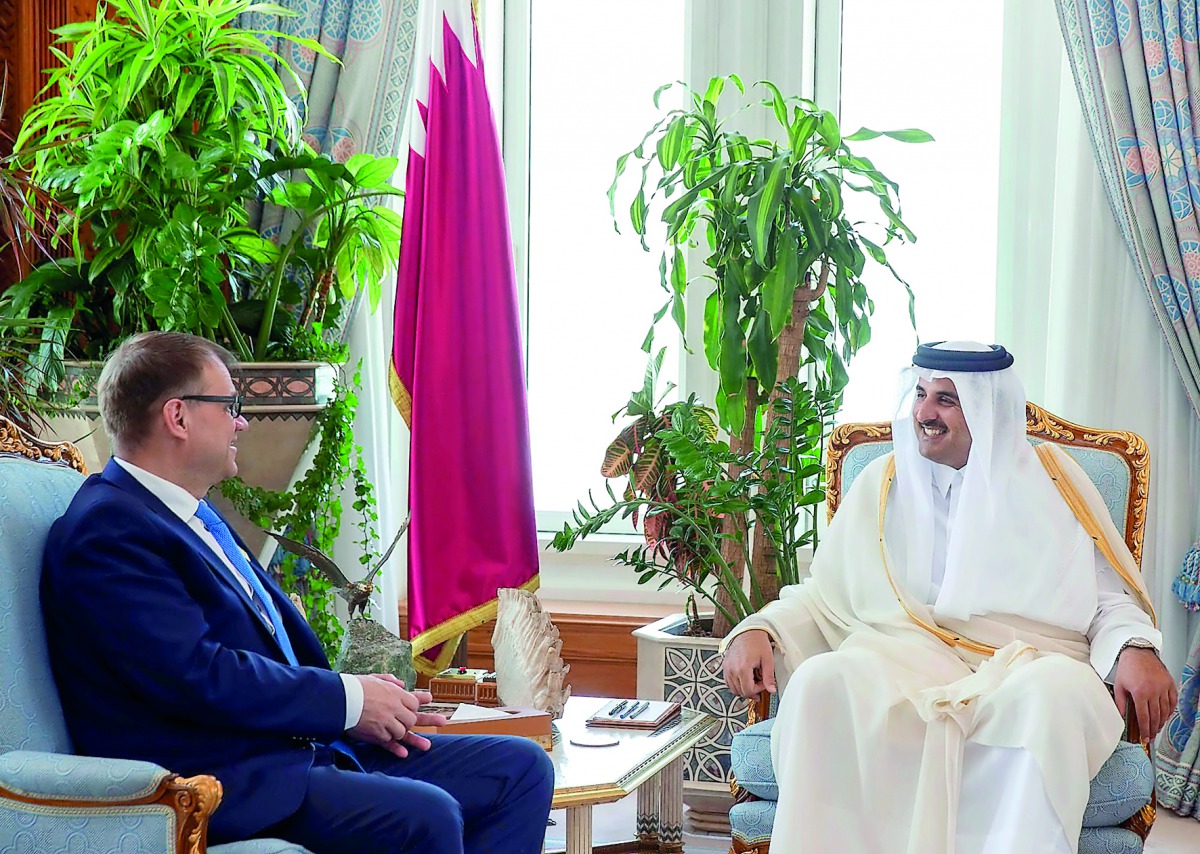
Emir H H Sheikh Tamim bin Hamad Al Thani with Prime Minister of the Republic of Finland, Juha Sipila, who is in Qatar to attend the 17th Doha Forum.
Participants in the 17th Doha Forum stressed that the global community must overcome the deflationary economic environment to build a strong global economy.
Speakers in a session entitled 'Recession of the Global Economy and Ways to Build a Strong One', said that there were a number of challenges facing the global economy. The first was the economic slowdown in the Asia Pacific region, which was an engine of growth for emerging economies. The second was the impact of the restructuring of GCC economies. The third was the burden that refugees have on hosting nations. There were other topics discussed such as inequality, and social justice among others.
The speakers agreed that every company should develop its own economic plan rather than rely solely on the neoliberal model which has detrimental effects so far. They agreed that there also must be a balance between social factors and economic development.
Some of the speakers touched on the issue of currency manipulation conducted by some countries and the impact it has on trade. They also questioned the credibility of some of international and regional multilateral trade agreements, something that keeps the pressure on growth in trade and could threaten an economic slowdown.
They also criticised the role of international financing institutions such as the World Bank and the International Monetary Fund. They criticised the tools that those institutions rely on with the claim that it will help enhance the economic performance of member countries.
The Forum also discussed, at a session entitled "The Impact of Refugees on the Hosting Countries", the positive and negative effects of refugees as well as the security, political, social and economic dimensions in this regard.
Discussion during the session, focused on the Syrian refugees in the neighbouring countries and the Bangladeshi refugees to India, reviewing the burdens borne by these countries in order to host and protect refugees and provide them with the necessities of living in spite of their own need for assistance.
In this regard, participants discussed effects of refugees on labor markets in the hosting countries, as well as their competition to citizens and migrants from other countries, though some of the participants pointed out that most of the refugees' employment is limited to private sector in the hosting countries.
Participants also called on Western countries to open their borders for refugees and work to protect them and provide humanitarian assistance to them.
A number of speakers at the session praised the State of Qatar's support of the refugees issues, through the programs of the United Nations and the Office of the High Commissioner for Refugees. They asserted that Qatar is a small country, but it is great in its efforts towards refugees issues and humanitarian assistance.
Participants, during the session titled "Political Challenges in the Far East and the Indian Subcontinent", discussed several aspects related to the Asian continent, particularly the Indian-Gulf relations and the changes that have taken place recently.
Secretary of the Gulf and Arabian Peninsula Studies Forum in Qatar and researcher at the Arab Center for Research and Policy Studies Sheikh Suhaim bin Mohammed Al Thani said that the nature of the Indian-Gulf relations were dominated by the GCC export of energy and India's export of labor over the past 50 years.
However, he noted that the relations between the two sides ties have recently witnessed many geopolitical and economic changes as India has had different relations with the Asian continent.
He said that the lack of major powers in the Asian continent led to the absence of a kind of balance in the region, stressing the need to coordinate the relations of the Gulf Cooperation Council countries with India, especially on security and strategic issues.
He added that the GCC countries must adopt a new policy to invest in India and to be dominated by diversification and investment in small sectors.