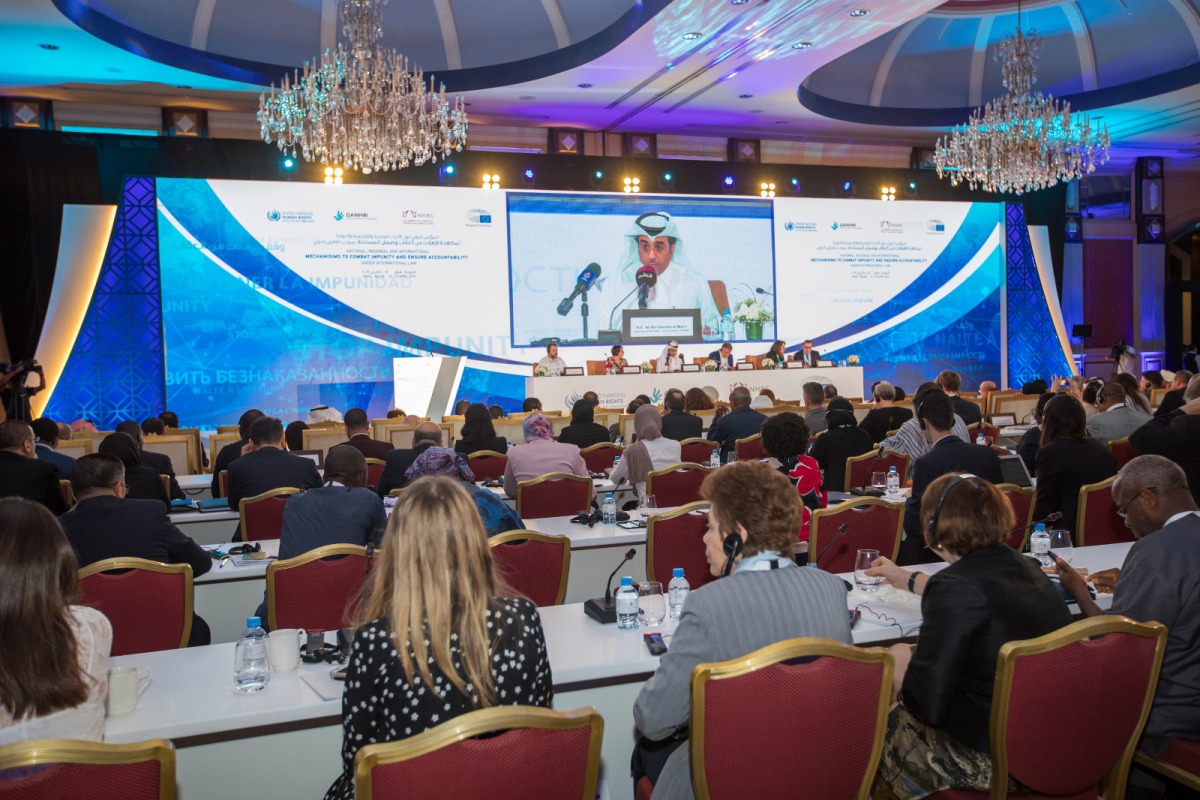
Doha: The international conference on ‘National, Regional and International Mechanisms to Combat Impunity and Ensure Accountability under International Law’ concluded yesterday with participants recommended that states should join the Rome Statute system and accede to all human rights treaties, including the International Covenant on Civil and Political Rights as well as its first optional protocol on individual communications.
The conference brought together more than 200 governmental and non-governmental organisations and international experts. The conference aimed at discussing national, regional and international mechanisms to combat impunity for gross violations of human rights law and serious violations of international humanitarian law, and to ensure accountability.
Participants recommended that states should incorporate the Rome Statute crimes into their domestic laws and establish absolute jurisdiction for international crimes, irrespective of whether the suspect is in custody or in the territory of the State and encourage coalitions of like-minded States and civil society organizations to enhance the debate in the General Assembly on accountability.
They recommended, states should enhance political accountability by advocating for an end to arms sales, in particular in conflict contexts and support institutions contributing to the responsibility to protect in order to enhance accountability at the national level.
States should create joint investigative teams of prosecutors from different countries and enhance international cooperation with regard to evidence sharing, extradition and mutual legal assistance and ensure that war crimes investigations remain free and protected from political pressure.
They called for establishing a research centre in the MENA region allowing exchanges of experiences and lessons learned in promoting accountability, bringing the knowledge available within OHCHR and of international experts to shape practical and technical recommendations.
States should develop a list of national remedies available to victims; and ensure public dissemination, including to other States to promote international cooperation.
They recommended states should organise events at the regional, national and international levels for victims to tell their stories and raise public awareness and empower victims to access and participate in the truth, justice, and reconciliation process.
The recommendations added that the states should provide support to victims to access justice and remedies in a language they understand, including in local languages of the country of origin and promote access to information through restorative justice in setting up agreed upon truth and reconciliation commissions. Learn from traditional justice, which is restorative and collective and adapt to local conditions with participation of all stakeholders. According to the recommendations, the civil society should advocate in the multilateral context for international crimes to be discussed in order for concerted pressure to be exercised on States beyond the confines of Realpolitik and raise awareness amongst States of the need for compensation to victims beyond criminal justice.
The recommended all national, international and regional mechanisms should ensure a victim-centered approach to investigating and prosecuting international crimes, and focus on redress and reparations, including through assistance and work towards the establishment of an international observatory that would focus on prevention, accountability and combating impunity notably through advice, support to intergovernmental and non-governmental organisations.