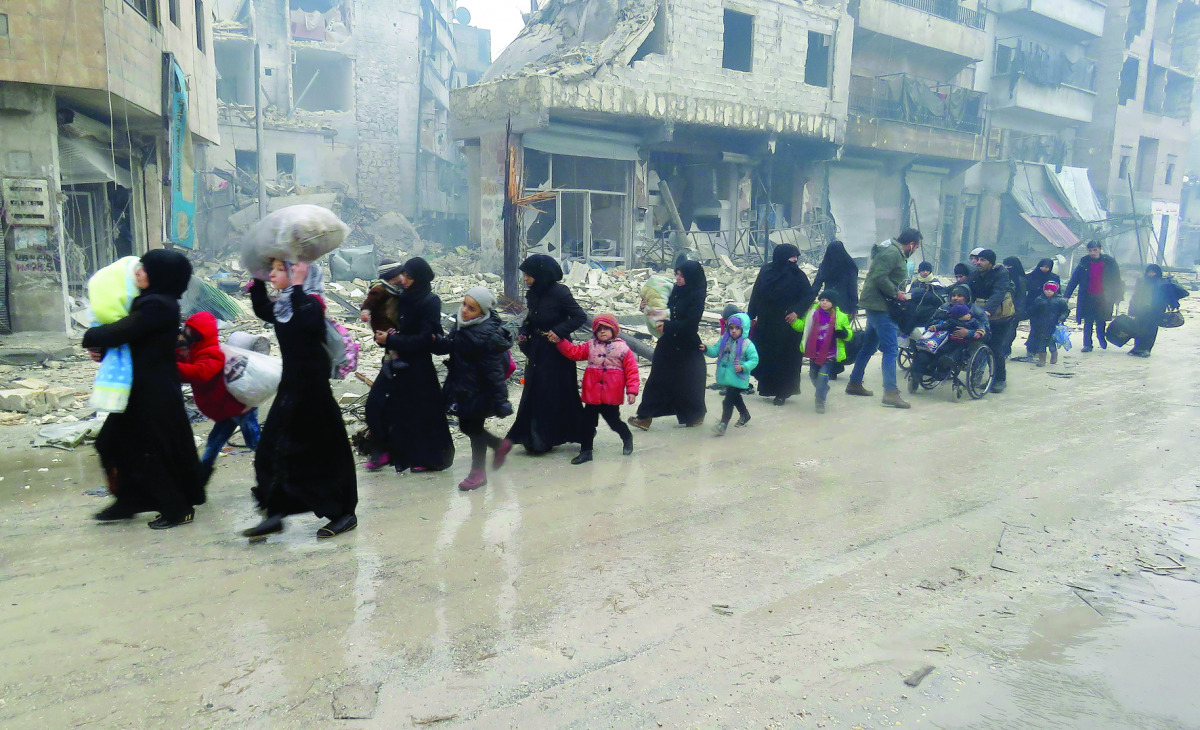
Syrian residents, fleeing violence in the restive Bustan Al Qasr neighbourhood, arrive in Aleppo's Fardos, after regime troops retook the area from rebel fighters, yesterday.
Aleppo: Plans to evacuate rebel districts of Aleppo stalled yesterday as more fighting rocked the city and insurgents appeared to have rejected new conditions imposed on the deal by Iran.
Iran, one of Syrian President Bashar Al Assad’s main backers in the battle that has all but ended four years of rebel resistance in the city, wanted the simultaneous evacuation of wounded from two villages, Foua and Kefraya, that are besieged by rebel fighters, according to rebel and UN sources.
There was no sign of that happening. Insurgents fired shells at the two majority Shia villages in Idlib province west of Aleppo, causing some casualties, the British-based Syrian Observatory for Human Rights said.
There was no immediate indication when the evacuation might take place but a pro-opposition TV station said it could now be delayed until today.
A ceasefire brokered on Tuesday by Russia, Assad’s most powerful ally, and Turkey was intended to end years of fighting in the city, giving the Syrian leader his biggest victory in more than five years of war.
But air strikes, shelling and gunfire erupted yesterday and Turkey accused government forces of breaking the truce. Syrian state television said rebel shelling had killed six people.
Russian Foreign Minister Sergei Lavrov said, however, that rebel resistance was likely to end in the next two or three days.
Russian President Vladimir Putin and his Turkish counterpart Recep Tayyip Erdogan will discuss Aleppo today, the Kremlin was quoted as saying.
Officials in the military alliance backing Assad could not be reached immediately for comment on why the evacuation, expected to start in the early hours of yesterday, had stalled.
Nobody had left by dawn under the plan, according to a witness waiting at the departure point, where 20 buses stood with engines running but showed no sign of moving into rebel districts. People in eastern Aleppo packed their bags and burned personal belongings, fearing looting by the Syrian army and its Iranian-backed militia allies.
In what appeared to be a separate development from the planned evacuation, the Russian defence ministry said 6,000 civilians and 366 fighters had left rebel-held districts over the past 24 hours. A total of 15,000 people, including 4,000 rebel fighters, wanted to leave Aleppo, according to a media unit run by the Syrian government’s ally Hezbollah.
The evacuation plan was the culmination of two weeks of rapid advances by the Syrian army and its allies that drove insurgents back into an ever-smaller pocket of the city under intense air strikes and artillery fire. By taking full control of Aleppo, Assad has proved the power of his military coalition, aided by Russia’s air force and an array of Shia militias from across the region.
Rebels groups have been supported by the United States, Turkey and Gulf countries, but the support they have enjoyed has fallen far short of the direct military backing given to Assad by Russia and Iran. Russia’s decision to deploy its air force to Syria 18 months ago turned the war in Assad’s favour after rebel advances across western Syria. In addition to Aleppo, he has won back insurgent strongholds near Damascus this year.
The government and its allies have focused the bulk of their firepower on fighting rebels in western Syria rather than Islamic State, which this week managed to take back the ancient city of Palmyra, once again illustrating the challenge Assad faces reestablishing control over all Syria.
Russia regards the fall of Aleppo as a major victory against terrorists, as it and Assad characterise all the rebel groups, both Islamist and nationalist, fighting to oust him. But at the United Nations, the United States said the violence in the city, besieged and bombarded for months, represented “modern evil”.
The once-flourishing economic centre with its renowned ancient sites has been pulverised during the war, which has killed hundreds of thousands of people, created the world’s worst refugee crisis and allowed the rise of Islamic State. As the battle for Aleppo unfolded, global concern has risen over the plight of the 250,000 civilians who were thought to remain in its rebel-held eastern sector before the sudden army advance began at the end of November.
Tens of thousands of them fled to parts of the city held by the government or by a Kurdish militia, and tens of thousands more retreated further into the rebel enclave as it rapidly shrank under the army’s lightning advance.