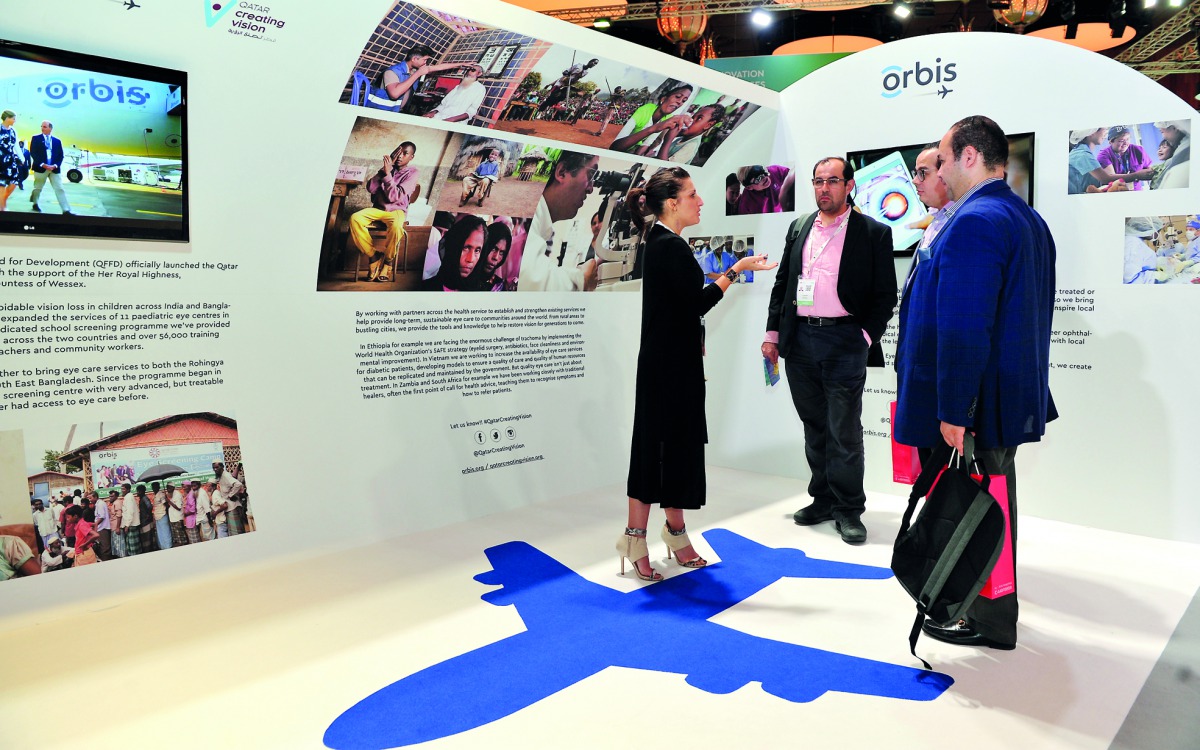
Florence Branchu, Head of Qatar Creating Vision, sharing information on the initiative at Innovation Hub Exhibition part of the WISH 2018 at the QNCC. Pic: Salim Matramkot / The Peninsula
DOHA: The world’s most exciting healthcare innovations ranging from practical devices and business models to design-based solutions were showcased at The World Innovation Summit for Health (WISH) 2018 Innovation Hub yesterday.
Fourth WISH Summit’s Innovation Hub showcased innovations in health care field, young innovators, an informal discussion space, library space, spotlight stage and a café setting which gave young innovators the chance to pitch their ideas.
Innovation Hub provided a chance for entrepreneurs to exhibit their healthcare innovations in front of some of the world’s leading health experts and decision- makers. WISH provides a platform to enable delegates to engage with these exciting ideas that are changing healthcare from the ground up.
Many innovators showcased their exciting innovations during the Summit; The Orbis Flying Eye Hospital was among them.
Talking to The Peninsula, Florence Branchu, Head of Qatar Creating Vision and Head of Region (Middle East) at Orbis said: “In July 2016, Orbis and the Qatar Fund for Development (QFFD) officially launched the Qatar Creating Vision (QCV) initiative, which aims to deliver eye tests and treatments to children across India and Bangladesh.”
“Qatar Charity launched a fundraising campaign in Qatar. Qatar Charity has raised over QR2m in two years. The funds have enabled us to launch an additional project in Bangladesh, focusing on developing human resources to generate more trained cataract surgeons highly capable to deliver a high volume of top-quality surgeries. Since the start of the programme in 2015, more than 38, 900 surgeries have been performed,” she added.
Boasting the efforts from State of Qatar, Branchu said: “All of us at Orbis are enormously grateful to the Qatar Fund for Development (QFFD), Qatar Charity, Qatar Airways and our many local partners. Our collective aspiration to make avoidable blindness a thing of the past has been impacting millions of lives.”
Innovators who showcased their innovations shared a common goal: driving improvement and excellence in healthcare. Each innovation showcased had the potential to transform global health, both reducing the costs of healthcare delivery and improving the quality of care for patients.
The showcases provided a chance for entrepreneurs to exhibit their healthcare innovations in front of some of the world’s leading health experts and decision makers.
Discussing about her innovation of The VeinTrain, Sarah Phillips, Marketing Director of Vein Train told The Peninsula: “Vein Flatpack Training System is a ‘flat-pack’ tool that enables practical simulation core training. It includes QR codes to video training media for app or online use, which accompany the clinical-based structured learning and assessment program used for 12 years across the UK.”
Sarah added, “By sharing these methods and tools it can ensure that every clinician everywhere can offer the best care to this most common, yet problematic, invasive procedure, which research reveals currently attain failure rates of 67%.”
This year, for the first time, the Innovation Hub included an informal discussion space, where delegates were be able to interact with those leading discussions on topics focusing on finding new ideas at the intersection of different aspects of healthcare policy.