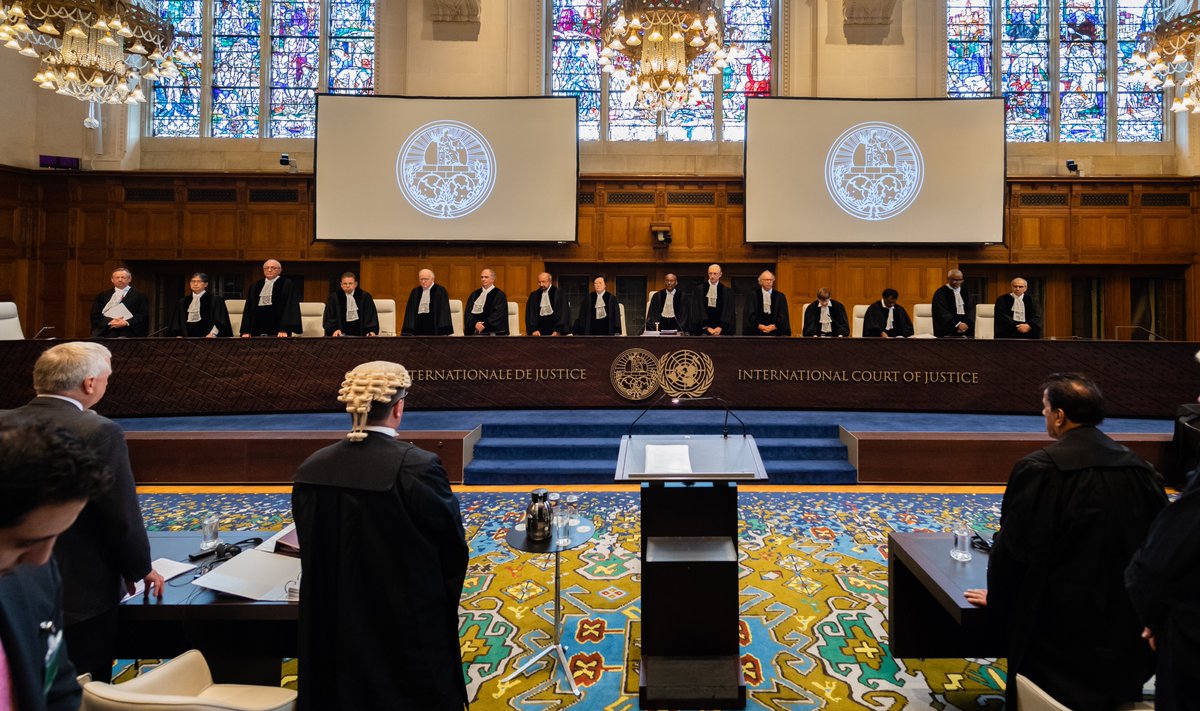
File picture of ICJ proceedings used for representation.
The Hague: The International Court of Justice (ICJ or 'Court') yesterday issued an order rejecting the request of the United Arab Emirates (UAE) for provisional measures against the State of Qatar in a case relating to the UAE's unlawful discriminatory treatment of Qatar and the Qatari people.
Background to the case on June 11, 2018, Qatar filed its Application instituting proceedings against the UAE before the ICJ pursuant to the Convention on the Elimination of All Forms of Racial Discrimination (CERD or 'Convention'), to which Qatar and the UAE are parties.
The same day, Qatar also requested that the Court, as a matter of urgency, indicate provisional measures protecting Qatar and the Qatari people from racial discrimination while ICJ proceedings are ongoing.
The Convention was adopted on December 21, 1965 and entered into force on January 4, 1969.
The State of Qatar acceded to the Convention on July 22, 1976. It is the oldest United Nations human rights treaty and sets forth an overarching goal: the elimination of all forms of racial discrimination.
Qatar's application arises from the discriminatory measures imposed in June 2017 by the UAE as part of an unlawful imposition of land, sea and air restrictions against Qatar as part of a campaign of political and economic coercion.
Qatar initiated proceedings before the ICJ as the best means to resolve peaceably the human rights violations arising from the UAE's discrimination against Qatar and Qatari people by taking the dispute to the principal judicial organ of the United Nations pursuant to Article 22 of the Convention.
Following hearings on the Qatar's request for the indication of provisional measures, the Court delivered its order on July 23, 2018 to protect Qataris, in a win before the Court that vindicated Qatar's rights.
The provisional measures in favour of Qatar were unprecedented in their scope and specificity, focusing on family reunification, the right to education and access to justice.
In the UAE's ill-founded request on March 22, 2019, the UAE filed a request for the indication of provisional measures allegedly in order to preserve its so-called “procedural” rights pending the final decision of the Court on the merits of the case, on the allegation that Qatar has “aggravated” the dispute before the Court.
Public hearings took place on May 7, 8 and 9, 2019. During the hearings, Qatar demonstrated that the measures requested by the UAE were inconsistent, incoherent, and unjustified.
Qatar argued that in seeking provisional measures based in part on the false assertion that Qatar has aggravated this dispute, the UAE failed to demonstrate that the rights for which the UAE was requesting protection were plausible, that they were linked to the requested measures, and that the UAE had evidenced the urgency and imminence of irreparable harm to its rights in issue in this case so as to provide a basis on which the Court might have indicated such measures.
On June 14, 2019, the Court delivered its judgement and firmly rejected the UAE's request.
Dr Mohammed Abdulaziz Al Khulaifi, Legal Advisor to Qatar's H E Deputy Prime Minister and Minister of Foreign Affairs and Agent of Qatar in the ICJ, stated that “Qatar welcomes the Court's strong acknowledgment of the lack of legal and factual basis for the request made by the UAE for the indication of provisional measures in its rejection of UAEs groundless request. Qatar brought this case to protect the Qatari people against the UAE's policy and practice of racial discrimination.
It is the Qatari people who are the victims here, and not the government of the UAE”.