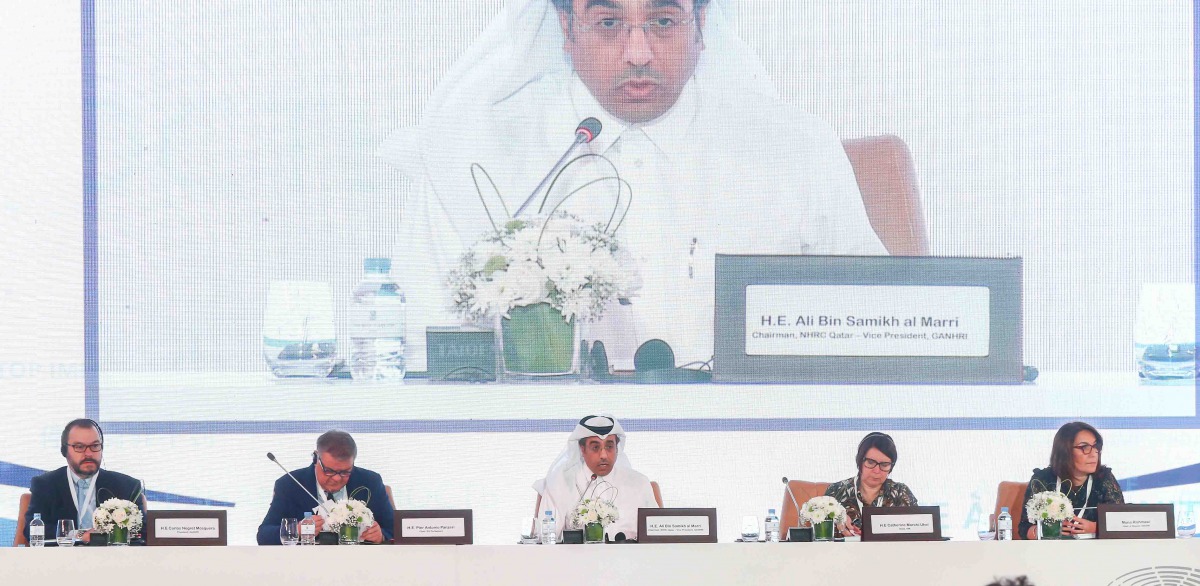
Chairman of the National Human Rights Commission calls for the establishment of an International Observatory for Prevention and Non-Impunity.
Chairman of the National Human Rights Committee (NHRC) Dr Ali bin Smaikh Al Marri said that organising the conference titled “National, regional and international mechanisms to combat impunity and ensure accountability under the law” comes at a critical time in light of the urgent need to promote the rights of victims, through legislation and mechanisms to deter violations and put an end to impunity.
In a speech during the opening session of the conference at the Ritz-Carlton he said that the presence of more than 250 international organizations and tribunals and representatives from a number of ministries and research centers and experts affirmed the importance that the international community attaches to combating impunity.
Al Marri called for the establishment of an international observatory on prevention, accountability and impunity with the aim to conduct studies, offer advice, support intergovernmental & non-governmental organizations and supporting countries in developing legislation and mechanisms. He proposed that the United Nations High Commissioner for Human Rights, and the European Parliament be permanent and key members in this mechanism.
He also called on the Office of the High Commissioner for Human Rights to establish a working group to submit an assessment study on national, regional and international mechanisms to combat impunity to the competent entities of the United Nations system for the purpose of developing legislation and mechanisms in this regard. He requested that the United Nations Human Rights Council to establish a special rapporteur on combating impunity.
Al Marri stressed that National Human Rights Committee of Qatar will spare no effort to continue to introduce further initiatives to support the human rights process not only in the State of Qatar, but also at the regional and international levels.
Al Marri highlighted that the global interest in the promotion and protection of human rights has grown, in recognition of the value of these rights and the noble goals to enable the progress of humanity towards prosperity. He noted that the promotion of human rights has become the cornerstone of the progress of States and the key pillar to reach a high international standing on the global level.
Al Marri noted that conflicts, crises and armed conflicts taking place in the world result in atrocities and violations that require concerted effort to ensure accountability and prevent impunity for these violations and to work towards the development and implementation of mechanisms to prosecute the perpetrators of offences, and ensure redress for victims and reparation.
He added that the world cannot endure more tragedies and atrocities, and that the realization of justice and the punishment of perpetrators of these crimes have become a collective responsibility of the international community, including all States, international and regional organizations and civil society institutions.
Al Marri stressed that the parties involved can reach that goal through cooperation and coordination on the collection and documentation of evidence, conducting investigations as well as undertaking measures essential to respect the principle of no impunity.
He called upon States to include terrorism and blockading people as crimes against humanity in the Rome Statute of the International Criminal Court of the year 1998, by amending the article 121 of its Statute.
The President of the National Human Rights Committee of Qatar stressed that the primacy of political and economic interests has become a stumbling block to the rule of law, the preservation of rights and freedoms. He stressed that totalitarian regimes cannot build democracy or guarantee respect for rights.
Al Marri highlighted the international community’s responsibility to uphold the principles of justice in the context of the humanitarian and moral imperative and joint responsibility in addressing the crimes that violate human rights.
He noted that this can only be realised through fostering national, regional and international criminal justice mechanisms.
He concluded his speech by expressing hope that the conference will deliberate and discuss all the different facets of this topic and come up with recommendations on the activation of the mechanisms of international criminal justice, ensuring the rights of victims to access national and international justice mechanisms, and hold accountable those responsible for serious crimes.