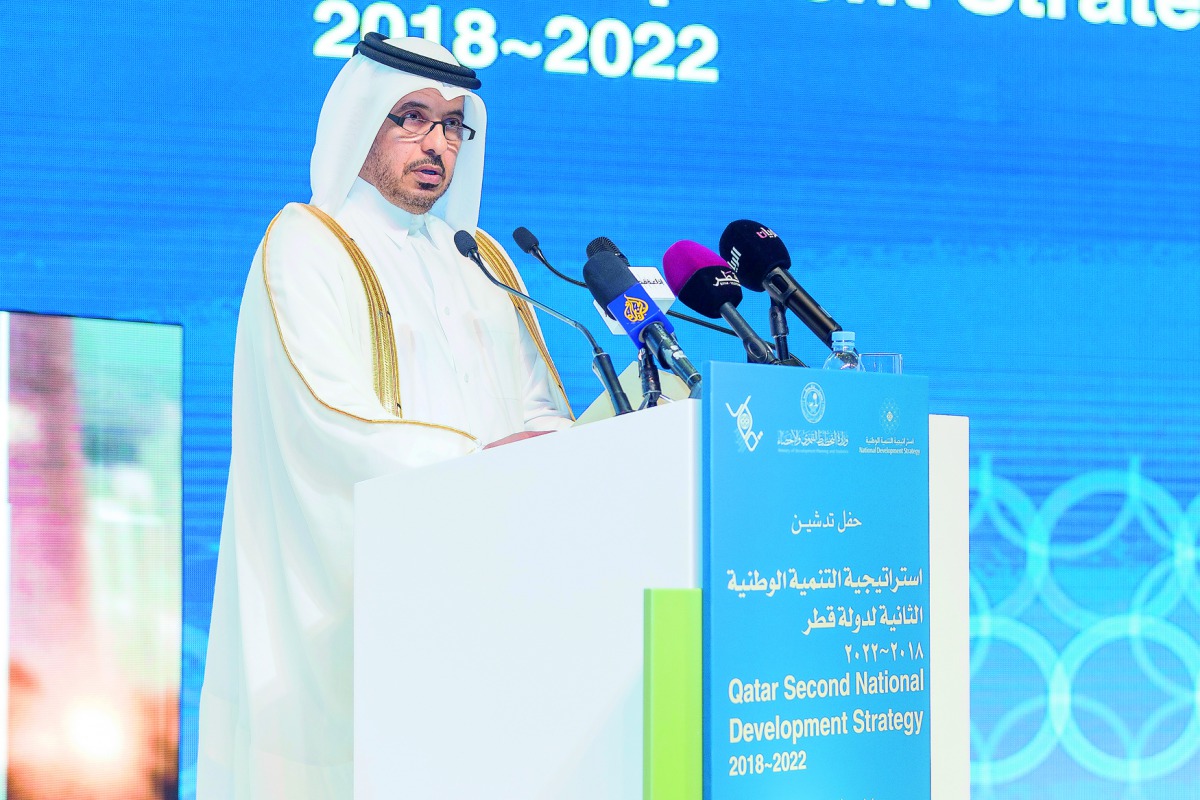
Prime Minister and Interior Minister H E Sheikh Abdullah bin Nasser bin Khalifa Al Thani speaking at the launch of Second National Development Strategy at Sheraton Hotel yesterday.
DOHA: The blockade enforced on Qatar has proven the visionary foresight of the country’s wise leadership which had launched Qatar National Vision 2030 back in 2008, said the Prime Minister and Interior Minister H E Sheikh Abdullah bin Nasser bin Khalifa Al Thani in a speech during the launch of Qatar’s 2nd National Development Strategy (NDS2) 2018-2022.
The national strategies are steps towards the completion of Qatar National Vision 2030 and its four pillars represented in economic, social, human and environmental development.
The Prime Minister launched the 2nd strategy during a ceremony held yesterday at Sheraton Hotel in the presence of a number of their excellencies sheikhs, ministers, and officials in governmental and non-governmental sectors which are part of the strategy.
The goal of the QNV 2030 was building a society based on justice and equality with a constitution that protects freedoms and enhances traditions, morals, security and stability said the Prime Minister, noting that the vision was responding to the ambitions of the people of Qatar in achieving balanced, sustainable development that uses the country’s resources optimally.
The Prime Minister listed some of those challenges including that development must be sustained, maintains the religious and cultural identity, must be managed in a way that avoids the negative consequences of years of rapid growth.
Other challenges also include the size and type of labour needed to strike a balance between the country’s national identity and the safety of society on one side, and the requirements of development on the other.
The attention paid to the environment was also crucial given the country’s hydrocarbon resources and the fact that the region’s economy relies on the same source, which compounds the threats to environment and the threats of pollution.
The Prime Minister said that the current phase requires meeting all the challenges that we must be overcome. He noted that all government entities, the private sector, and non-governmental organisations participated in the preparation of the NDS2.
The methodology focused on analysing the current status, comparing it regionally and internationally, and then determining the priorities for the strategy.
The Prime Minister called for strengthening of human planning capacities and the capacity-building of the members of the specialised departments, and for enhancing the efficiency of their performance.

Prime Minister and Interior Minister H E Sheikh Abdullah bin Nasser bin Khalifa Al Thani, Their Excellencies the Ministers, and other dignitaries during the launch of NDS 2 yesterday.
The Prime Minister emphasised on sustainability as a principle in national development initiatives that stimulated important policy innovations, such as the development of a road map to modernise the budget and the development of comprehensive National Health policy, restructuring of the educational system, management of public investment, stimulation of the private sector and reform of the policy government support and guidance to target groups, rationalisation of public expenditure and conservation and development of natural resources.
Minister of Development Planning and Statistics H E Dr Saleh Mohamed Salem Al Nabit said that Qatar’s economy is expected to grow between two and three percent in 2018, while the non-oil sector is expected to achieve good growth rates this year, which are important growth rates under the current conditions in Qatar.
Addressing a press conference held on the sideline of the launch of Qatar’s (NDS2) 2018-2022. Al Nabit praised the role of the governmental and non-governmental bodies that participated in drawing up NDS2, which was formed following the efforts of a team of about 150 people.
Regarding the impact of the siege imposed on Qatar on the preparation of NDS2, the Minister noted that the strategy has flexibility to respond to all variables including the new situation, focusing on increasing self-sufficiency and international cooperation. He pointed out that NDS2 dealt with the emerging development priorities and absorbed the goals of global sustainable development.
He stressed that the coming period until the end of NDS2 requires all government agencies to prepare their strategic and executive plans that are consistent with NDS2, and that can achieve their results within the specified time frame.
Al Nabit pointed out that Qatar is going through a crucial period of its economic and social development and institutional maturity, whereas NDS2 has pushed towards achieving this transformation in all sectors of the State and at all levels.
He expressed hope for achieving greater economic diversification and private sector development in addition to creating the suitable investment environment to attract foreign investments over the next five years, especially in the field of innovation and creativity, in addition to encouraging investment in sectors that accelerate the transition towards the knowledge economy.
Al Nabit said the next five years will witness the completion of a high-level physical and informational infrastructure and economic infrastructure related to major developmental projects, where with its completion, a comprehensive system will be operated to manage and maintain the infrastructure and its facilities.
He said the next few years will also witness the completion of updating the public sector including the e-government projects and services sector, an increase in the efficiency of financial management, enhancement of economic stability and rationalisation of expenditure.
The health sector will work on consolidating a comprehensive model to offer a high-level healthcare system and there will be a focus on promoting education quality and increasing enrolment numbers and levels of achievement, in addition to an increase in the number of Qatari graduates from academic programs associated with knowledge-based economy, the Minister added.