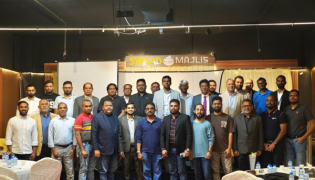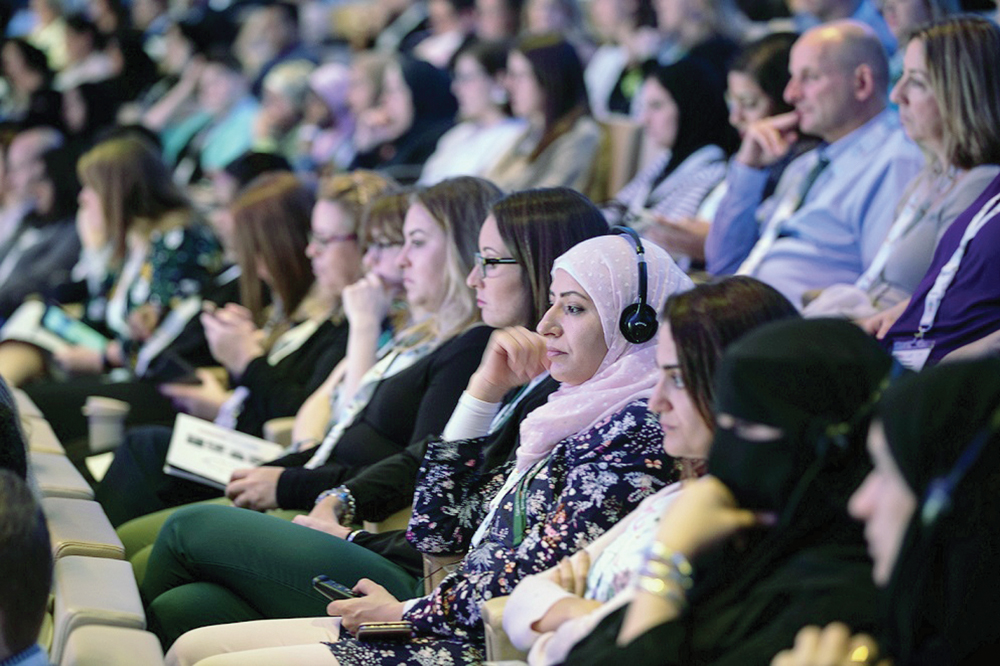
Participants at the Bi-annual Teaching and Learning Forum, organized by EDI.
Qatar Foundation’s Education Development Institute, (EDI) has emerged as the country’s key facilitator of, and authority on, the International Baccalaureate curriculum. In the process, it has reduced QF schools’ use of education-focused expertise from abroad by at least 90 percent, in the space of five years.
Before EDI started its professional learning initiatives, 70 percent of QF schools’ professional learning budget in a year was spent on sending teachers abroad for workshops and conferences. The remaining 30 percent was focused on bringing in experts to deliver in-school training. Despite such investment, this model was covering less than 20% of schools’ faculty.
In the meantime, QF’s Pre-University Education (PUE) saw rapid growth that resulted in an 18 percent increase in teaching faculty in just four years.
The importance of investing in the creation of Qatar’s own center for teachers’ professional development was clear and started EDI.
“Within two years, we helped QF schools reduce their spending on travel-based professional learning to less than 25 percent,” said Mehdi Benchaabane, Director of EDI. “For example, in 2018, EDI led 75 percent of local training, and schools were only spending 25 percent of their budget on non-EDI professional learning.”
In 2016, a Professional Development Management System was developed in-house. This provided the data necessary to initiate changes that would support a more equitable distribution of professional learning opportunities.
As a result, a new policy was introduced in QF schools in 2017, entitling any teacher to a minimum of 10 hours of professional learning per year. And it worked – in the 2018-19 academic year, 92 percent of QF teachers received at least this level of formal professional learning opportunities via EDI.
“When EDI was established in 2014, our mandate was not only to limit spending on travel costs, but to design and offer context-specific training in key curriculum areas,” said Joanna Moe, Assistant Director for Teaching and Learning.
“In order to be more impactful, one of the first things that EDI did was to open its doors to teachers across the country.”
One way EDI does this is through its annual Teaching and Learning Forum, the country’s biggest education conference. Last year alone, 1,800 delegates, together with educators and speakers from around the world, attended the event.
And, during the second semester of each academic year , EDI organizes iSTEMed (Innovation in STEM Education) – an event that focuses on innovation in STEM (science, technology, engineering and math) education across all schools in Qatar and abroad as well as an Education Forum for Heritage and Identity.
EDI also initiated a Heads of School Summit, another first for the country. Its first edition brought together 60 heads of private and international schools in Qatar, offering a common platform for school leaders to share their expertise and challenges. According to Moe, the gathering also inadvertently served another purpose.
EDI also initiated the development of the Qatar Heritage Curriculum. It provides students from kindergarten to Grade 9 with age-appropriate content on Qatar’s culture and heritage – a significant step toward ensuring the preservation of the country’s cultural identity and traditions.
In 2019, EDI activated its partnership with the Ministry of Education and Higher Education by designing and offering multiple professional learning programs including the training of around 300 teachers at the early childhood and elementary levels.
These courses stand alongside an array of programs that EDI offers teachers from both within and outside QF – from workshops and conferences, to one-year programs, all the way to newly-launched Masters degrees.
In order to encourage homegrown talent and expertise, EDI initiated two new programs that, according to Benchaabane, are a global first. Titled PETAL (Program for Effective Teaching And Learning) and PALME (Program for Aspiring Leaders and Managers in Education) they have been developed through a belief that personalized learning matters as much for teachers as it does to students.
“Five years of passion-driven practice” is how Benchaabane defines EDI’s short yet impactful journey.