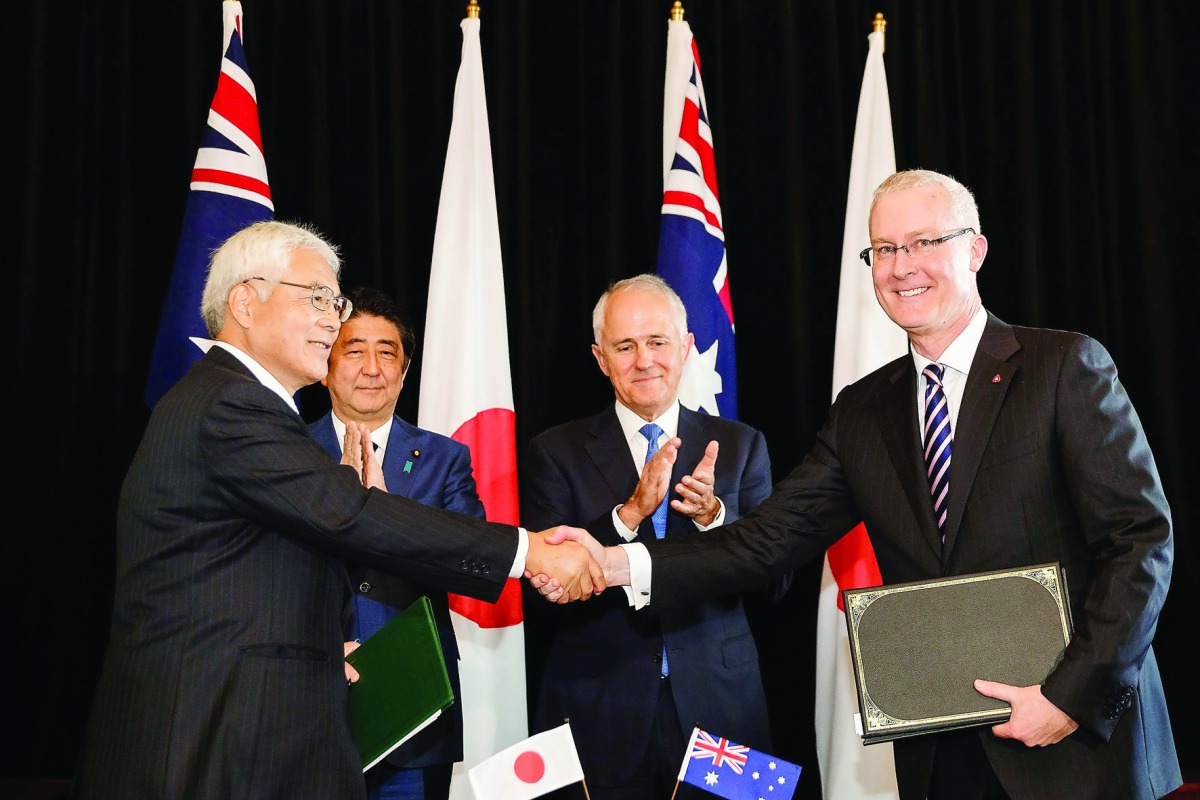
Japan's Prime Minister Shinzo Abe and his Australian counterpart Malcolm Turnbull applaud as Japan's Ambassador to Australia Sumio Kusaka (left) and Australia's Ambassador to Japan Bruce Miller (right) shake hands during a joint signing ceremony at the co
Sydney: Japanese Prime Minister Shinzo Abe met his Australian counterpart Malcolm Turnbull in Sydney yesterday where the pair agreed to deepen defence ties through joint military training and exercises. Abe's visit to Australia is the first since Turnbull became prime minister in late 2015, and comes amid heightened regional tension as China asserts its claims over disputed territory in the South China Sea.
"We have confirmed our commitment to the rule of law, free trade and open markets in our region," Turnbull said yesterday.
Abe said the increasingly uncertain geopolitical landscape made the relationship between Japan and Australia more important than ever.
"It is important to guard and increase the robustness of the free, open and rules-based international order," he added.
The two leaders announced the signing of an Acquisition and Cross-Servicing Agreement (ACSA), which will increase cooperation in combined exercises, training and peace-keeping operations.
The agreement is expected to be finalised by the end of 2017.
The announcement comes nearly nine months after Australia chose a French bid over a Japanese design for a new fleet of submarines.
The loss of the $40bn contract was a major blow for Abe's ambitions to develop Japan's defence export capabilities as part of a more muscular security agenda.
Japan, as well as Australia, is looking to protect its strategic and trade interests in Asia-Pacific, especially as China becomes increasingly assertive in the South China Sea.
Both leaders also reaffirmed the importance of their respective security alliances with the United States yesterday.
China's recent naval exercises in the South China Sea and the building of islands there, with military assets, has unnerved its neighbours and risks a fallout with the United States.
US president-elect Donald Trump's nominee for secretary of state, Rex Tillerson, has said China should be denied access to islands it has built in the South China Sea.
China claims most of the resource-rich South China Sea through which about $5 trillion in ship-borne trade passes every year.