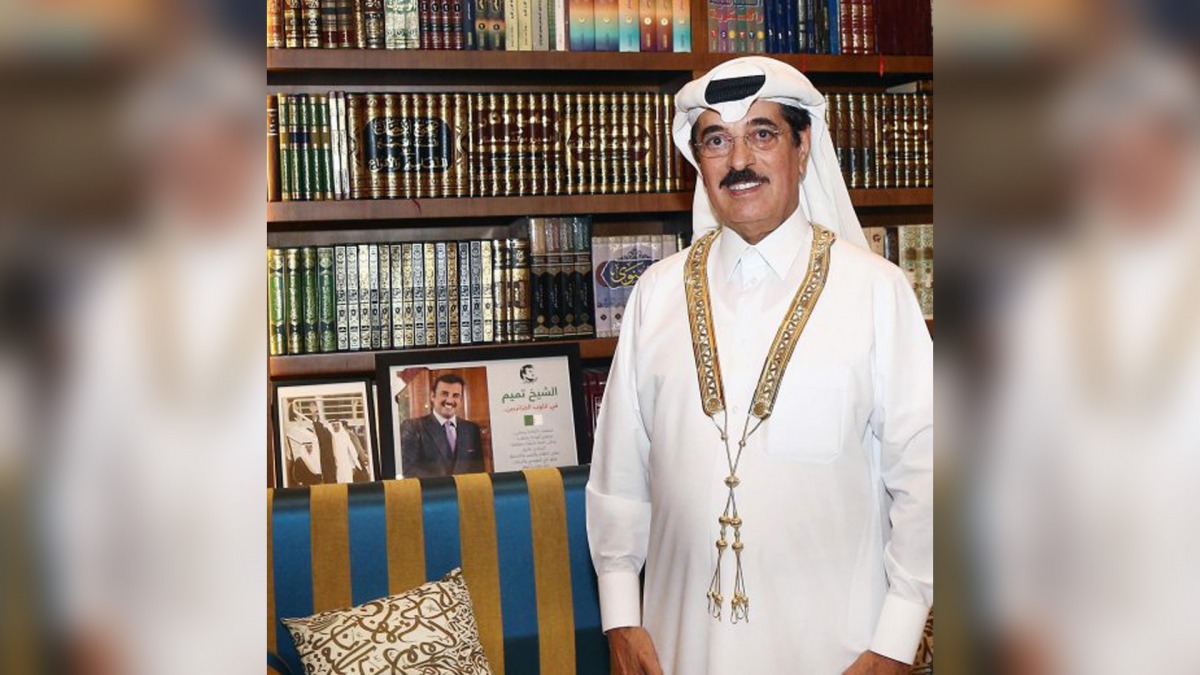
H E Dr. Hamad bin Abdulaziz Al Kuwari
Doha: H E Dr. Hamad bin Abdulaziz Al Kuwari, who has been appointed President of the Qatar National Library (QNL), has emphasised the place that reading holds in Qatar’s culture, and why libraries — and what they provide — are more important than ever in a COVID-19 world.
“This appointment is a honour for two reasons: it brings me pride, and it also brings me responsibility. I am fully aware of the responsibility that comes with this role, of the trust that has been placed in me, and of the expectations,” he said.
According to Dr. Al Kuwari, libraries act as a collective memory — the memory of human heritage, including our Arab and Islamic heritage — and, for such a long time, they have been a source of knowledge for the entire world. “The value of science and culture, and the power of books, is rooted within our culture in Qatar.”
“Our country’s founder, Sheikh Jassim bin Mohammed Al Thani, was a poet who interacted with scholars and had a passion for knowledge and its dissemination. And the Father Amir H H Sheikh Hamad bin Khalifa Al Thani, the pioneer of Qatar’s modern-day renaissance, has been the driving force behind many achievements and initiatives in the sphere of culture, an approach now being taken forward by the Amir H H Sheikh Tamim bin Hamad Al Thani,” he said.
“As a member of QNL’s board of directors, I have been a member of its family for some time, and have been involved in transforming the vision for this library — the vision of H H Sheikha Moza bint Nasser, Chairperson of Qatar Foundation — into reality. Her Highness envisioned QNL to be one of the world’s pre-eminent centers of learning, research, and culture; a guardian of our nation’s heritage; and an institution that promotes the importance of imagination, discovery, and the nourishment of the human spirit,” he added.
He also said that in the role as Ambassador of the State of Qatar to several countries and institutions — including France, the US, Lebanon, Syria, the United Nations, and Unesco, as well as several European countries — and being a non-resident ambassador to Latin American countries has allowed him to explore many cultures as well as to contribute to sharing Qatar’s culture with the world.
“It brought home to me the importance of cultural diversity. During my time as Qatar’s Minister of Culture, Arts, and Heritage, as well as being a candidate for Unesco General Secretary, I also had the opportunity to visit many cultural and heritage institutions, and meet experts from universities and academic institutions in more than 70 countries,” said Dr. Al Kuwari.
“I feel this has given me cultural insight and knowledge that I can invest in helping QNL to reach its goals. I also believe I can use cultural diplomacy to support QNL’s vision and mission, as this is an area I am well-versed in, and I understand how education and culture are pivotal in strengthening relations between countries.
“QNL — existing, as it does, in such a diverse educational environment as Education City — reflects cultural diplomacy. I hope my experience in the diplomatic and cultural field will help to enhance QNL’s role in radiating knowledge and research, and strengthen its relationships with local and international universities, and other institutions,” he said.
Speaking about the important aspect of QNL’s role, its greatest achievement to date, and its future prospects, he said that, it’s important to recognize that libraries are not just a storage space for books.
“They carry a message that supports culture, knowledge, and interaction between civilizations. The vision that would become QNL was present long before the library was established, and while it may be a ‘young’ library that embraces modernity, its content and resources reflect our Arab and Islamic heritage and the continuous efforts of our leadership to enable access to the richness of this heritage.”
QNL is characterized by many features, including its unique design by the renowned architect Rem Koolhaas. The library is also characterized by its use of innovative technologies, to an extent not seen in many international libraries.
Its Children’s and Young Adults’ Library has more than 150,000 books in its collections, in languages including Arabic, English, French, Spanish, German, Urdu, and Italian, as well as many electronic resources. This reflects our commitment to building the future — because the future is built through our children.
“And one of the most distinctive elements of QNL is its focus on digitization. In light of the global COVID-19 pandemic, where education, work, and communication have become remote, this is even more relevant. QNL was a forerunner in providing such a wealth of digital resources long before the pandemic, and the current situation that the world faces demonstrates how important this commitment to digitization was. QNL now offers access to 190 databases, more than 16,000 journals, and more than 465,000 reports, theses, dissertations, and other documents,” said Dr. Al Kuwari.
Since QNL opened in 2017, it has welcomed more than 1.2 million visitors. In 2019 alone, it welcomed 500,000 visitors. And since its inauguration, its programs and its impact have flourished.
“Despite the fact that the library building itself is currently closed due to COVID-19, we have added more than 170,000 new members since it closed, and this reflects QNL’s important role as a modern destination that enables permanent access to knowledge, including during times when people seek such knowledge to help them deal with crises,” said Dr. Al Kuwari.
“We aim to strengthen our international partnerships through our commitment to providing lifelong learning opportunities. QNL has developed partnerships and collaborations with key institutions around the world, including the British Library, the Ottoman State Archives, Bibliotheque National de France, the National Archives and the National Library of the Netherlands, the National Libraries of China, Turkey, and Azerbaijan, the Russian Presidential Library, New York University, and Unesco. We are currently working on further collaborations with India and Russia, as well as many different organizations, and we are an active member of the Digital Library Federation, the World Digital Library — a Unesco initiative — and the Library of Congress, a digital portal for material from the world’s leading libraries and institutions,” said Dr. Al Kuwari.
“Through all our partnerships and collaborations, we will strive to serve knowledge and research, whether through digitisation initiatives, direct communication, or through our programs and activities. We want the world to benefit from our resources,” he added.
In Qatar and across the Arab world, our culture has always drawn us toward reading and seeking knowledge — this is illustrated by the first word in the Qur’an, which translates as “read”.
“Our great scholars who have helped to build civilization did not gain their knowledge from universities, but from books,” said Dr. Al Kuwari.