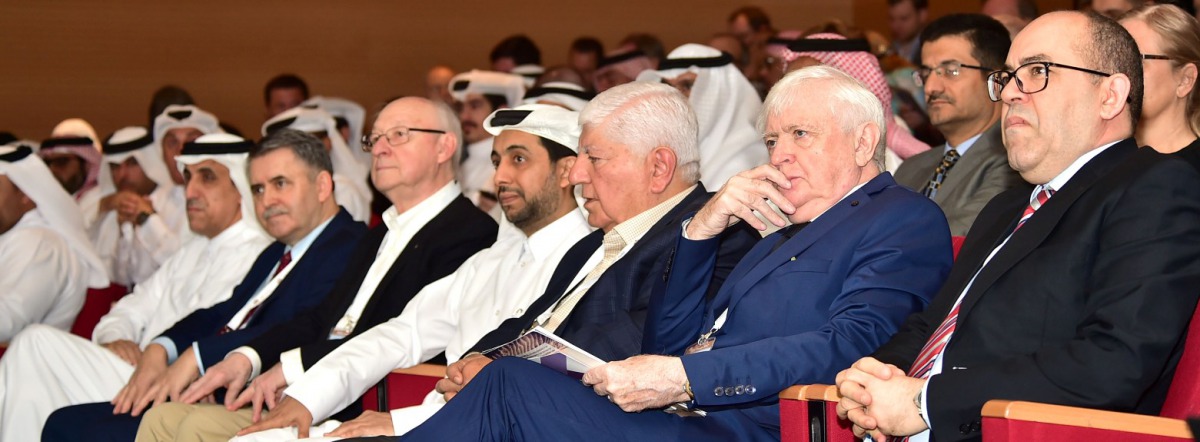
The Economic Adviser at the Emiri Diwan and Member of Qatar University (QU) Board of Regents H E Dr Ibrahim Al Ibrahim, QU President Dr Hassan Al Derham and other officials at the IREG Forum 2017 in Doha yesterday.
Qatar University (QU) yesterday launched the “IREG Forum 2017: “Excellence as the University Driving Force”, aimed to provide a platform to discuss the various aspects of academic excellence, and to learn about new initiatives in academic rankings.
The two-day forum is the first of its kind in the region. It is organised in collaboration with IREG Observatory on Academic Ranking and Excellence (IREG Observatory).
Economic Adviser at the Emiri Diwan and Member of the QU Board of Regents H E Dr Ibrahim Al Ibrahim said: “First, let me thank Qatar University for hosting this forum. I am particularly grateful that you decided to focus on the quality of higher education in Qatar as it goes right to the core of the tasks we are working on in the implementation of Qatar National Vision 2030. In the face of considerable challenges (the economic crisis, changing world demographics, the emergence of new competitors, new technologies and modes of working) Qatari education sector cannot be complacent. Qatar needs to become more outward-looking and more innovative. For Qatar to reach its potential as a society, it must enlarge its pool of talents. Higher education needs to become more inclusive so Qatar is able to draw on the talents of a wider range of people, from all sectors of society and especially groups who have not traditionally taken part in higher education. That in itself represents Qatar University’s first challenge.”
He added: “And for Qatar University to provide quality, relevant higher education to more students from diverse backgrounds, it has designed mechanisms to support the students and bridge the gap between the level of education of incoming students and its own levels that are, and have to remain of international standards. On the other side of the spectrum, the university provides opportunities for its current students to engage in more advanced courses and in new forms of teaching and learning such as MOOCs (Massive Open Online Courses) that are opening up new opportunities in education, and giving the university a chance to reshape the education systems.”
He said: “Qatar University needs to equip students with the entrepreneurial and work-relevant skills they need. The 14 research centres the university created are essential in that endeavor. They propose a new approach to innovation based on structured partnerships between universities, research centers and businesses. Such centers help the country use the potential of higher education to re-energize its society and to organize a genuine mindset change towards a more entrepreneurial culture. The Qatar National Research Fund, established in 2006, is also another source of strength at the national level, helping in that direction."
QU achievements
QU President Dr Hassan Al Derham said: “Despite of many challenges, Qatar University has achieved over the last years numerous achievements in regional and international rankings. This success could not be achieved without the support of our wise leadership that initiated Qatar National Vision with the aim to establish a knowledge-based economy in Qatar by 2030. At Qatar University, we have completed the preparation of our new strategic plan and restructuring process towards maintaining excellence and quality assurance at the academic and administrative levels.”
He added: “Is the necessity to define if ranking is a means or an end. In other words, does ranking lead towards more benefits or is it a means to define a university position among other academic institutions? At Qatar University, we have had many discussions to reach a clear and well-defined answer to this question. We believe that ranking is a means to compare our level of excellence with other academic institutions, to measure our research effectiveness, to evaluate our commitment in meeting the needs of the labour market, and to assess our relationship with regional and international partners. As part of its commitment to providing high-quality education in areas of national priority, Qatar University has been successful in its accreditation initiatives for its colleges and programs, and as we know, accreditation is an important key of performance measurement. Hence, quality assessment covers two factors: international ranking and academic accreditation.
He added: “Universities are established to lead societies and fulfill their ever-increasing academic and research needs. Are international rankings equally assessing the needs of societies by following a balanced approach? Do the ranking standards align with the needs of the emerging and developing countries? This is not a call to create specific rankings for each region because this may lead to a process of classification among universities. However, we aim to reconsider all ranking standards to make them more comprehensive and flexible, in line with the needs of the region. We have recently met with international ranking institutions from which we received feedback in this regard. Now, it is the time to get the view of IREG Observatory as an expert in the field of ranking, especially that IREG has various ranking interests that meet the objectives of Qatar University.”
IREG Observatory President Dr Jan Sadlak said: “There are a number of reasons for the increased attention to excellence. They can be summarised in the following way; higher education became a key mechanism for economic and social development. As ranking is gaining importance in society, it is increasingly subject to competition and various expectations of the major stakeholders in higher education and science."
The forum discussed a number of topics such as “Excellence in Higher Education and its role in Qatar National Vision 2030”, “Benefits and excesses in the use of rankings”, “Excellence in the context of cultural and economic transformations”, “Principles of “excellence” in various academic disciplines and institutional settings”.