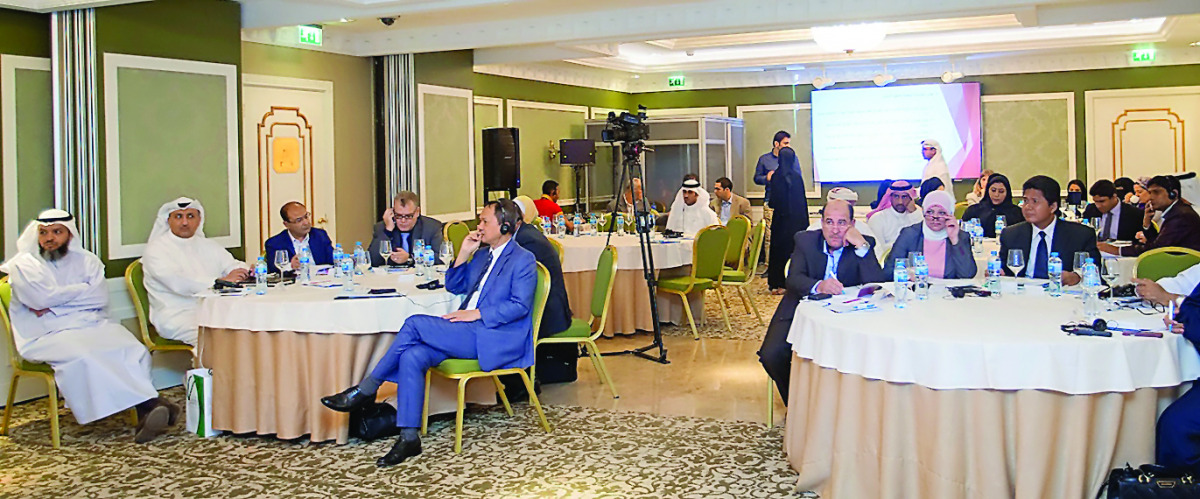
Participants at the two-day workshop on labour rights.
Labour rights are integral part of human rights which are indivisible rights which all states are required to respect in order to make people enjoy equal rights and protections, said a senior official from the Qatar National Human Rights Committee.
Speaking at the two-day workshop on “labour’s rights” ending today, Maryam bint Abdullah Al Attiyah, NHRC Secretary General said the aim of the workshop is to raise awareness about labour rights and means of its protection at local, regional and global levels, along highlighting the key role of national institutions and civil society organisations in enhancing these rights. The workshop was organised by NHRC and Regional Office of Asia-Pacific Forum (APF) in Doha with the aim of enhancing the culture of human rights among the members of national human rights institutions in the countries exporting and receiving expatriate workers.
The unlimited cooperation of QNHRC shows it is committed to disseminate the culture of human rights at local and regional levels, said Kieren Fitzpatrick, Director of the APF secretariat.
Protection of the rights of the expatriate workers is essential everywhere in the world not only in Qatar, Keiren said adding that the number of migrant workers has doubled within the past 50 years. ILO has estimated the number of migrant workers in 2014 by 214 million accounting for 3 percent of the world’s population. More than 90 per cent of these are workers who have migrated with their families and the overlap between living conditions and social environments will become key factor increasing the number of expatriate workers in the coming decades he added.
The workshop was held to support the role of national human rights institutions in the countries exporting and importing labours and these institutions can cooperate with each other to set up polices helping to protect the rights of the migrant workers and their families.
The head of the Department of Legal Affairs, at NHRC, Jaber Al Huwail, highlighted the means of cooperation between the national institutions and with the competent governmental institutions to protect the rights of the workers.