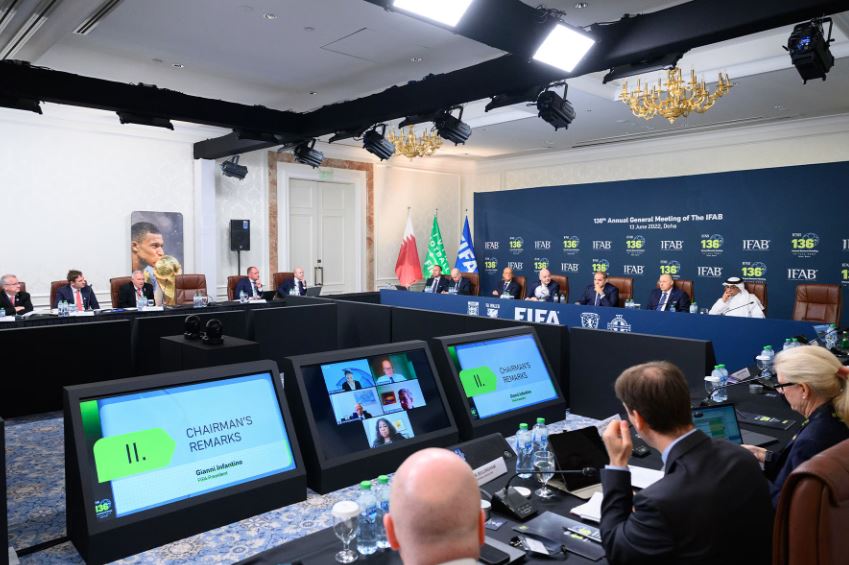
Doha: Football lawmakers yesterday ratified the changes to the rules related to substitutes, paving way to 26-man squads at the FIFA World Cup Qatar 2022.
During a press conference which followed the International Football Association Board’s (IFAB) 136th Annual General Meeting held in Doha, yesterday, FIFA President Gianni Infantino highlighted the fact that the majority of coaches of teams qualified for Qatar 2022 wanted to have the three extra players apart from the 23-player squads.
The ability to make five substitutions in matches was introduced on a temporary basis to help teams cope with the busy schedules during the COVID-19 pandemic, and it has now become a permanent part of the laws of the game.
The IFAB, which regulates the Laws of football, also noted that they have reconsidered the idea of temporary substitutions to deal with concussions.
"Members received an update on the early results of the global trial with additional permanent concussion substitutes. Although over 140 competitions are involved in the trials, the AGM supported the ABM decision to extend the trial until August 2023 to gather sufficient data to form a scientifically valid decision. Temporary concussion substitutes were reconsidered, but the members agreed that the trials should continue to focus on permanently removing any player with actual or possible concussion to ensure this player does not continue taking part in the match in question. It was agreed that further education is needed to ensure the trial protocols are applied correctly,” IFAB said in a statement.
Also yesterday, IFAB noted that more and more semi-automated technology will be used to help Video Assistant Referees take quicker and accurate decisions.
Infantino said that the trials on the Artificial Intelligence technology will continue.
“We tested it at the Club World Cup and it looks very good. We are very satisfied and we will take decision before the tournament,” the FIFA President said.
Pierluigi Collina, Chairman of FIFA’s Referees Committee, added: “I’m confident it can go ahead.”
Also, IFAB identified lack of respect for referees during matches and issues related to their safety, noting that the members have agreed to establish initiatives, including potential trials with body cameras worn by referees in adult grassroots football.
“Referees will profit from the possible protection, which sadly still takes place in many parts of the world,” Infantino said.