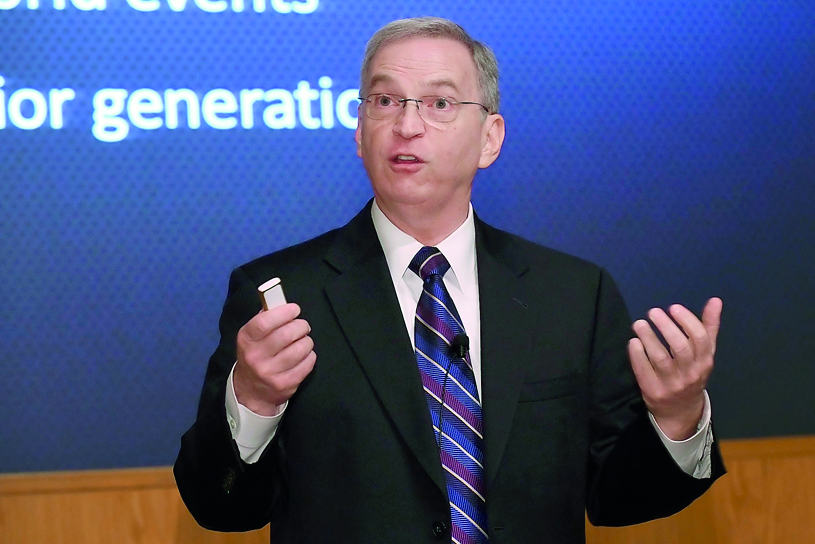
Dr John F Mahoney giving a lecture.
The challenges posed to educators by generational differences were explored at the latest instalment of Weill Cornell Medicine-Qatar’s (WCM-Q) Grand Rounds.
Visiting expert Dr John F Mahoney, Associate Dean for Medical Education at the University of Pittsburgh’s School of Medicine, explained how the different cultural and personal characteristics of baby boomers, generation Xers, millennials and Gen Z affect the way each group studies, learns and interacts, and the challenges and opportunities arising from these differences.
Boomers are considered to be the demographic cohort born between 1946 and 1964, generation Xers between 1965 and 1980, millennials between 1981 and 1994, and Gen Z between 1994 and 2012. Dr Mahoney explained that each generation has unique characteristics, cultural values and work habits and discussed ways to improve inter-generational communication to enhance teaching outcomes. One of the biggest differences between the generations is their attitudes to technology.
Dr Mahoney said, “For a lot of the older generation, reaching for technology is not the first or intuitive solution to a problem, whereas for the younger generation the technology solution is the obvious way to go. While millennials feel that technology is essential, for the Gen Z person who has grown up with technology, things are subtly different — they don’t just value connectivity, they assume they will have connectivity, and they view Internet access as a right. These things have always been part of their everyday lives and that impacts the way they see the world and see learning.”
Dr Mahoney also outlined generational differences in the way people interact, with boomers preferring face-to-face meetings, generation Xers and millennials favouring emails and texts, and Gen Z increasingly spurning emails and using text messaging almost exclusively.
Attitudes to work are also different, with boomers more prepared to work long hours and overtime but resistant to work-related interruptions to their free time, while the younger generations demand more leisure time but are comfortable fielding work queries while away from the office.
In terms of learning habits, millennials and Gen Z prefer learner-centred tasks, are good at computer-based learning and multi-tasking, have a need to perceive relevance, are resistant to learning by rote, and often have short attention spans.
The lecture, titled ‘Why do Generational Differences Pose a Challenge to Educators?’, was accredited locally by the Qatar Council for Healthcare Practitioners-Accreditation Department (QCHP-AD) and internationally by the Accreditation Council for Continuing Medical Education (ACCME).