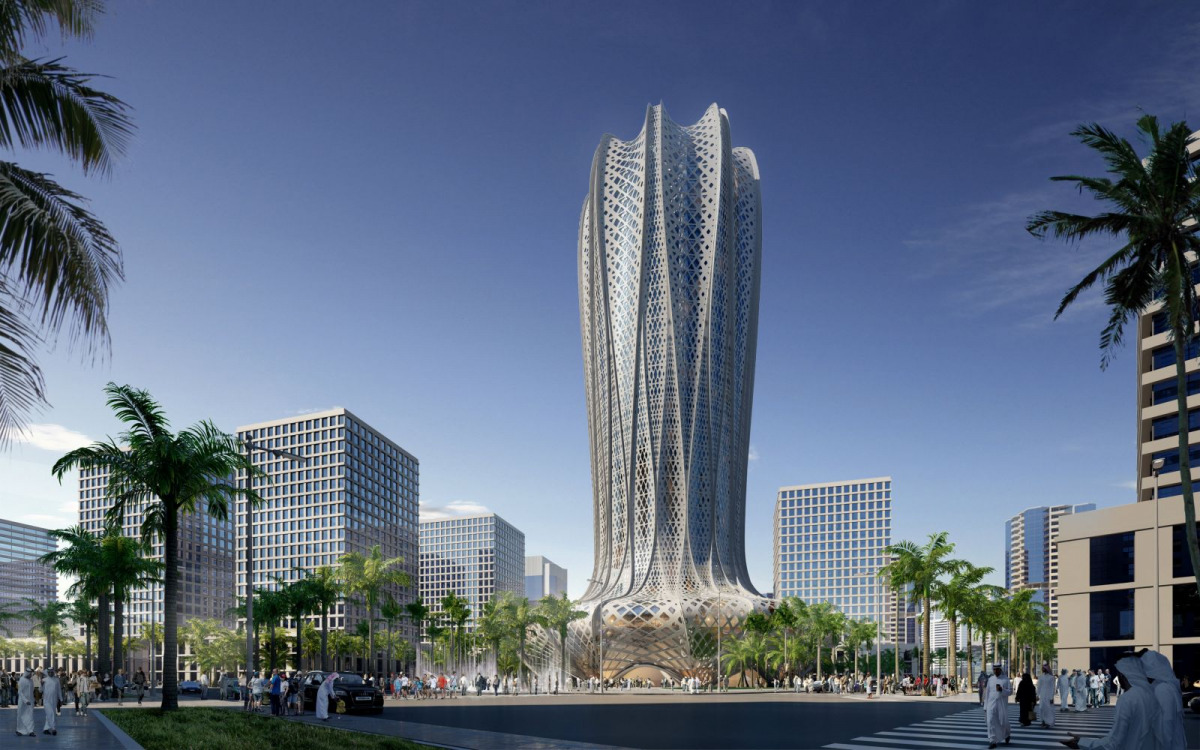
DOHA: Qatar will construct two buildings designed by late Iraqi-British architect Zaha Hadid, including a tower shaped like a desert flower close to the site of the 2022 soccer World Cup final.
H E Sheikh Mohammed bin Hamad al-Thani commissioned Hadid in 2013 to create the structures, one a 38-story hotel in the form of a hyacinth and featuring a nine-pointed base to shield visitors from the searing Gulf sun.
Sheikh Mohammed's Al Alfia Holding said in a statement it would construct the tower "designed in response to current and future environmental challenges" by 2020 in the city of Lusail, 23 km (14 miles) north of the capital Doha.
“With truly inspirational public spaces and atrium, 120 unique residences and 200 hotel rooms of Zaha Hadid’s unmistakable signature, we celebrate her remarkable legacy and continue Lusail City’s commitment to creating the region’s most sustainable, interconnected community,” said Sheikh Mohammed, Chairman of Al Alfia Holding.
"We often look at nature's systems when we work to create environments, at her unrivaled logic and coherence," Hadid, who died in March, said of the project.
Now led by Patrik Schumacher, Hadid's architecture firm ZHA has announced a number of new projects including a new central business district for Prague and a technology park near Moscow.
In April, the firm said it would complete 36 projects that had been started or were under contract before Hadid's death including an "oyster-like" ferry terminal in Salerno, Italy, the King Abdullah Petroleum Studies and Research Center in Riyadh, and the Mathematics Gallery at London's Science Museum.
The formal composition of Hadid’s design has been inspired by the structure of the Desert Hyacinth; a flowering plant native to the landscapes and coastlines of the Arabian Gulf. The nine-pointed form of the building’s podium surrounds a central core defined by the interwoven fluid geometries of the hyacinth. A filigreed mashrabiya façade envelops the building to reduce solar gain.
Fluidity is embedded within the region’s architectural heritage and traditions. Continuous calligraphic and geometric patterns flow from domes to ceilings, ceilings to walls, walls to floors, establishing seamless relationships and blurring distinctions between architectural elements.
Zaha Hadid developed this historical understanding of the region’s architecture in a contemporary interpretation evolving from her research into natural systems of organization and structure, as well as applying the possibilities achieved through advancements in design, construction and material technologies to deliver workable solutions for the 21st century.
Hadid’s work sees form and space composed into fluid spatial progressions. Transforming notions of what can be achieved in concrete, steel and glass, Zaha Hadid’s architecture combines her unwavering optimism for the future and belief in the power of invention with concepts of connectivity and fluidity.
Working with Arup Engineering and Atelier Ten, global leaders in environmental design and engineering, Zaha Hadid Architects’ vision for the 38-storey project embraces collaboration between disciplines, responding to current and future environmental challenges and providing the most comfortable living spaces for residents, guests, visitors and staff.
Reuters / The Peninsula