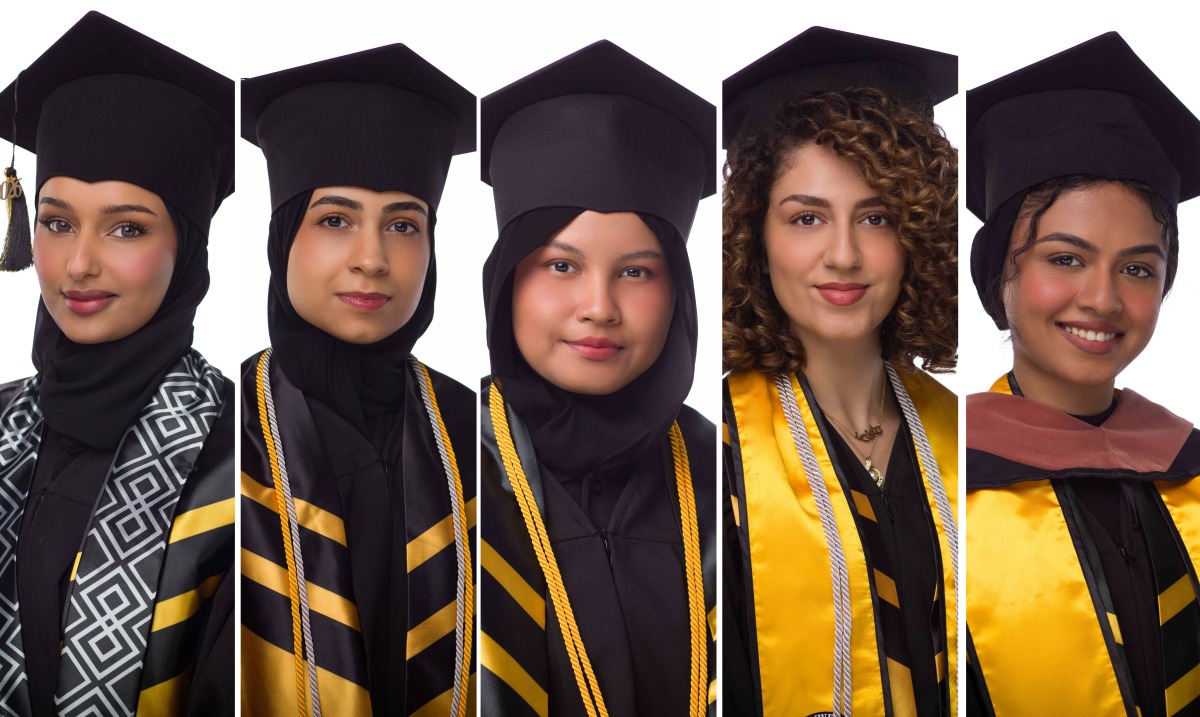
From left: Reema Al Mohannadi, Khawla Al-Essa, Tarishah Ramanda Fadilah, Nourhane Tarroun and Alice Mohammed Aslem
Doha, Qatar: What is an astrolabe? Can karak tea reveal a deeper story of cultural connection? How has digital media changed the way we remember?
These questions were explored by senior students at Virginia Commonwealth University School of the Arts in Qatar (VCUarts Qatar) as part of the 2026 Graduation Showcase, now available online. The exhibition marks the culmination of students’ academic and creative journeys and features work from five programmes: Art History (ARTH), Graphic Design (GDES), Interior Design (IDES), Painting and Printmaking (PAPR), and Master of Fine Arts in Design (MFA).
GDES student Khawla Al-Essa explored the history and function of the astrolabe in her project The Astrolabe: Taker of the Stars. Through a handcrafted artist book with sequential illustrations, she examined the instrument’s development, anatomy, and uses. “The more I researched, the more I understood how and why astrolabes gradually fell out of use,” she said, adding that her goal was to reintroduce the instrument in an engaging and accessible way.
ARTH student Nourhane Tarroun focused on Qatar’s beloved karak tea in her project Karak Routes. Tracing its origins through Indian Ocean spice trade routes and South Asian migration to the Gulf, she used takeaway cups collected across Qatar to explore how ordinary objects carry cultural history. “Karak tea is everywhere in Doha, yet I had never questioned how it got here,” she noted.
In Afkarna (Our Ideas), IDES student Reema Al Mohannadi designed a collaborative space for emerging designers navigating uncertainty, particularly in the age of AI. Inspired by vernacular door geometries, she created interconnected pathways symbolising growth, experimentation, and professional transition.
Themes of emotional well-being shaped PAPR student Tarishah Ramanda Fadilah’s project Sparklers. Using illustrations and animations, she compared anxiety and numbness to the brief but lingering bursts of sparklers, drawing inspiration from childhood memories in Indonesia.
Meanwhile, MFA student Alice Mohammed Aslem examined memory and digital documentation in Between the Veins. Inspired by viewing countless photos of her son on her phone, she questioned whether constant documentation weakens meaningful remembrance. Using weaving techniques on screw pine and palm leaves, she connected personal memory with her ties to India and Qatar.
Together, the projects highlight how research, art, and design can address culture, identity, memory, and contemporary challenges.
Collectively, the projects reflect how students’ technical skill, introspection, and curiosity address timely themes through research, art, and design.