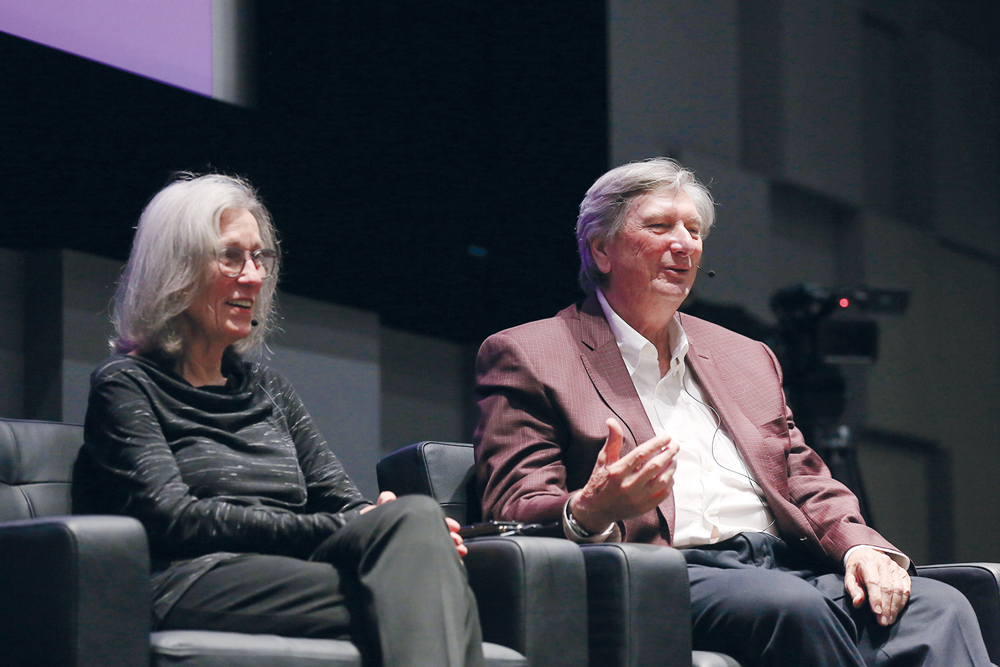
John Bailey (right) and Carol Littleton.
Taking a Northwestern University-Qatar (NU-Q) audience on a journey through Hollywood history with examples from their own work, acclaimed cinematographer and director John Bailey and his wife, the award-winning film editor, Carol Littleton, focused much of a joint presentation on present and future filmmaking.
Speaking to faculty, staff, and students at NU-Q, Bailey, who is also the president of the Academy of Motion Picture Arts and Sciences (Oscars), and Littleton noted that because it is cheaper to create content digitally today’s films have much more material for filmmakers to work with and has created new challenges.
As a result, Bailey said, dramatic structure and character integrity have become the most important and challenging elements in filmmaking today. Littleton added that what happens is that, “when it comes to budgeting time, film editors are now spending more time combing through footage rather than focusing on the editing process.”
The conversation with Bailey and Littleton was moderated by NU-Q Dean Everette E. Dennis.
“While drawing on decades of experience, some with the most iconic films of our time, Bailey and Littleton pointed to the changes in filmmaking brought about by the digital age, while also offering a gift for storytelling and film history that added a richness to their presentation and brought the history of Hollywood alive for our community,” Dennis said.
During the session, the couple screened scenes from two of their films, Silverado (1985) and The Accidental Tourist (1988), and discussed the differences in approach – from building a suspenseful scene with American cowboys in the Wild West, to using close-up shots and warm lights to develop the ambience for characters in an intimate scene.
The visit, which was organized in collaboration with Qatar Museums and Doha Film Institute, also allowed Bailey and Littleton to meet with faculty and students from NU-Q who were able to share their on-going and past projects with the guests. They also discussed film history, narrative development, and documentary film making.