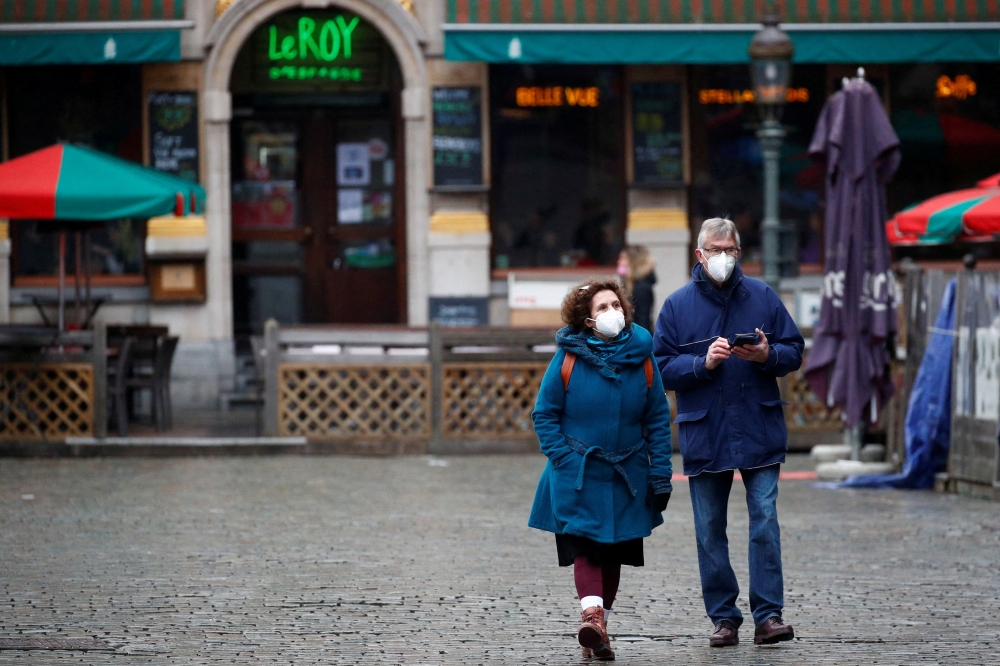
People wearing protective face masks walk at the Grand Place in Brussels, amid the rise of the coronavirus disease (COVID-19) cases due to the Omicron variant in Belgium, January 21, 2022. REUTERS/ Johanna Geron/File Photo
Belgium agreed to loosen most of the virus restrictions it introduced late last year now that all but one of the indicators used to monitor the surge of the omicron variant show that the outbreak is past its peak.
Starting on Feb. 18, the requirement to work from home four days a week will disappear and become a recommendation, Belgian Prime Minister Alexander De Croo said on Friday. At that time, restaurants won’t face a mandatory closing hour or table limits, and a ban on events with moving crowds will subside, along with the obligation for children younger than 12 to wear masks.
"This is an enormous step, but it would be wrong to say we have eradicated the virus,” De Croo said at a briefing in Brussels. "Let’s not make that mistake again and mind ourselves that our behavior is what matters the most.”
The use of a Covid pass -- which provides proof of vaccination, recovery or a negative test result -- will still be required to gain access to most venues until there are more significant declines in the number of hospital admissions and patients in intensive-care units. Those indicators signal the current outbreak likely reached its peak earlier this month, and are the key ones for the government to implement pre-determined easing steps hammered out last month.
The gradual loosening of virus curbs in Belgium signals federal and regional governments are about to put an end to almost two years of social and corporate support measures, which have amounted to 34.4 billion euros ($39.2 billion) by the end of last year, according to Eva De Bleeker, the federal government’s budget secretary. In a statement on Friday, she called for a swift end to such government aid, arguing that Belgium’s deficit, even when adjusted for one-offs and the effects of the economic cycle, has also become too wide during the pandemic.
Weekly data show there was no more excess mortality in the Belgian population during the first three weeks of January, with a sole exception among men in the age group 15 to 64 years in the Brussels capital region. Reported deaths attributed to the Covid-19 virus are still on the rise in the country of 11.5 million people, currently at a seven-day average of 43 deaths per day.