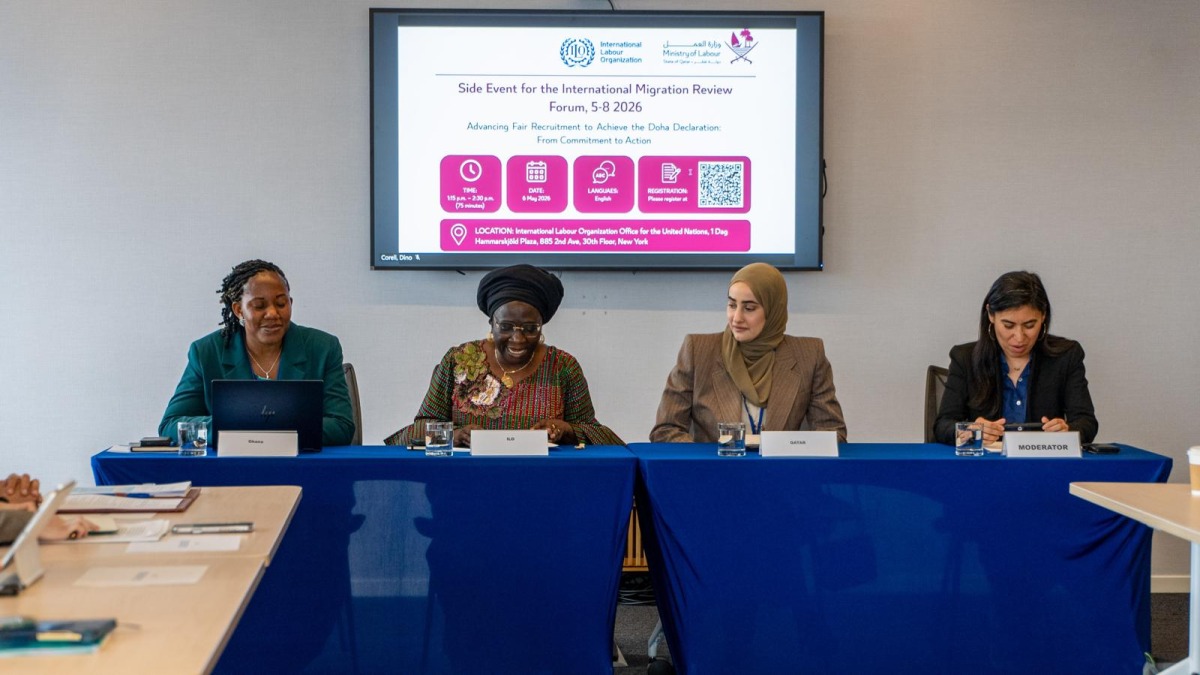
Undersecretary of the Ministry of Labour H E Sheikha Najwa bint Abdulrahman Al Thani during the event.
Doha, Qatar: Undersecretary of the Ministry of Labour H E Sheikha Najwa bint Abdulrahman Al Thani yesterday played a leading role at a significant side event entitled “Advancing Fair Recruitment to Achieve the Doha Declaration: From Commitment to Action”, convened alongside the Second International Migration Review Forum in New York.
This gathering offered a vital occasion to scrutinise the Doha Dialogue as an innovative and forward-thinking instrument designed to enhance inter-regional cooperation. At its core, this initiative plays an indispensable role in facilitating the effective realisation of the Global Compact for Safe, Orderly and Regular Migration, with a pronounced focus on fostering fair and ethical recruitment practices between African countries of origin and Gulf states as principal destinations. Moreover, the forum sought to delineate pragmatic and sustainable avenues for ongoing collaboration in anticipation of the 2026 migration review cycle.
Since its inception by the State of Qatar in 2024, the Doha Dialogue has emerged as a comprehensive policy framework dedicated to advancing fair recruitment through sustained dialogue, enhanced institutional coordination, and the dissemination of exemplary regulatory practices.
Its core mandate is to deepen engagement between labour-sending and labour-receiving nations, broaden whole-of-government and whole-of-society approaches, and champion recruitment systems that are transparent, rights-based, and aligned with the highest standards of decent work. Integral to this mission is the establishment of practical, measurable mechanisms for monitoring progress, fully aligned with international commitments under the Global Compact for Migration.
In her address, Sheikha Najwa underscored the extraordinary timeliness of this assembly, noting that the international community must now move decisively beyond perfunctory declarations towards a resolute commitment to tangible, measurable, and sustainable implementation. She emphasised that such a paradigm shift is essential to fortifying the global governance of labour mobility and embedding the imperatives of fairness, accountability, and partnership at the very heart of international migration governance.
Opening her remarks, Sheikha Najwa highlighted that the Doha Dialogue was conceived on the critical premise that labour mobility governance transcends bilateral exchanges between countries of origin and destination. Instead, it necessitates a collective multilateral responsibility, predicated on enduring trust-building, structured knowledge-sharing, and the formulation of practical, adaptive responses to the shifting dynamics of regional and global labour markets.