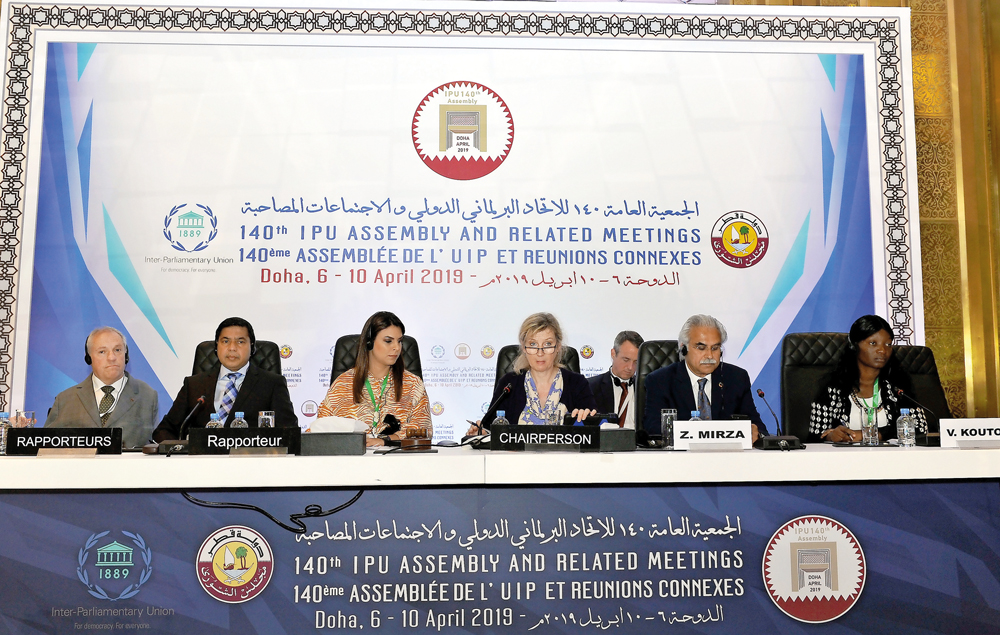
The participants at the debate on the draft resolution to be adopted at the 141st Assembly on Achieving Universal Health Coverage by 2030: The Role of Parliaments in Ensuring the Right to Health, on the fourth day of the 140th Inter-Parliamentary Union As
Doha: Yousuf Al Khater, the member of the Shura Council, has said that Qatar’s healthcare is comprehensive and integrated in accordance with clear plans that have absorbed the various challenges of this sector.
Taking part in the discussion a draft resolution to be adopted at the 141st General Assembly on achieving universal health coverage by 2030 and the role of parliaments in ensuring the right to health in the Standing Committee on Democracy and Human Rights of the Inter-Parliamentary Union (IPU) session, Al Khater highlighted the experience of the State of Qatar in the health sector.
“Health care in Qatar, since its inception, is free of charge for citizens and residents, except for a very small amount paid by the resident to buy medicine only,” he said.
He pointed out that the State of Qatar has built many hospitals to meet health challenges at the local level such as Heart Hospital, Al Amal Cancer Hospital, and primary health care centers, maternity and childhood centers, and other centers for care and rehabilitation, in addition to building hospitals for workers who contribute to the construction 2022 FIFA World Cup facilities, and in other projects.
Dutch parliamentarian Arda Gerkens, who chaired the session, stressed the importance of discussions on the proposal submitted by Bangladesh during the 139th Session of the Union, hoping to come up with specific parliamentary procedures to be included in the resolution, noting that universal health coverage is essential, and is part of the goals of sustainable development 2030.
She pointed to the role of parliamentarians in achieving universal health coverage through the enactment of legislation and the allocation of budgets to ensure citizens access to health care services as an inherent human right and a fundamental pillar for achieving the goals of sustainable development in 2030.
Dr Zafar Mirza of the World Health Organization (WHO), who attended the session within the partnership with the IPU, pointed to current global health challenges, saying that about 36 percent of the world’s population and 53 percent of the Middle East population do not have access to health services because of poverty or poor quality of these services.
He stressed the important role of parliamentarians in achieving universal health coverage through the adoption of legislation guaranteeing this right and approving budgets for health care.
He affirmed that achieving the goals of sustainable development 2030, approved by world leaders in 2015, depends on the success of the third objective of ‘good health and well being’.
Mirza pointed out that the economic indicators of the last three decades of the twentieth century showed that 11 percent of the world’s economic growth is the result of investment in health and decreasing the number of deaths. He called on parliaments around the world to begin discussing the possibility of reaching a decision on universal health coverage in their countries.
The Committee, through its rapporteurs, introduced parliamentarians to some general indicators on health services at the global level, noting that about half of the world’s population is deprived of basic health services, while the high costs of health services have pushed about 100 million people into poverty.
The rapporteurs highlighted the importance of providing mechanisms to ensure sustainable financing of comprehensive health services, including capacity-building for those working in this area, access to services and medicines, with a strong legislative framework guaranteeing this right and putting clear and transparent mechanisms of accountability and equity.