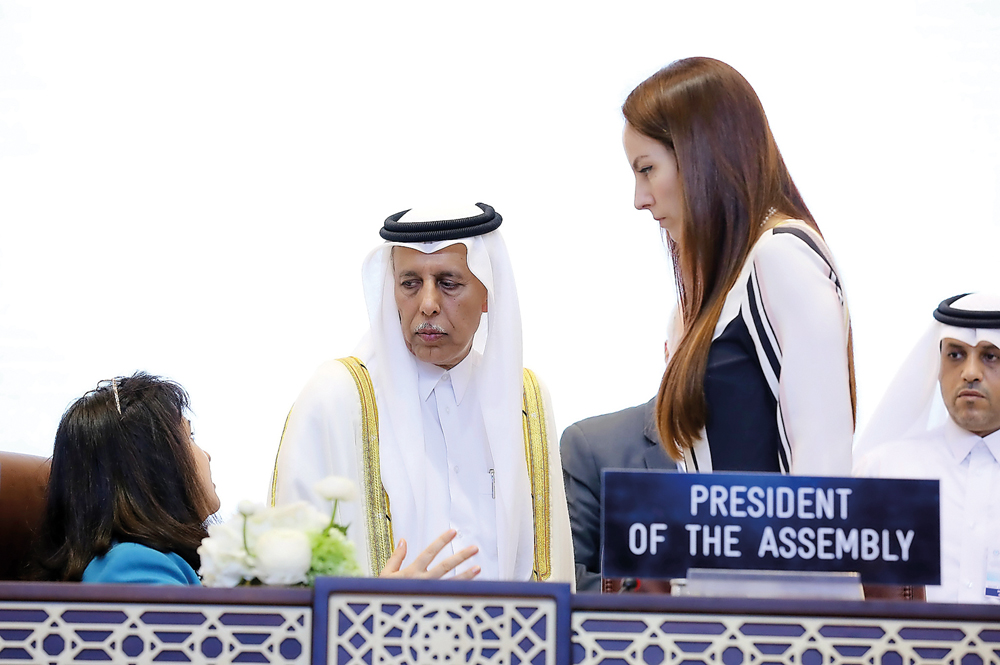
The Speaker of the Shura Council and the President of the 140th General Assembly of the Inter-Parliamentary Union (IPU), H E Ahmed bin Abdullah bin Zaid Al Mahmoud, with the President of the IPU, Gabriela Cuevas Barron, yesterday at the meeting.
The 140th General Assembly of the Inter-Parliamentary Union (IPU) under the chairmanship of the Speaker of the Shura Council and the President of the 140th IPU General Assembly, H E Ahmed bin Abdullah bin Zaid Al Mahmoud, unanimously adopted yesterday the emergency resolution on humanitarian assistance to cyclone-hit African countries including Mozambique, Zimbabwe, and Malawi.
The Rapporteur of the Drafting Committee William, read out the report of the Committee in this regard calling for intensified international action to support the three countries affected recently by Hurricane Idai, pointing out that heads of parliaments meeting in Doha expressed in their speeches the need to support these countries to rebuild what was destroyed by the hurricane and adapt to normal life. He explained that the hurricane and its aftermath losses remind everyone of the harmful effects of climate change and threats of global warming.
The General Assembly resolution calls on parliamentarians to urge their governments to support urgent United Nations appeals for Mozambique, Malawi, and Zimbabwe in accordance with the values of the international organisation and to contribute appropriately by ensuring that adequate human and financial resources are allocated to the concerned countries.
The resolution also called on national parliaments to urge their governments to take a leading role and take effective action to combat global warming, raise awareness about the impacts of climate change and adopt more sustainable livelihoods, and work with governments in partnership with the private sector to gradually progress towards clean and renewable energy.
The resolution also called upon the United Nations, the relief organizations and the international community to continue to focus on the most vulnerable groups in flood-affected areas to support them in rebuilding their livelihoods and enhancing their ability to care for their families and to pay particular attention to the needs of children, girls, women and other vulnerable groups at risk of abduction, trafficking, exploitation and sexual abuse.
The resolution also urged all parties to invest in adaptation, financing, and innovation at vulnerable countries, as well as to urge high-income economies to provide more financial and technical assistance and help build capacity for middle- and low-income economies to help them deal with climate change.
The resolution called upon the international community to support the affected countries in developing comprehensive national mechanisms for disaster prevention and to enhance their readiness for effective responses, reconstruction, and rehabilitation, as well as to invite the Governments of the concerned States to invest in community risk reduction measures.
The General Assembly continued the general debate on the main theme of the discussion, “Parliaments as Platforms for Promoting Education for Peace, Security and the Rule of Law”. It also devoted part of the discussion to refugee education.