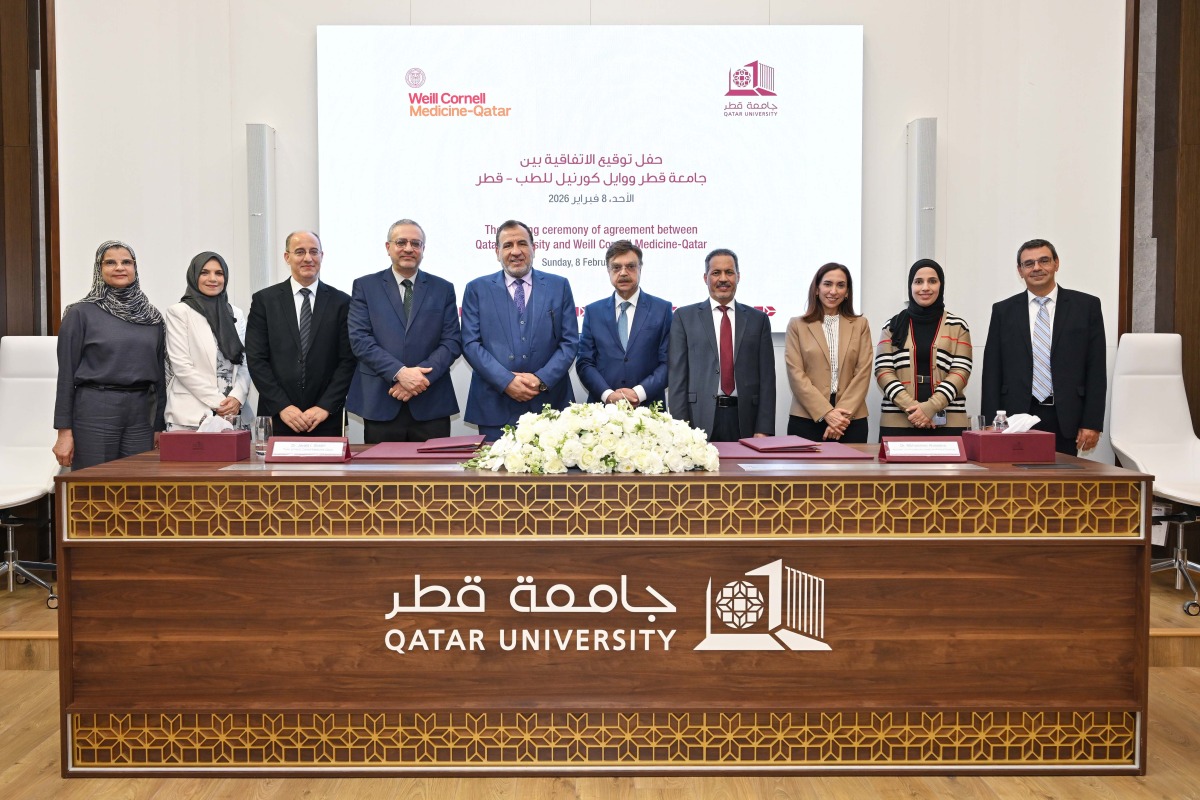
QU and WCM–Q officials during the signing of the agreement.
Doha, Qatar: Qatar University (QU) signed a collaboration agreement with Weill Cornell Medicine in Qatar (WCM–Q) to strengthen joint efforts in graduate education and research training in the health sciences.
The agreement was signed in the presence of QU’s Vice President for Health and Medical Sciences Prof Asmaa Al-Thani by QU’s Associate Vice President for Health and Medical Sciences, Prof. Mohamed Ahmedna, and the Dean of WCM-Q, Prof Javaid Sheikh in the presence of several officials from both entities.
Under the agreement, the QU graduate students enrolled in the PhD in Health Sciences programme will have the opportunity to conduct their dissertation research at WCM-Q laboratories, under joint supervision from faculty at both institutions.
The collaboration aims to provide students with advanced research exposure within a world-class academic and scientific environment and interdisciplinary research advising.
The agreement also provides for the appointment of eligible WCM–Q faculty as adjunct graduate faculty at QU, further enhancing academic integration and knowledge exchange between the two institutions.
As part of the collaboration, WCM–Q will cover tuition fees and stipends for participating students for the duration of their PhD study, in accordance with agreed regulations.
QU’s Vice President for Health and Medical Sciences, Prof. Asmaa Al-Thani said in a statement, “This collaboration reflects Qatar University’s commitment to providing its graduate students with high-quality research training opportunities and exposure to leading academic and scientific environments.
“By working closely with Weill Cornell Medicine-Qatar, we aim to strengthen research capacity, enhance knowledge exchange, and support the development of highly skilled researchers who will contribute to the advancement of health sciences in Qatar.”
Dean and Professor at WCM-Q, Dr. Javaid Sheikh said, “We are extremely gratified to sign this collaboration agreement with an institution of the calibre of Qatar University, and we look forward to welcoming the first cohort of PhD students to our laboratories very soon.
“Deepening our integration with QU in this way contributes to our ongoing mission to play a positive and active role in building human capacity in research and development, education, and the health sciences in Qatar.”
This partnership reflects the shared commitment of both institutions to advancing health research, developing national research capacity, and supporting the training of highly qualified researchers in Qatar.