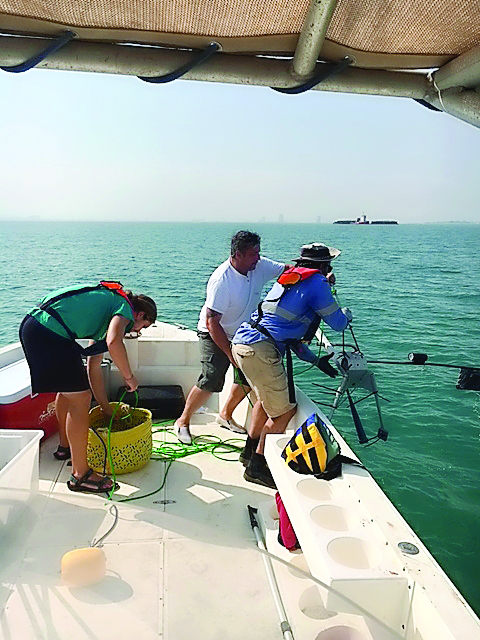
Qatar University team using baited remote underwater video.
A pioneering research project by a team of Qatar University (QU) researchers and external collaborators has used underwater video to survey the abundance of sharks and rays in the coastal waters of Qatar.
The team used a technology called baited remote underwater video (BRUV) system to study the marine creatures. The BRUV system, which consist of fish bait and cameras, attract and record fish life in the immediate area.
Preliminary results of the study, “Underwater Video Survey of the Elasmobranchs of Qatar: A first step towards conservation” shows that very few sharks and rays have been observed. It may be a sign that sharks are no longer found in habitats where they should be, due to overfishing or habitat destruction.
The team has completed over 100 deployments of the BRUVs in northern and southern Qatar, to undertake the study. The lack of observations is also a useful data, providing a baseline for future studies.
Sharks and rays are of particular conservation concern due to their vulnerability to overfishing, and to their slow growth and reproductive rates.
“The research outcomes can be used to guide conservation and/or restoration efforts for vulnerable species, such as sawfishes, which have been heavily overexploited in the Gulf,” said Professor Dr J Jed Brown, Research Assistant at QU Centre for Sustainable Development (CSD).
Dr Brown, with a team of researchers from QU and the Australian Institute of Marine Science (AIMS) is conducting the study.
The project is part of an agreement signed between CSD and AIMS. It is funded by a QU internal grant awarded to Dr Brown and Global FinPrint project -a 3-year project sponsored by Microsoft Co-founder Paul Allen to study tropical reef ecosystems for sharks and rays.
Another highlight of the study was one of the camera systems deployed is actually a 3D virtual reality camera housing, which houses six individual cameras. Footages from this camera can be viewed on virtual reality head-sets or other systems such as virtual reality cave in QU reality lab.
“This is one of QU’s research activities that highlights its core role in addressing important environmental issues. It also demonstrates QU’s commitment to knowledge-sharing and providing expertise for multidisciplinary research, education and learning in line with its research priorities and in contribution to objectives of Qatar National Vision 2030, the National Research Strategy, and other national development strategies,” Dr Brown said.
“We welcome these partnerships that help us carry out Global FinPrint project. Working with collaborative institutions like Qatar University has enabled us to gain local knowledge and expertise, which are invaluable to our research. We hope this collaboration will foster additional research in future and build local capacity for carrying out marine surveys using BRUVs in the Gulf,” said Dr Conrad Speed, AIMS Postdoctoral Research Scientist.