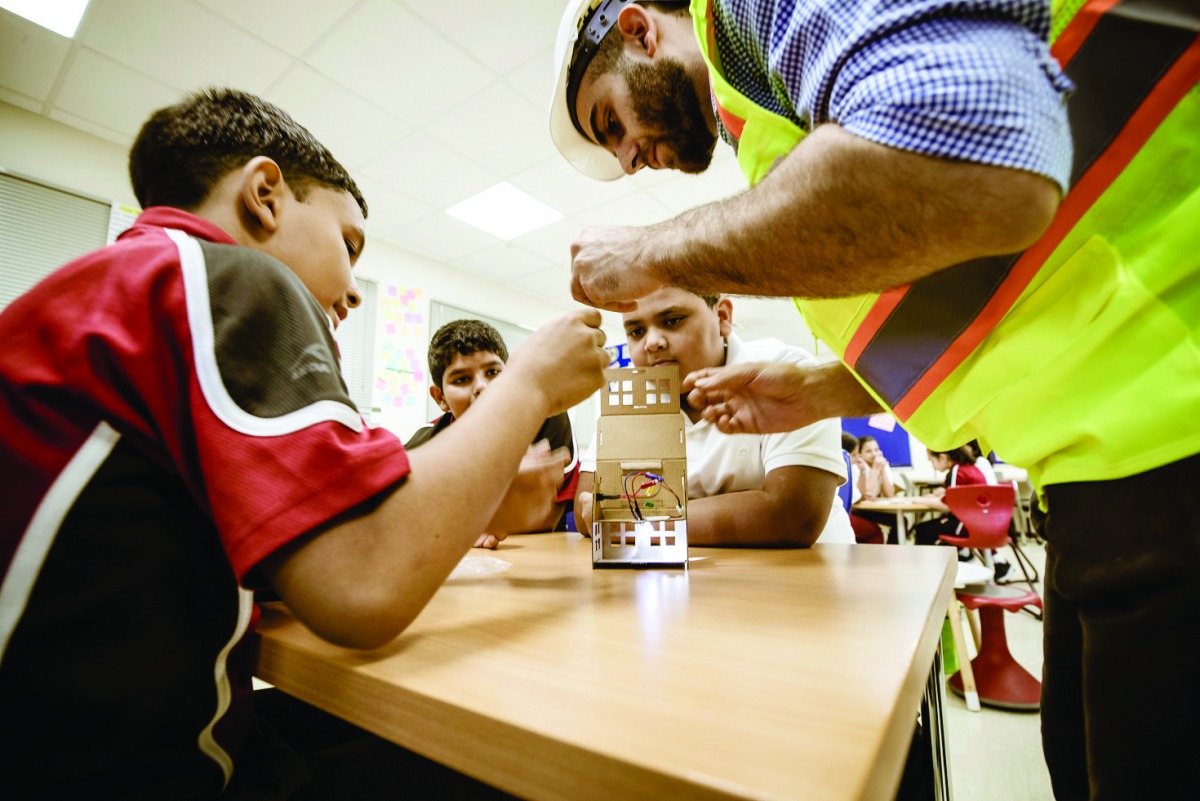
An expert shares knowledge in sustainability with students during an interactive workshop on the sustainability of 2022 FIFA World Cup stadiums.
Doha: Throughout the generations, those who call Qatar their home have always recognised the need to respect nature. And as Qatar prepares to host the 2022 FIFA World Cup, the people of the nation want to ensure nature continues to be nurtured.
Water conservation, waste management, reducing carbon emissions, increasing use of renewable energy, and protecting the environment head the list of topics that Qatar is teaching its young people about, both for the country’s future resilience and to show them that even a tournament of the scale of a World Cup can be held in a sustainable way.
As part of these efforts, Dr. Sami Al Ghamdi, Assistant Professor of Sustainable Development at Qatar Foundation (QF) member Hamad Bin Khalifa University’s College of Science and Engineering, and a group of his Ph.D students shared their expertise in sustainability with Qatar Academy Sidra students during an interactive workshop on the sustainability of 2022 FIFA World Cup stadiums.
“The upcoming World Cup is a very important event for Qatar,” says Dr. Al Ghamdi. “When the country invested its resources in facilities for the tournament, we did it with sustainability in mind, and it is important to make the next generation understand the effort that has gone into to organizing and making the World Cup sustainable.
“We explained more about the aspects of sustainability that were incorporated into the planning and construction of the eight World Cup stadiums, and discussed important themes related to sustainability – including energy, water, and the local environment and its resources – with the students.
“For HBKU, serving the community is one of our goals. Meeting Qatar Academy Sidra students was an important step in this direction, as it enabled us to share details of the major events taking place in Qatar, and educate them about the future challenges.”
During the workshop, students constructed a miniature model of an environmentally friendly home and were given an insight to how renewable energy can be part of construction processes, so that new developments produce clean, environmentally friendly energy. “We choose workshops based on the subjects offered by schools to students,” said Dr. Al-Ghamdi. “We learned that one of the topics presented by Qatar Academy Sidra was around the World Cup, so we wanted to take this opportunity to explain the meaning of sustainability to students and provide them with information.
“Our workshops vary from one school to another – for example, we cover topics related to recycling and waste management, energy, and water, according to the subjects offered by the school.”
Mohammed Zaher, a Ph.D student in Sustainable Environment at HBKU, was part of the presentation and said: “It’s always good to transfer knowledge to the next generation because they are our future.
Qatar’s development is based on science and technology. But if we do not transfer knowledge – along with the message of the importance of sustainability — to future generations, our current efforts will be in vain.”
Ayman Raouf, a PhD student in Sustainable Environment at HBKU, said: “I am working on research on green building projects, and through our community service program at HBKU we visit various schools, such as Qatar Academy Sidra. This means we can reach out and educate students about green buildings and sustainable environment when they are young, creating engagement and interaction.”
“One of the things that surprises students today is that one of the 2022 World Cup stadium — Ras Abu Aboud stadium — can be completely disassembled after the tournament, and this approach reduces the waste generated during production of stadium components and the waste created on-site during construction.”
Ali Al Dosari, a student at Qatar Academy Sidra, said: “I learned the basics of implementing green buildings and their importance, because they preserve the environment and protect them from pollution. We are proud that Qatar is creating green buildings and sustainable stadiums for the 2022 World Cup.”