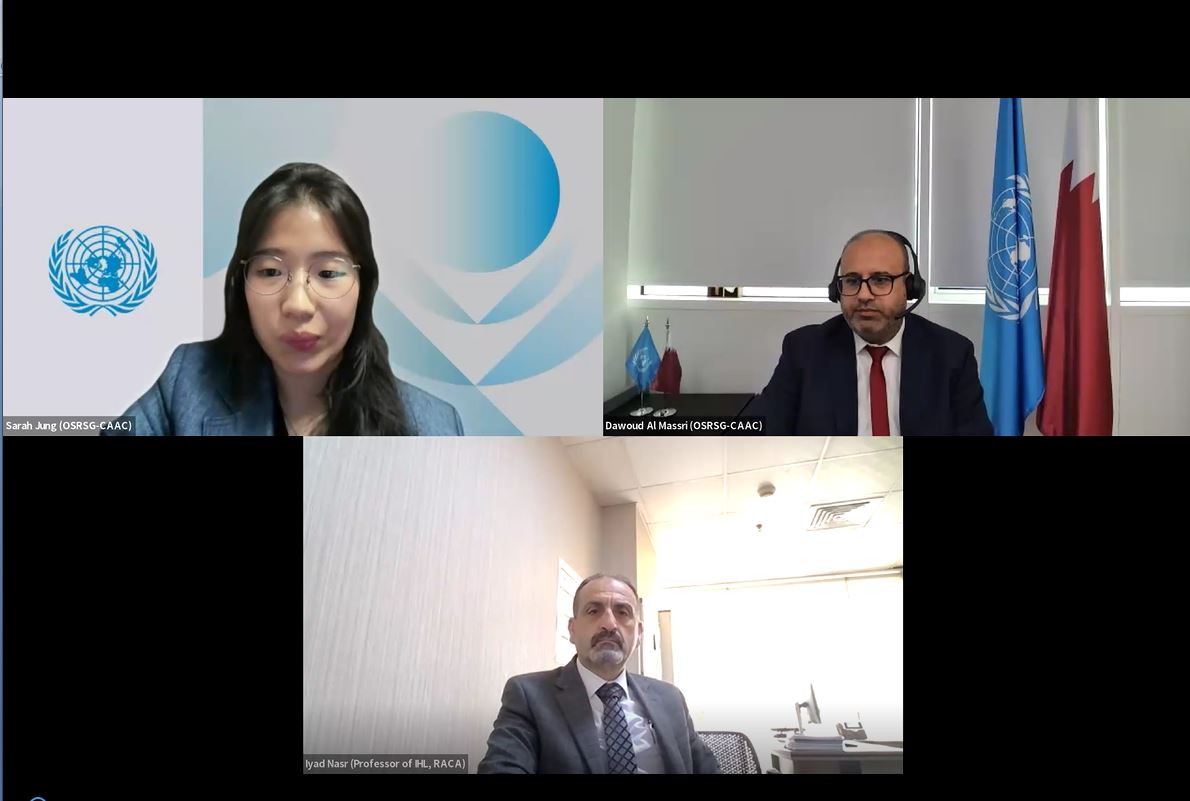
Participants during the webinar.
Doha, Qatar: The crisis across the Middle East exacted a devastating toll on millions of children, with urgent calls for stronger international action to safeguard their rights, according to speakers at a high-level webinar convened yesterday by the Office of the Special Representative of the Secretary-General for Children and Armed Conflict (OSRSG-CAAC).
The webinar, titled “Current Middle East Crisis and Its Impact on Children,” brought together global experts and policymakers from organisations including Unicef, Unesco, and Qatar’s Regulatory Authority for Charitable Activities to examine the worsening humanitarian situation and explore solutions.
Opening the session, Deputy Head of the Analysis and Outreach Hub at OSRSG-CAAC in Doha, Sarah Jung, stressed that children remain the most vulnerable victims of conflict.
“Children are innocent and these are wars that they have no say in,” she said, underscoring the urgency of coordinated global efforts.
Dawoud Al-Massri, Head of the Doha Hub, warned that the pace of violence continues to outstrip diplomatic efforts, leaving children to bear long-term consequences. “Children’s safety, well-being and future are deeply affected in ways that are both immediate and enduring,” he noted.
Presenting key data, Head of Unicef Qatar, Anthony McDonald, revealed the staggering scale of the crisis. Across the Middle East and North Africa region, around 45 million children faced life-threatening risks, while nearly 40 million required protection services and 35 million needed educational support.
The region also accounts for the highest number of verified grave violations against children globally since 2005, with over 127,000 cases recorded.
In 2024 alone, more than 13,200 violations were documented, representing 37 percent of the global total. “These are not just numbers,” McDonald said. “Behind them are children suffering severe trauma, displacement, and the loss of their futures.”
He highlighted the widespread impact, including physical injuries, psychological distress, and disrupted education. Millions of children remain out of school, while displacement continues to rise, with hundreds of thousands forced from their homes in recent months alone. On the education front, Lily Neyestani-Hailu of Unesco emphasised that schooling is often one of the first casualties of conflict. Globally, over 117 million children are displaced, and attacks on schools and educators are increasing.
“In crisis settings, education is not a secondary priority, it is life-saving and essential for peacebuilding,” she said. Neyestani-Hailu noted that at least 52 million school-age children across affected regions have experienced disruptions to learning due to the current escalation. In conflict zones such as Gaza, the destruction of educational infrastructure has reached unprecedented levels, with the vast majority of schools damaged or repurposed as shelters. She also pointed to declining humanitarian funding for education, which has dropped significantly despite rising needs, leaving millions without access to support.
Addressing the legal dimension, Dr. Iyad Nasr, an expert in international humanitarian law, stressed that children are entitled to special protection under international law. He cited core principles such as distinction, proportionality, and precaution, which obligate all parties to conflict to avoid harm to civilians, particularly children.
“Children must never be the object of attack under any circumstances,” he said, adding that both states and non-state actors bear responsibility for ensuring their protection.
Dr. Nasr further emphasised that accountability is critical, urging states to investigate violations and uphold international legal obligations. “The protection of children is not only a legal duty but a moral test for the international community,” he stated.
Speakers also highlighted the role of Qatar in supporting humanitarian efforts and promoting dialogue, noting its continued engagement with international organisations and conflict mediation initiatives.
The webinar concluded with a call for intensified global action, including increased investment in child protection programmes, improved humanitarian access, and stronger enforcement of international law.
Participants stressed that safeguarding children in conflict zones requires collective responsibility and sustained commitment. “Children must never be the price of war,” Dr. Nasr said. “Even wars have limits, and those limits must be respected.”