

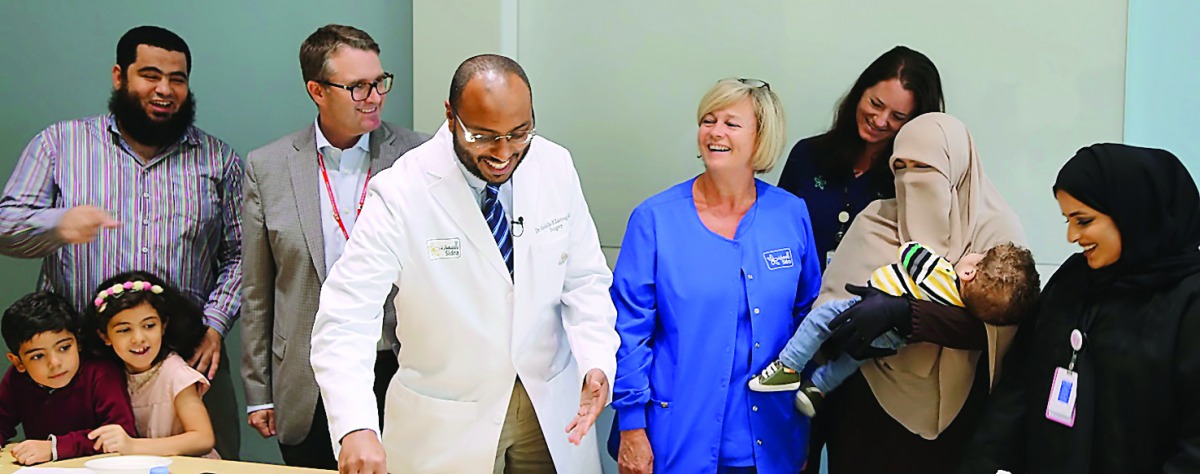
Baby Mohamed’s family with doctors at an event in the Outpatient Clinic.
A multidisciplinary team of clinical experts from Sidra Medical and Research Center (Sidra) and Hamad Medical Corporation (HMC) have made medical history by successfully performing a series of hugely complex surgeries on a baby for the first time in the Middle East.
During the past two years, the team has worked to save the life of a baby boy through multiple procedures designed to correct birth defects resulting from OEIS Syndrome, a rare and life threatening condition which can prove fatal in 95 to 99 percent of cases.
The hugely experienced interdisciplinary medical team led by Sidra’s Division Chief of Paediatric General and Thoracic Surgery, Dr Abdalla Zarroug, comprised of paediatric surgeons, paediatric urologists, paediatric anaesthesiologists, paediatric neurosurgeons and paediatric orthopaedic surgeons have worked closely together to conduct more than seven pain-staking and highly complex surgical procedures to save the life of the young patient, baby Mohamed (pictured), who was born to an Egyptian family living in Qatar since 2014.
During the most recent of these, an operation conducted in October 2016, which lasted more than 12 hours, the team led by Joao Luiz Pippi Salle, Sidra’s Division Chief of Paediatric Urology, successfully conducted bladder exstrophy surgery to repair the baby’s bladder, as well as ventral hernia repair, genital reconstruction and gastrostomy tube placement. This marked the latest of the more complex procedures needed to correct the specific set of malformations affecting the baby and which are caused by OEIS.
Mohamed’s medical journey began in his mother’s womb following an early diagnosis of possible OEIS Syndrome during a prenatal ultrasound conducted by Sidra’s Division Chief of Maternal Fetal Medicine Dr Karim Kalache and Dr Sawsan Al Obaidly from HMC. The expert team of physicians from Sidra and HMC developed the necessary treatment plan to secure the best possible outcomes for baby Mohamed. Diseases of such complexity require that medical teams are able to draw on the expertise and experience of a full range medical professionals and institutions. In this case, the team of more than 30 clinicians worked in collaboration during the past twenty four months, each playing a major part in helping to save the patient’s life. Their success provides an important blueprint for effective collaboration between medical experts and institutions in Qatar and elsewhere across the region.
“Modern medical care of complex paediatric diseases such as OEIS requires a multi-disciplinary approach of true experts coming together to create an individualised plan for each patient. Although each clinician has an important role or procedure to oversee, all medical decisions need to be coordinated to the patient’s needs; it’s the team that makes the difference nowadays and it’s incredibly satisfying to see that, as a result of experts coming together in a patient-centered manner, baby Mohamed is now thriving,” said Dr Zarroug.









