By Mohamed Osman
DOHA: A Qatari expert said he didn’t see world oil prices improving to $70 to $80 a barrel before 2019 as supplies were high and demand remained low.
Khalid Al Khater said yesterday the supply and demand situation of oil was a result of Opec’s reluctance to reduce production and increasing production of shale oil.
Non-conventional crude producers are keeping a watch on the market and increasing production, he told a conference here, It was held to debate the impact of low oil prices on producing countries by city-based Arab Center for Research and Policy Studies. Al Khater said the oil price crisis was not going to end soon and rates may likely improve to $70 to $80 per barrel only by 2019.
Another expert at the event didn’t agree and said he saw crude rates bouncing back to be in the $70-80 per barrel band by 2015-end.
“Prices might fully recover by next year,” said Mamdooh Salama, a consultant at the World Bank in Washington, DC.
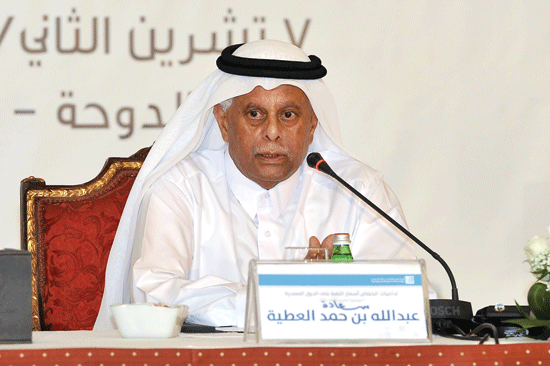
Qatar’s former energy and industry minister H E Abdullah bin Hamad Al Attiyah said it was not fair for Opec to reduce production to help stabilise prices in the global oil markets.
“If Opec members reduce production, the gap will be filled in by non-Opec producers…These are the countries that have always refused to cooperate with Opec members,” said Al Attiyah.
He said that looking at global commodity prices, one sees that they have been on a downslide whether it is gold or copper or some metal. Oil is a commodity, too. “However, in Arab world people are worried due to the oil price decline because we are the producers.”
One of the main reasons of price downslide is slow economic development in China, a large consumer of oil, besides India. “But no one is asking why there is suddenly this economic slowdown in China,” he said.
The GCC states must change financial and economic policies and reduce state subsidies and support for citizens — which have been growing with the population.
Other speakers agreed with Al Attiyah and said the GCC states have for long been talking about diversification but tend to mostly diversify their economies into fields related to oil like petrochemicals. So there is confusion.
Experts underlined the need for what they said was a deeper understanding of causes of oil price fall rather than focusing on demand and supply factors.
The demand and supply situation is largely influenced by geopolitical factors, they said.
Shale oil has a role to play because oil prices were ruling at $110 a barrel in September 2014 and a year hence have plummeted to around $40.
Opec decided to keep its production levels unchanged in November 2014. This June, it said the responsibility to stabilise world oil prices should not rest on its shoulders alone.
Salama said Opec’s decision not to reduce production had led to a 57 percent decline in oil prices. Other experts said Opec’s share in the world oil market had shrunk to 30 percent.
According to Salama, the US shale production is going up. It was six million barrels a day in 2012 and reached 8.5 million barrels last year. He said it was wrong to think that low crude rates would discourage shale oil producers due to higher cost of exploration. The fact is that constantly improving and sophisticated exploration technology meant oil production costs are gradually coming down for shale producers.
Mohamed Al Shatti, from Kuwait Petroleum Corporation, said today’s situation was like the one in 1985 when high oil prices continuing since the 1970s through early 1980s encouraged huge interest in exploration in North Oil, though the cost of production of North Oil was high and there was a glut which led to a fall in prices at the time.
The Peninsula