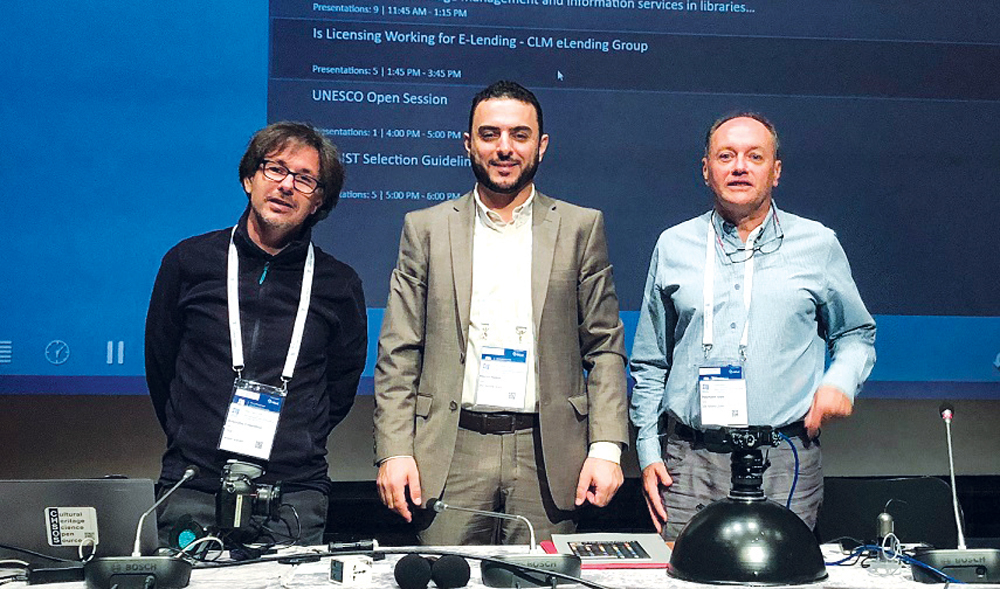
Panellists at the session ‘Collections and Science’ which was organised by Qatar National Library as part of the 85th IFLA World Library and Information Congress 2019 held in Athens, Greece.
Qatar National Library (QNL), in its role as the International Federation of Library Associations and Institutions (IFLA) Regional Center for Preservation and Conservation for Arab Countries and the Middle East, organised a scientific session titled “Collections and Science” at the 85th IFLA World Library and Information Congress 2019 held in Athens, Greece.
During the session, held in partnership with the Library of Congress, the QNL experts presented a variety of topics, including the scientific techniques for studying heritage items, the importance of the results obtained for preserving these objects and a better understanding of the nature of the materials being conserved.
Jeanne Drewes, Director of the IFLA’s Regional Preservation and Conservation Center for North America, hosted by the Library of Congress in Washington DC, delivered the opening remarks at the session and touched on its importance to the overall theme of the congress, “Libraries: Dialogue for Change.”
Stephane Ipert, Preservation and Conservation Manager at QNL, then highlighted the “USB Microscope in Infrared (IR), Ultraviolet (UV) and Visible Wavelengths,” a method that enables conservators to check the critical characteristics of manuscripts such as ink types and underlying drawings or text. Ipert also highlighted best practices on “Reflectance Transformation Imaging,” a computational imaging technique used to capture and visualize specific features of the objects’ surfaces.
“This was an interesting opportunity to share the Library’s efforts in the field of digitisation and raise awareness of the best practices in maintaining rare books, documents and manuscripts in our role as IFLA’s Regional Preservation and Conservation Center for Arab Countries and the Middle East,” he said.
In his presentation, Ipert explained that for nearly 50 years, forensic techniques have been used to understand the composition of library materials to determine the most appropriate conservation treatment, storage and exhibition methods for these old, often fragile items. Until recently, only the largest, highly funded programs could afford this expensive equipment, but today there are new devices that are available at much lower cost.
As a result of these advances, “Forensic discovery of material composition is no longer for an elite group, but available to a broader community, which allows libraries and conservation laboratories to share and add value to their documentation of collections. We are delighted to have access to some of the newest technologies for conservation of historical books and manuscripts at the Library,” Ipert added.
Antonino Cosentino, Director of Cultural Heritage Science Open Source, shared insights on “Technical Photography,” an advanced skill that allows conservators to use a modified digital camera with different lighting sources and filters to acquire a selection of technical images, each providing different information regarding the object under examination.