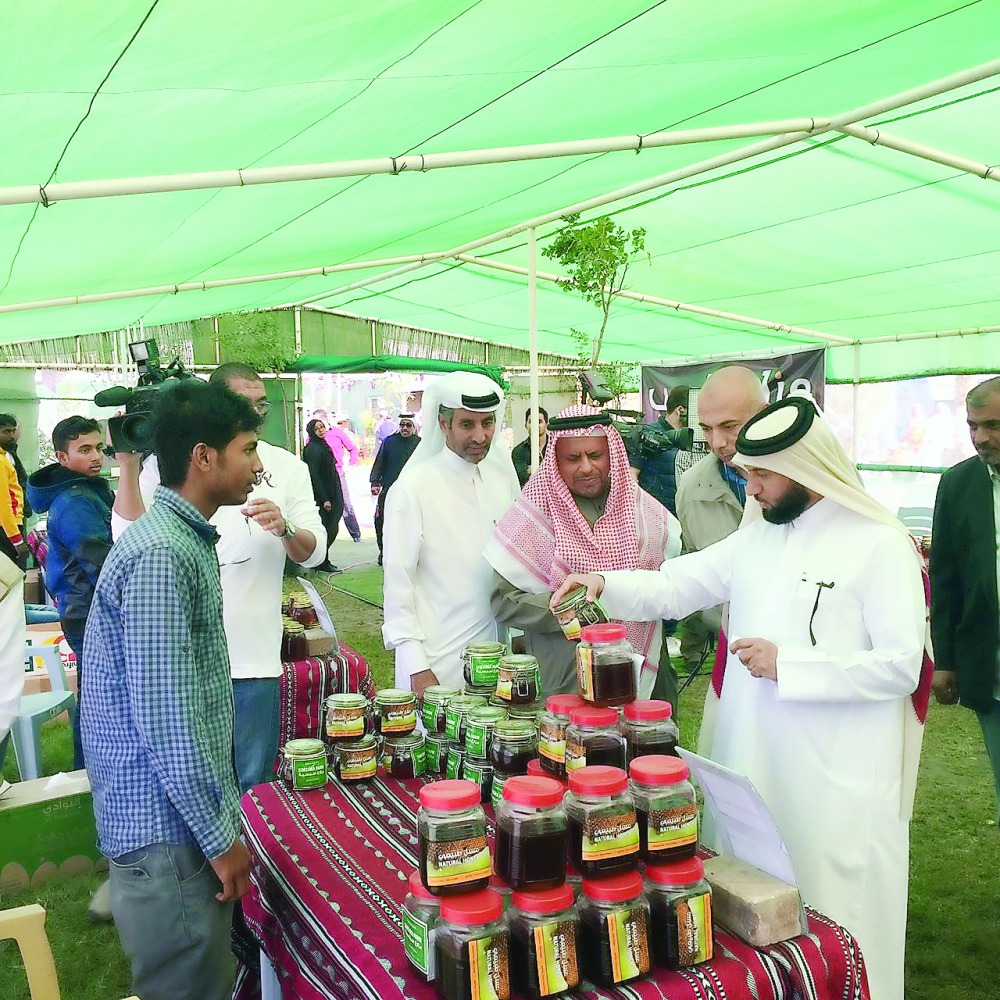
Yousuf Al Khulaifi, Director, Agricultural Affairs Department, visiting a honey stall at the winter vegetable market in Al Mazrouah Yard, in Umm Salal, yesterday.
Showcasing honey from local farms, a three- day ‘Honey Festival’ opened at the winter vegetable market in Al Mazrouah Yard in Umm Salal, yesterday. The annual event, organised by Ministry of Municipality and Environment, attracted both beekeepers and honey-lovers to purchase a variety of locally produced honey.
The festival is a part of national honey bee project, that aims to promote indigenous honey production by providing financial and technical support to farmers. It will be followed by similar events at the Al Khor-Dakhira yard and Al Wakrah yard winter markets over the next two weekends.
“The festival this year has more farmers and we have seen an increase in number of participants and visitors. Some 16 local farms and four companies are participating in the festival, which provides an opportunity to introduce the national project to farmers,” said Yousuf Al Khulaifi, Director, Agricultural Affairs Department at the ministry.
Local honey is becoming popular , with increased number of takers , as it is trusted by people for its quality and purity. Honey is classified according to the flower from which the bees extract nectar. The colour and flavour of the honey are determined by the type of plants visited by the bees. It can be either mono-floral , coming from a single type of flower or poly-floral.
Different varieties of locally produced honey are on sale at the venue.
The most popular honey in Qatar is that produced by bees that collect nectar from the Sidra trees. Locally produced honey is considered to be of high quality with medicinal value. The taste of Sidra honey is considered to be a true luxury and it is often described as rich and unforgettable. Poly-floral honey is also available in the market.
Since the launch of the national project in 2012, the ministry has set up a programme to support and popularise bee farming. From 30 farms in 2012, the number of farms increased to 50 in 2014 and there are some 130 farms in honey production currently, according to experts.
“The project aims to support farms producing honey and many farms have doubled their output over the past years, with support from the ministry. We also have experts to assist farmers in every phase of honey production who train workers and follow-up honey production with routine farm visits,” Al Khulaifi said.
“This season, we have 4000 kg of honey locally produced, which is unique compared to the size of quantities imported from abroad. The ministry is providing guidance and training to farmers on the best methods for the production of honey, and this year we have also included packaging training so that the honey can be marketed locally in best possible way,” he said.
The festival at Al Mazrouah Yard will close tomorrow. Al Khor-Dakhira yard will host the honey festival from January 12 to 14 and Al Wakrah yard from January 19 to 21.