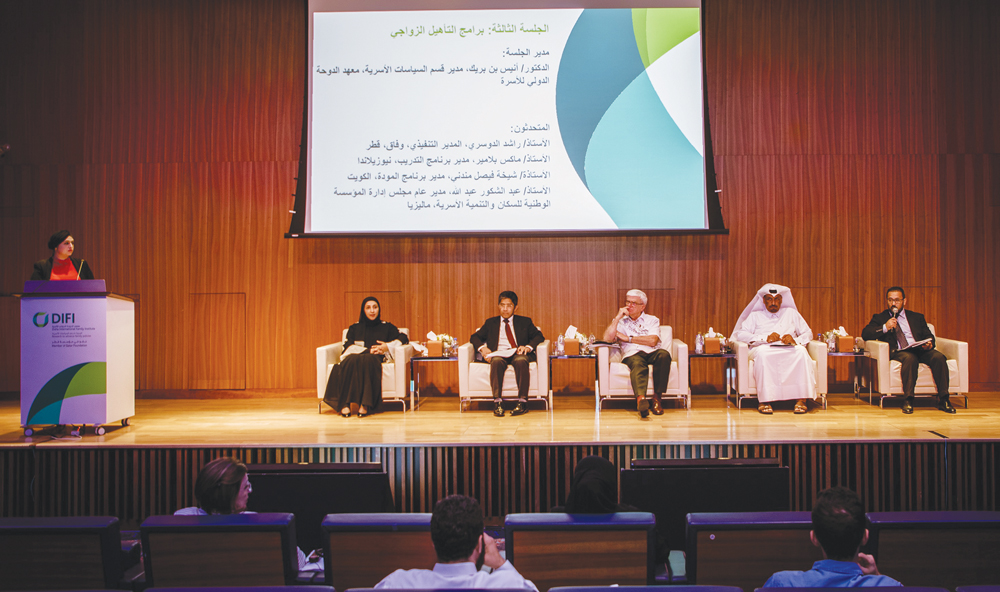
Panellists during a discussion at the ‘Arab Family Forum on Marriage: Approaches to Research and Policy’ conference at Qatar Foundation.
Poor understanding between husbands and wives, lack of responsibility, parental involvement, and a lack of awareness about what being married really means are among the key factors behind the breakdown of marriages and divorce in the Arab world and beyond, experts have told a conference at Qatar Foundation.
During a panel discussion at the Arab Family Forum on Marriage: Approaches to Research and Policy – organised by Qatar Foundation member the Doha International Family Institute (DIFI) – speakers focused on the positive impact that marital education programmes can have, and the importance of married couples making use of them.
The session on the second day of the forum at Qatar National Convention Centre brought together Rashed Al Dosari, Executive Director, The Family Consulting Center (Wifaq), Qatar; Max Palmer, Director and National Trainer at New Zealand’s Prepare/Enrich initiative; Shaikha Faisal Medndi, Head of the Mawada Program, Kuwait; and Abdul Shukur Abdullah, Director General of the National Population and Family Development Board, Malaysia. It was led by Dr. Anis Ben Brik, Director, Family Policy Department, DIFI.
Speaking about programme that seek to educate couples who may be intending to marry, Al-Dosari said,”We aim to encourage young people to join marital education programmes in order to better understand the marital relationship, strengthen the bonds between family members, and gain the knowledge of the behaviours that individuals who are going to marry need to show, helping to build a strong and sustainable emotional relationship between the couple. “
Al-Mandani highlighted her perspectives on marriage and marital education programmes in Kuwait, saying: “We noticed that most divorces were among newly-married couples, because of their lack of awareness about married life.
“This emphasises the importance of marital education because it provides couples with the knowledge that will help them enter marriage in the right manner, with awareness of what it entails.
During the forum, DIFI also organised five sessions focusing on the state of marriage in the GCC; the wider Middle East; North Africa; the Nile Basin; and Yemen, Somalia, Djibouti, and Comoros.
In a panel discussion addressing marriage within the GCC, Dr. Fatima Al-Kubaisi, Head of the Department of Social Sciences at Qatar University, gave a presentation on the social factors surrounding marriage in the “pre-oil” era, including parity ratios, marital upbringing, and the material costs of marriage; and in “post-oil” times, such as the role of education in marriage, parental involvement in marital life, and social networking programs.
The forum featured the discussion of topics and findings highlighted in two DIFI research reports, titled The State of Marriage in the Arab World and Marital Education Programs in the Arab world.
The reports are intended to provide new knowledge that helps to address the problems faced by Arab families related to marriage and marriage patterns, age and marriage, marital relations, work and marriage, migration and marriage, and marriage during conflicts and wars.