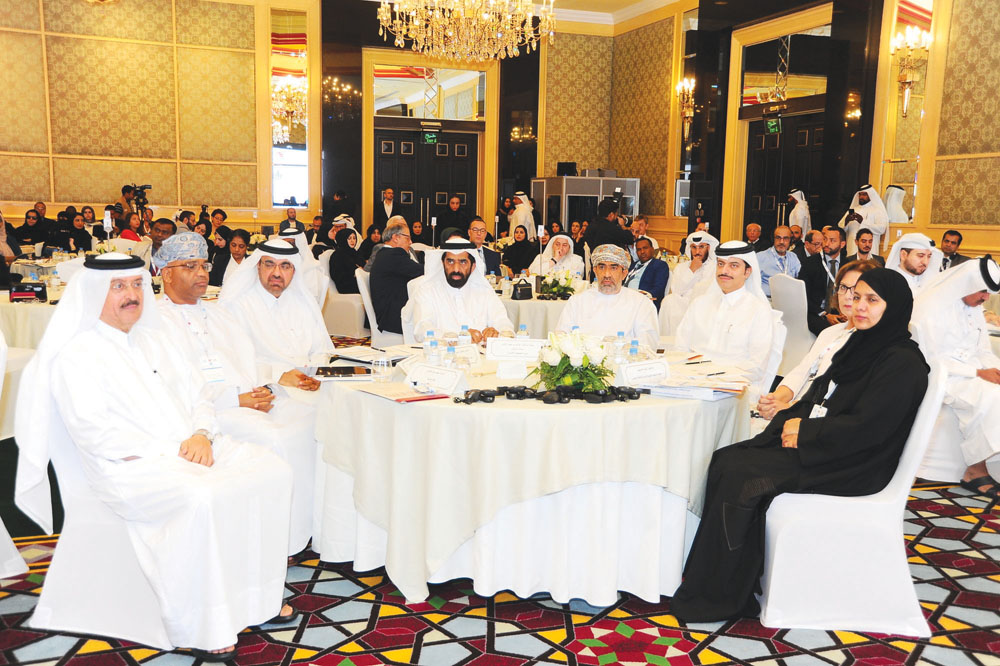
The representatives of various local, regional and international organisations and research centres, academics, experts and specialists during the workshop.
A regional workshop on modernisation of official statistics in the State of Qatar, aiming to examine the scope of updating official statistics and its role in achieving goals of the Sustainable Development Agenda 2030 and non-traditional data sources of official statistics, kicked off yesterday.
The two-day workshop was organised by the Planning and Statistics Authority and attended by representatives of a number of local, regional and international organisations and research centres, along a number of academics, experts and specialists.
The workshop also explores capacity-building frameworks and strengthened partnerships in statistics as has been stated by the President of the Planning and Statistics Authority, H E Dr. Saleh bin Mohammed Al Nabit, during his opening speech.
“There is a need of countries, including Qatar, to make significant changes in its statistical system in order to collect and disseminate high-quality coordinated and reliable data and indicators to provide them to users in a timely manner,” said Al Nabit.
He pointed out that the workshop comes in response to the calls of the UN as well to complement the efforts of the State of Qatar seeking to implement the agenda of transformation in official statistics adopted by the United Nations Statistical Commission in 2016, in which Qatar was selected as the leading country in the field of modernization and statistical transformation.
Dr. Al Nabit also noted that the workshop was a continuation of the dialogue initiated two years ago in Doha on modernization of official statistics aiming at prioritizing the transformation of the national statistical system in partnership, with various international, regional and local committees. He stressed the importance of building effective partnerships with all stakeholders to achieve the desired progress to modernize the statistical system and enable it to produce, organize and use the necessary data in decision-making, monitor progress in development processes, assess their societal impacts, provide them to international organizations and follow up their dissemination at the national and international levels.
The Director General of GCC Statistical Center, Saber Saeed Al Harbi, highlighted the efforts of the GCC Statistical Center to improve the various statistical products, including sustainable development indicators through the implementation of the strategic plan for joint statistical action 2015-2020 and its evaluation to shift to the strategic plan for the next period 2021-2030 which will focus on the GCC joint action in the field of transformation and modernization of statistical systems and production of smart statistics.
In his speech during the opening session Al Harbi expressed his gratitude to the Qatari role in promoting joint GCC statistical work stressing the importance of implementing strategies for the transformation to modern and smart statistics to benefit from the data revolution and maintain its leading role in all fields of development and meet national needs efficiently within the indicators of sustainable development 2030.
For his part, Chief of Data Innovation at the United Nations Statistics Division, Ronald Jansen, stressed the importance of statistics in implementing the goals and objectives of the 2030 Agenda for Sustainable Development adopted by all Member States in 2015.
He added out that the United Nations, through its specialized organs, called on countries to modernize and strengthen their statistical systems, apply world standards and use modern technology in producing statistics.
The Regional Director of the United Nations Population Fund (UNFPA), Louay Shabana, shed light on the fruitful cooperation between the UNFPA and Qatar’s Planning and Statistics Authority, over the past years.
He said that the workshop is an important and necessary step to modernize the official statistical system to cope with the developments and challenges surrounding the collection and dissemination of official statistics. During same session, Dr Ahmad Hussein from the Planning and Statistics Authority highlighted the scope of modernization of official statistics, the importance of the modernization processes and its steps, procedures and stages, efforts of partners and other related topics.
The first session of the workshop hosted Qatari officials and academics including Dr Sheikh Mohammed bin Hamad Al Thani from the Ministry of Public Health; Dr Hamda Al Sulaiti, Qatar National Commission for Education, Culture and Science; Dr Hassan Abdulraim Al Sayed, Social& Economic Survey Research Institute at QU; Dr Mohammed bin Saif Al Kuwari, National Human Right Committee; and Mohammed Ali Al Ghamdi, Qatar Charity.