By Fazeena Saleem
DOHA: Well-known woman activist from Afghanistan Dr Sakena Yacoobi has walked away with the coveted fifth $500,000 ‘WISE Prize — a ‘Nobel’ for Education’ — for working persistently to rebuild her country’s educational landscape, devastated by decades of war.
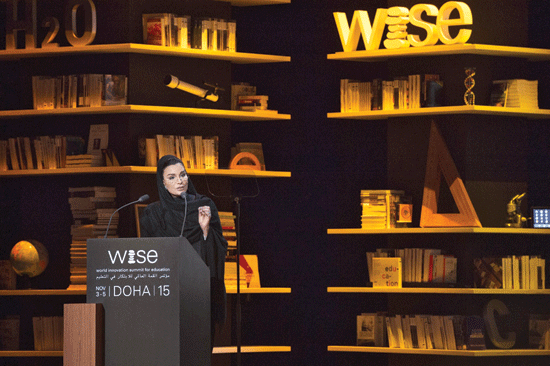
H H Sheikha Moza bint Nasser presented the award to Yacoobi, fondly known as Afghanistan’s mother of education, at the seventh World Innovation Summit for Education (WISE), which began at Qatar National Convention Centre yesterday. The award was presented during the opening plenary session of the summit in the presence of US First Lady Michelle Obama.
While inaugurating WISE 2015, Sheikha Moza said that education is under attack in many places. “The issue of accountability and punishment for attacks on education must be considered in the implementation of the Framework for Action of the new education Sustainable Development Goal, SDG 4, agreed upon last September.”
EAC (Educate a Child), launched in 2012, took up the mandate to develop international partnerships in order to address the problem of lack of quality educational opportunities for out of school primary aged children. EAC works in partnership and emphasises innovation, scale, and sustainability, to facilitate the fulfillment of children’s rights to education, Sheikha Moza said.
“I am well aware that the education journey does not and should not end with primary school and that there is a substantial drop out rate as children transition from primary to secondary education. In fact, we know that that in low income countries, only 1 in 3 adolescents finish lower secondary school as compared to 5 in 6 in upper middle income countries. Therefore, it is necessary to advocate for and build effective mechanisms to ensure that the smooth transition from primary to secondary education is a fundamental condition to achieving the basic education target of SDG goal 4.
“As we meet here today, another meeting is taking place in Paris to approve this action plan. This adoption must result in real chances to consolidate our commitment and efforts to find new practical methods capable of achieving our priorities. One thing we know for certain, the SDGs seem like a dream in MENA where we experience the nightmarish sensation of falling backwards, where our schools have been turned into cemeteries, and our students and teachers into refugees,” she added.
Announcing the WISE Prize laureate, Sheikha Moza said: “This year’s laureate is distinguished by her determination to bring education to her fellow citizens in the most adverse conditions of war and occupation. From refugee camps to secret night schools, and often at great personal risk, she established a network of organisations that provide general education and public health education. While her work focuses on girls and women, it also benefits boys and men. Millions have benefited from her optimism.”
Dr Yacoobi’s work started two decades ago in Afghan refugee camps in Pakistan. She trained teachers, opened schools for children, and learning centres for women. She launched Afghan Institute of Learning (AIL) in 1995 to carry on work. Her primary objective was to improve and innovate teacher training.
AIL has brought education and health services to at least 12 million beneficiaries in rural and marginalised areas of Afghanistan.
More recently, Dr Yacoobi opened private schools under her name to provide high quality affordable education. She also set up a radio station and her plans include the creation of a television network and a university for women.
“With this prize, we know that we can continue to educate more and more Afghans, giving them hope and encouraging them to go forward no matter what they are facing. It is such a great gift to me, and I dedicate the prize to AIL and all women, men and children we are educating,” said Dr Yacoobi on receiving the award. WISE 2015, the two-day Summit is being held under the theme ‘Investing for Impact: Quality Education for Sustainable and Inclusive Growth.’
The opening ceremony was also attended by Gabon First Lady Sylvia Bongo Ondimba, 1,250 experts, government and non-government representatives and entrepreneurs from 120 countries.
Michelle, speaking at the plenary session, called on the world community to fund and promote how to bring a change and support girls’ education. “If we truly want to get girls into our classrooms, then we need to have an honest conversation about how we view and treat women in our societies and this conversation needs to happen in every country on this planet, including my own,” she said.
Her speech focused on her ‘Let Girls Learn’ initiative, which encourages world leaders to provide education opportunities to an estimated 62 million girls globally who do not attend school.
“When girls are young they are often seen simply as children but when they hit adolescence and start to develop into women they are suddenly subject to all of their society’s bias around gender. That is precisely when they start to fall behind in their education,” added Michelle.
Meanwhile, exploring some of the key factors affecting education access around the world, Education Above All (EAA) convened panels addressing two factors — poverty and quality. Against the backdrop of SDGs reinforcing the importance of education’s role in the development agenda, speakers from government, NGOs and multilateral organisations addressed timely and relevant topics via the platform of EAA’s programmes.
During a session organised by EAA’s Educate A Child programme on poverty, ‘Current Education Financing Mechanisms and Promising Options’, speakers discussed the issue of financing education. Moderated by Dr Nick Burnett, Managing Director, Results for Development, speakers included Julia Gillard, Board Chair, Global Partnership for Education; Ichiro Miyazawa, Unesco Bangkok; Nadia Bernasconi, Norwegian Refugee Council, Louis Falcy, International Rescue Committee; and international consultant Claire Trainar.
The Peninsula