
DIFI Content and Planning Manager Dana El Kahlout
Doha, Qatar: As children spend increasing amounts of time online, protecting them from the potential harms of digital technology is becoming a shared responsibility, one that begins at home.
Through its research on children, families and digital wellbeing, Qatar Foundation is contributing evidence and expertise to Qatar’s national “Digitally Aware Family” campaign, helping strengthen the focus on informed and empowered families.
Launched by the Ministry of Social Development and Family under the slogan “Their Protection, Your Responsibility,” the 14-week national campaign brings together a number of national entities to promote digital safety and encourage families to guide children towards safe, balanced and responsible use of technology.
Running from September to December, the campaign features more than 120 educational materials and activities, including videos, guides, media content, workshops, lectures, school visits and direct meetings with parents.
For the Doha International Family Institute (DIFI), a member of Qatar Foundation, the campaign reflects an issue that has been at the centre of its research for years: how technology is changing children’s lives and reshaping relationships within families.

“It is now a well-studied fact that digital technologies affect children,” said DIFI Content and Planning Manager Dana El Kahlout.
“Technology offers important opportunities for learning, communication, creativity and access to services. However, it can also have a negative impact if not used properly.”
DIFI’s research indicates that digital technology has become deeply embedded in everyday family life.
A 2024 study, Childhood Well-being in Qatar: Survey of Qatari Families, conducted with the Social and Economic Survey Research Institute (SESRIC) at Qatar University and based on responses from 1,607 Qatari parents and guardians, found that 81% of children have access to the internet and spend an average of around 4.5 hours online each day.
Parents identified both benefits and challenges associated with technology. While access to information, learning new skills and maintaining social connections were among the benefits, 41% of parents said internet use had negatively affected their children’s sleep patterns.
According to El Kahlout, however, the impact extends beyond screen time to the way family members communicate and interact.
DIFI’s 2026 Family Cohesion in Qatar: Survey of Qatari Families, conducted with SESRIC and involving 1,017 Qatari nationals, found that 76% of respondents said family members are distracted by social media, while 71% said younger family members spend more time on social media than older members. Only 54% said their families had rules governing social media use.
“These findings confirm how digital life is entering family space and affecting patterns of attention, communication and interaction,” El Kahlout said.
The issue is particularly significant among adolescents.
DIFI’s 2023 report, Adolescent Overuse of Digital Technology: Perspectives of Parents, Adolescents, and Practitioners in Qatar, developed in collaboration with the World Innovation Summit for Health (WISH), World Innovation Summit for Education (WISE) and Hamad Bin Khalifa University, examined digital technology use among adolescents aged 10 to 16 and their parents.
The study found that adolescents with average academic performance spent around 10 hours online on weekdays, compared with around seven hours among those with good academic performance. It also found that 30% of parents rarely monitored their children’s online activity.
The findings form part of a wider global challenge. International research indicates that children and young people spend substantial portions of their daily lives using digital devices, with students aged eight to 18 spending an average of around 7.5 to eight hours a day on digital devices — roughly equivalent to school hours.
This means that measures introduced within schools alone cannot address the issue, with governance, guidance and family engagement outside school also playing an important role.
El Kahlout stressed that the response therefore cannot be limited to restricting screen time or monitoring devices.
“The response stems from the central role of the family,” she said. “When families are provided with the necessary support to take on their roles and responsibilities, then children can be protected from digital harm.”
Research into family cohesion in Qatar points to the strength of that foundation. DIFI’s 2026 study found that 99% of respondents reported a strong sense of belonging to their families, 98% said family members support and care for one another, and 97% said their families provide support during difficult times.
At the same time, families themselves need support and practical tools.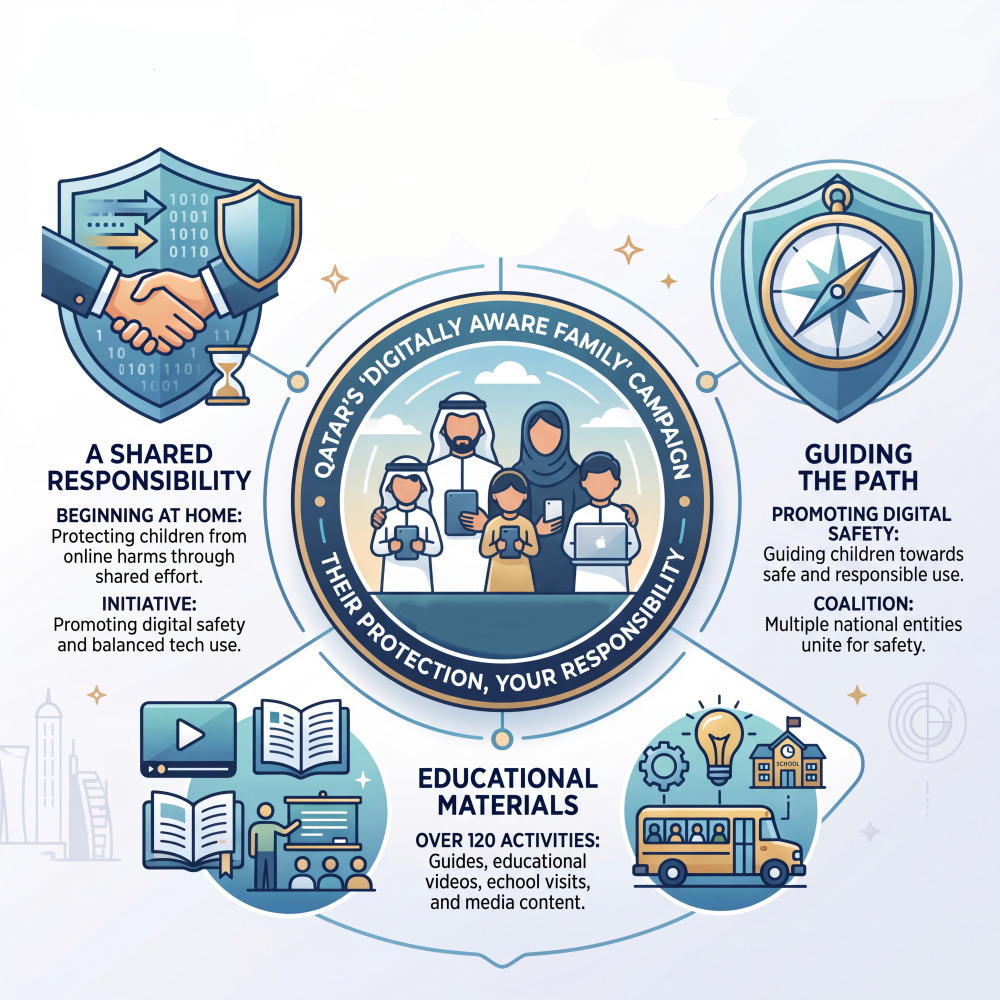 DIFI’s research found that parents often rely on basic strategies such as limiting screen time, taking away devices or distracting children with other activities. While such measures may sometimes be necessary, El Kahlout said they are not sufficient on their own.
A particularly significant finding was that 98.28% of parents surveyed were unaware of local services that could help them address excessive internet use.
“This shows that families are not only facing a digital challenge; they are also facing a support gap,” she said. “Parents need knowledge, confidence, digital literacy and practical tools to enable them to support their children’s digital use.”
The need for a coordinated response was also highlighted at the 2025 WISE 12 Summit, where Qatar Foundation brought together leaders from education, health, youth, sports, culture, technology and other sectors to examine the impact of digital technology on children and young people.
A roundtable session at WISE 12, the biennial summit hosted by Qatar Foundation’s global education initiative WISE, explored how education can remain human-centred in an increasingly AI-influenced world and positioned child and adolescent digital safety as a national priority for advancing youth wellbeing in Qatar and beyond.
Qatar Foundation presented evidence from successful pilot projects in its K-12 schools aimed at reducing digital technology use.
The discussions focused on balancing the opportunities offered by technology with ethical and responsible use, including policies to reduce phone use during school hours, greater family and community engagement, and stronger digital literacy.
The session also emphasised that safeguarding children’s digital wellbeing cannot be the responsibility of governments alone, but private sector, parents, educators and wider communities all have roles to play.
The discussions also come against a growing recognition internationally that digital environments can have a significant influence on young people’s wellbeing. While digital tools provide children and adolescents with opportunities for learning, creativity and social connection, experts have also raised concerns about patterns of use that some young people struggle to control.
The World Health Organization and UNICEF have similarly highlighted the need for countries to strengthen measures to protect young people’s wellbeing as digital technology becomes increasingly integrated into daily life.
The broader national response in Qatar has included the establishment of the Digital Safety Committee for Children and Youth, following a decision approved by the Council of Ministers. The committee is tasked with contributing to the protection of children and young people from challenges posed by technology and supporting work on emerging digital risks, policy development and recommendations for legislative and technical measures.
These efforts complement the “Digitally Aware Family” campaign, which gives families a practical point of reference through eSafety.qa, a dedicated online platform launched by the Ministry to provide reliable information, guidance and support on digital safety.
DIFI’s Families and Technology report, developed in collaboration with Duke University, further illustrates the scale of the transformation. It notes that there were 5.35 billion internet users and 5.04 billion social media users globally in 2023, with people spending an average of 6.4 hours a day online or using technology.
Against this backdrop, the “Digitally Aware Family” campaign places families at the centre of digital safety, not simply as monitors of children’s devices, but as sources of guidance, dialogue and support.
For El Kahlout, effective policy must therefore go beyond creating safer digital environments.
“Policy response should be preventative and protective,” she said, adding that families should be supported in taking on their roles rather than being expected to protect children alone.
She also called for a family-centred and culturally responsive approach that recognises families as partners in prevention, early intervention and long-term wellbeing.
“While safer digital spaces are important, they are not enough,” El Kahlout said. “Children also need positive relationships, stronger families and empowered parents who can guide them with knowledge, confidence and care.”
The campaign comes as Qatar places greater emphasis on equipping families and communities to navigate the changing digital landscape, in line with the Ministry of Social Development and Family’s 2025–2030 strategy, “From Care to Empowerment,” and the human and social development goals of Qatar National Vision 2030.
By bringing together expertise from education, health, cybersecurity, technology and family welfare and by drawing on research from Qatar Foundation and other participating institutions , the national effort seeks to move the conversation beyond simply controlling children’s screen use towards building the knowledge, relationships and support systems that can help young people navigate the digital world safely and responsibly.