By Sidi Mohamed
DOHA: As part of a campaign to promote safety awareness during Ramadan, the Traffic Department will distribute reflective accessories to pedestrians, said a senior Department official.
The Department will give out a greenish yellow reflective bracelet that can be strapped on the arm, to keep motorists aware of the presence of pedestrians at night, especially when they cross roads.
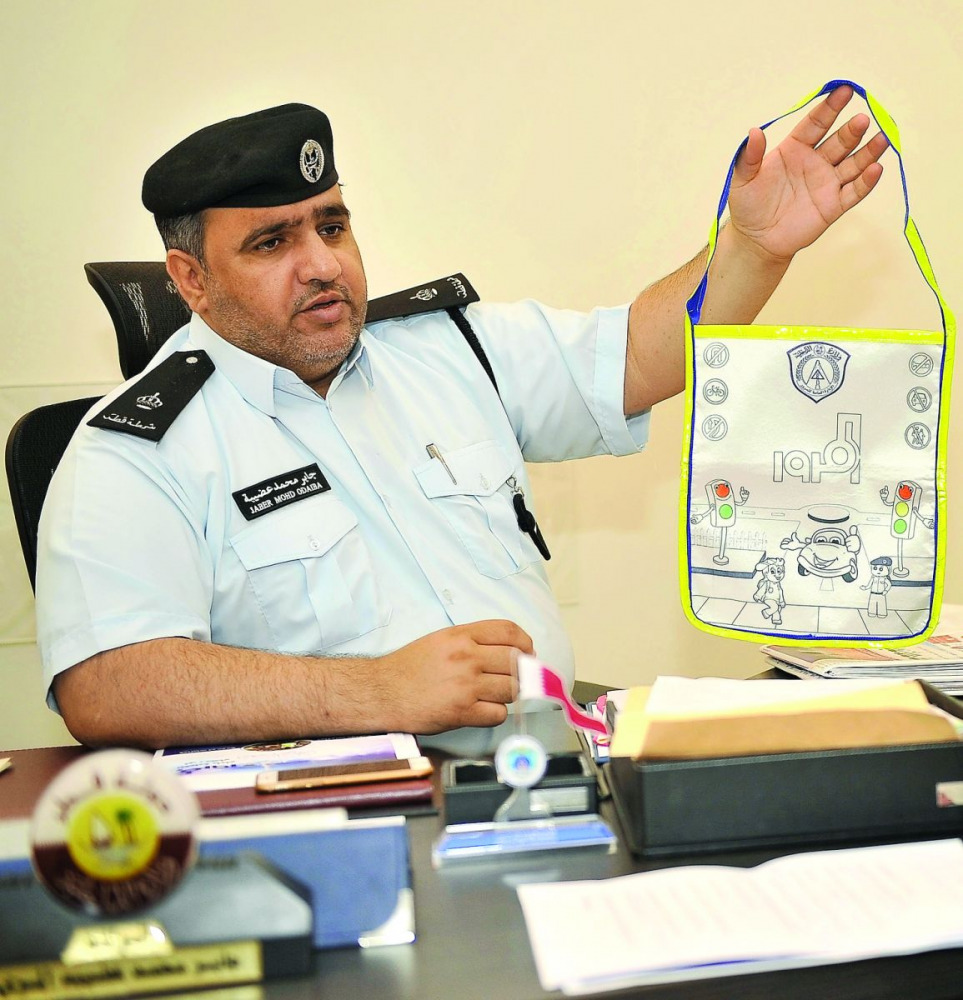
During Ramadan, the Department will also distribute Garangao reflective bags to children as a safety measure against them being knocked down by vehicles during Garangao nights.
“For the first time, we will distribute safety bracelets to pedestrians during Ramadan to protect from accidents. We have also proposed to build more pedestrian bridges at several busy commercial streets and the Doha Corniche, where more accidents take place,” Major Jaber Mohamed Rashid Odaiba, Assistant Director of Media & Traffic Awareness Department told The Peninsula in an interview. He cited Salwa Road, Al Wakra Commercial Street and Grand Hamad Street as places with a higher number of accidents.
The official said that about 5,000 reflective bags will be distributed to children for Garangao. “We will start distributing the bags on the first day of Ramadan from our traffic safety awareness pavilions at major shopping complexes,” he said.
Such pavilions will be set up at Landmark Mall, Villaggio and Al Khor Mall, during alternate weeks of Ramadan. “For Ramadan, we have prepared a traffic safety awareness programme intended for all segments including motorists and pedestrians,” said Odaiba.
During Ramadan, trucks will be banned on Doha roads during peak hours — from 8am to 9.30am, 1.30 pm to 3pm, and 5.30pm to midnight. The ban will be in force from the first day of Ramadan and violators face a fine of QR3,000.
Trucks transporting material to some special projects will be exempted from the rule. “We are distributing 5,000 leaflets in English, Arabic and Urdu to inform truck drivers about the new timing,” said Major Odaiba.
He said the department will deploy traffic patrols in markets and busy commercial streets to detect violations, especially those parking in the wrong way, in front of restaurants, sweetmeat shops and supermarkets.
“Speeding is the most common traffic violation during Ramadan, committed by those rushing to their homes in the pre-Iftar hours. Parking in undesignated places is another common violation,” said Major Odaiba.
The Traffic Department will hold lectures on traffic safety at Iftar gatherings organised by expatriate communities and charities across Qatar.
He said due to increased awareness, the number of traffic accidents this year has decreased by 33 percent compared to last year. According to data released by the Ministry of Interior, the number of deaths due to road accidents declined by 4.8 percent per 100,000 people last year compared to 2014 and major traffic violations declined by 4.7 percent over the past two years.
The Peninsula