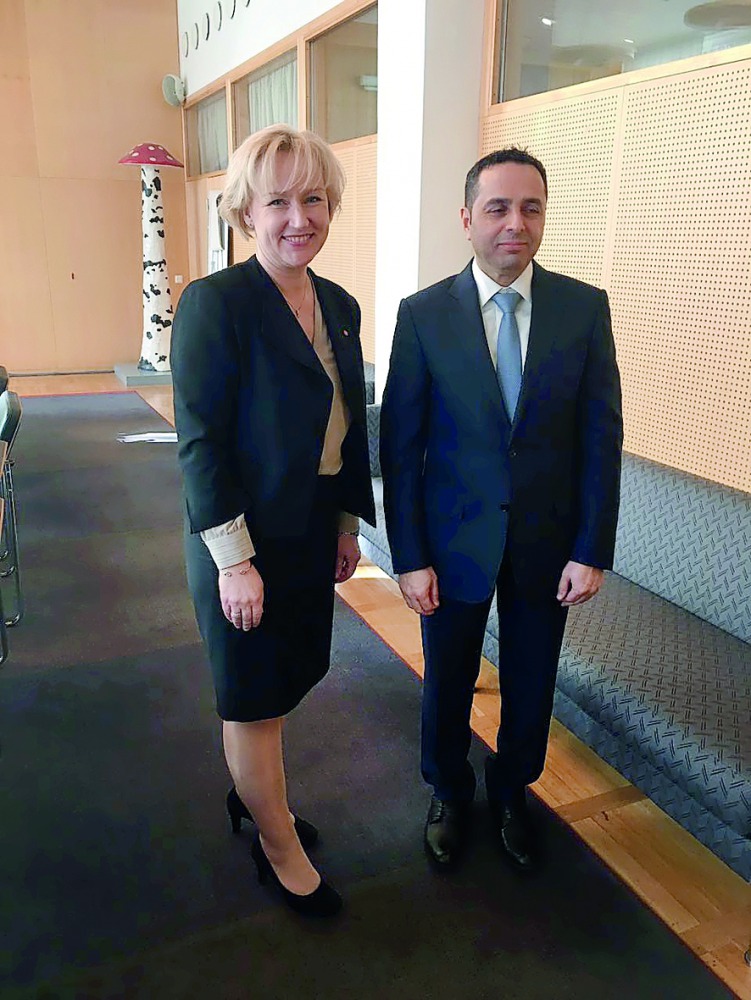
H E Dr Mohammed bin Abdul Wahid Al Hammadi with Helene Hellmark Knutsson, Swedish Minister of Higher Education and Research.
H E Dr Mohammed Bin Abdul Wahid Al-Hammadi, Minister of Education and Higher Education, has visited Sweden with a Qatari delegation for meetings with Swedish ministers and representatives from Swedish universities and research institutes in order to explore and strengthen collaboration between Qatari and Swedish education and research institutions.
Following up on the successful visit of Helene Hellmark Knutsson, Swedish Minister of Higher Education and Research, to Qatar in February 2016, Sweden has through the embassy and various bilateral visits from Sweden consistently worked towards increased bilateral cooperation in research and higher education.
A milestone in this area is being passed this week with the official visit of Dr Mohammed Al-Hammadi, made upon the invitation of Helene Hellmark Knutsson. An MoU designed to encourage increased cooperation in all educational and scientific areas is in process, based upon the principles of equality and mutual respect for the two countries’ legal environments, as well as the mutual protection of intellectual property rights, and expected to be signed in the near future.
Following the Minister in the delegation is Dr Hassan Rashid Al-Derham, President of Qatar University; Dr Ahmad Hasnah, President of Hamad Bin Khalifa University; Dr Egon Toft, Dean of the Medical College at Qatar University; Fawzia Al-Khater, Assistant Undersecretary for Educational Affairs in the Ministry of Education and Higher Education (MoE); Ali Marafi, Director of International Cooperation Affairs Dept. at MoE; and other members of Qatar’s MoE.
A major focus during the trip was on medicine and life sciences, with an important visit to Karolinska Institute (KI): one of the best medical research institutions and university hospitals in the world, and a member of the prestigious Emeri List published by Qatar’s MoE.
While at KI, the Minister and his delegation got the opportunity to study all of its educational programs, paying special attention to KI’s heavy focus on clinical research, and gave a presentation on higher education in Qatar.
Additionally, great importance has been placed on knowledge sharing in the areas of innovation and entrepreneurship, where Sweden is consistently top ranked internationally. During the Minister’s visit to the Royal Institute of Technology, a special presentation was given on translating academic and research results into entrepreneurial business ideas; a specialized skill set that takes a concerted effort to develop, and which is needed in Qatar in its effort to diversify its economy as part of the National Vision 2030.
Dr Al-Hammadi also got the chance to visit the Swedish Institute, the Government of Sweden’s cultural promotion agency, at a very opportune time for both parties. In the last few months the Swedish Institute, together with the Swedish private sector and Lund University, has been developing a tailor made Master’s program for young Qataris focusing on innovation and entrepreneurship in the STEM fields.
The program will be unique in that it will offer unprecedented experience and access with the innovative Swedish private and startup sectors, giving Qatari Master’s students enhanced capabilities to translate their academic achievements into economic engines for Qatar’s future. This initiative was presented to and discussed with Dr Al-Hammadi, in order to find the best solution to helping Qatar reach what it deserves: the best from its citizens.
During a visit to the upper-secondary school Åva Gymnasium, the Minister and his delegation learned about its success in the areas of leadership and vocational training for grades 10-12. Vocational training could play an important role for Qatar in the future, enabling the country to reduce its dependence on foreign, low-skilled labor and increase its human capital.