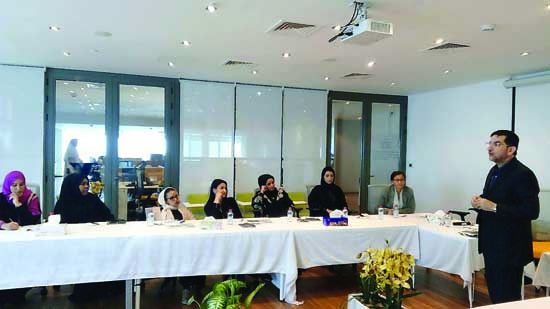
DOHA: Qatar Red Crescent Society (QRCS) has held a lecture for the staff of Doha Centre for Media Freedom.
The lecture, “Human Rights and International Humanitarian Law (IHL): Convergence or Divergence?”, was delivered by Dr Fawzi Oussedik, Head of QRCS International Relations. It reviewed different approaches to the concept of human rights, as well as its historical and modern legal backgrounds.
Dr Oussedik explained the origin of Red Cross and Red Crescent emblems, related to political and historical circumstances that culminated in the creation of these symbols to ensure protection for civilians and medics at times of war.
He highlighted the fundamental principles governing humanitarian interventions, particularly humanity, impartiality, neutrality, voluntary service, and unity. In relation to the IHL-granted protection, he said IHL considers the status of reporters in conflict zones and provides for their safety in the Geneva Conventions of 1949 and their Additional Protocols, which expressly cover journalists in Article 4 A (4) of Geneva Convention (III) and Article 79 of Additional Protocol (I).
These two articles, he emphasized, imply that the protection provided by IHL is absolutely comprehensive. Most importantly, Article 79 of Additional Protocol (I) states that journalists engaged in dangerous professional missions in areas of armed conflict shall enjoy all the rights and protections enjoyed by the civilian population.
In response to questions from the participants, Dr. Oussedik acknowledged that, despite all these protections, the enforcement of international laws is double-standard and fails to obey the spirit of the law in terms of journalist protection.
Dr Oussedik strongly recommended a wider scope of discussion and stricter accountability of involved parties whenever there is a violation against journalists, especially as the numbers of journalist casualties are on the rise.The Peninsula