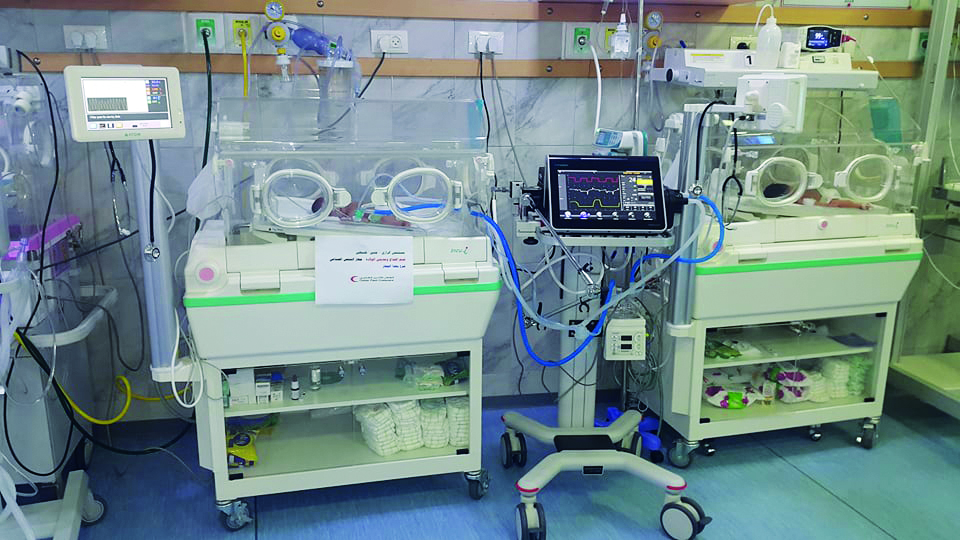
A ventilator for premature babies provided by QRCS to a hospital in West Bay.
DOHA: In support of the health sector of Palestine, Qatar Red Crescent Society (QRCS) has provided medical equipment for the department of premature births at Al Razi Hospitals in Jenin, the West Bank.
At a total cost of $19,627, the new procurement is estimated to help 10,800 beneficiaries. In cooperation between QRCS’s mission in the West Bank and the Al Razi Hospital management, a ventilator was supplied to serve newborn, premature, and in vitro fertilization (IVF) babies, said a release.
The purpose of this project is to reduce the mortality rate among newborn infants, minimize the risk of travel for pregnant women who experience early delivery, and develop the capacity and effectiveness of the department of premature birth intensive and critical care.
QRCS’s mission and Al Razi Hospital worked together to prepare the documentation, set the schedule, determine the specifications, announce a tender, examine the received bids, and award the contract.
It was strictly required that the procured equipment must be of high-quality up to the standards of the Palestine’s Ministry of Health (MOH).
The first case to be served by the new machine was Youssef Zakzouk (4 days), a son of low-income family with eight children from Al Judeida, a village of the Jenin Governorate.
The infant was admitted to a neonatal intensive care unit (NICU) due to severe breathing problems. He was referred from the Dr. Khalil Solaiman Public Hospital, because it had no NUCU. Coming from another governorate posed a serious risk to the baby’s life. After three days inside an NICU, his health condition improved and is now stable.
According to MOH statistics, 99 percent of births in Palestine take place at hospitals or safe birth houses, facilitated by well-trained and specialist medical professionals. Home births constitute only 1 percent of overall births.
Date published by the Palestinian Health Information Center (PHIC) shows that the mortality rate among under-one-year infants is 10.5 out of every 1,000 live births, compared to 10.9 in 2015.
As for the under-five children, the mortality rate is 12.2 out of every 1,000 births, vis-à-vis 13.9 in 2015.The findings of a dead infant forms received from primary health care centers across the West Bank indicate 51.9 percent female deaths and 48.1 percent male deaths. From those deaths, 87.9 percent take place at hospitals, while 12.1 percent take place out of hospitals.
Most of these deaths, the report asserts, are attributed to a lack of departments of neonatal care and a shortage in the number of ventilators for premature babies, particularly the critical cases.