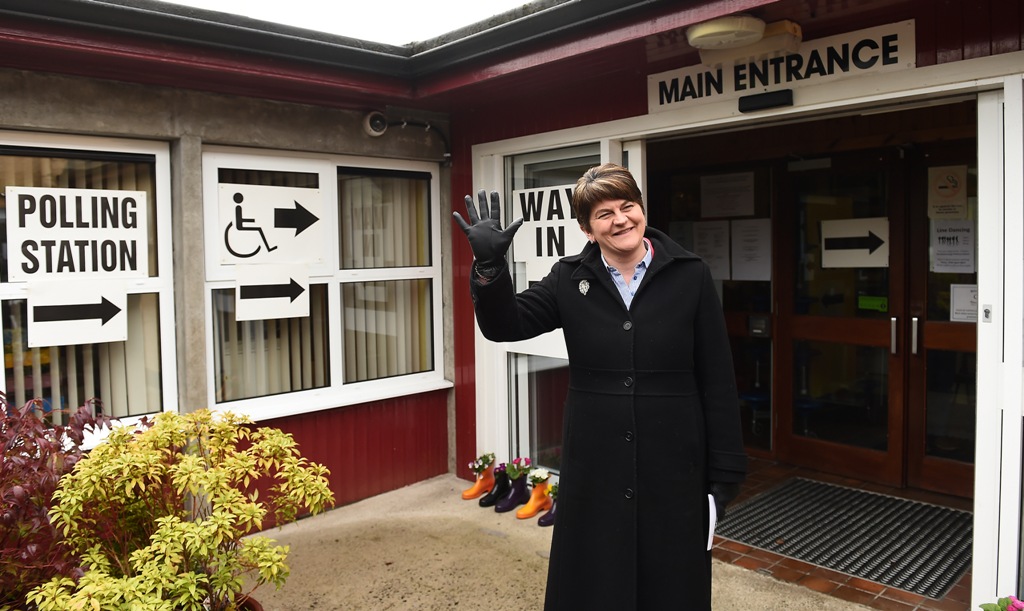
DUP leader Arlene Foster leaves the polling station Brookeborough Primary School after casting her vote in the Northern Ireland Assembly elections on March 2, 2017 in Brookeborough, Northern Ireland. ( Oliver McVeigh - Anadolu Agency )
Belfast: The new Northern Ireland Assembly was taking shape Friday after snap elections that energised voters but could ultimately fail to resolve the deadlock that triggered them.
Tensions boiled over in January between the two parties in the power-sharing executive, collapsing the administration in the semi-autonomous British province.
But while early results showed that voters had surged to the polls, the outcome was likely to leave the Democratic Unionist Party and Sinn Fein as the two biggest parties.
If Sinn Fein still refuse to work with the DUP's leader Arlene Foster, who was Northern Ireland's first minister, then the assembly could be suspended and the province fully governed from London.
The first count results put the pro-British DUP almost neck-and-neck with Irish Republicans Sinn Fein, who appeared to have made solid gains since last year's vote.
The Protestant, conservative DUP was on 28.1 percent, down 1.1 percent from the May 2016 election. The Catholic, socialist Sinn Fein was on 27.9 percent, a rise of 3.9 percent.
Foster, who won re-election in her Fermanagh and South Tyrone seat, conceded to Sky News that it "looks like it has been a very good day for Sinn Fein".
With 54 out of 90 seats filled -- Sinn Fein had 23, the DUP 14, six went to the cross-community Alliance Party and other groups took 11.
Ulster Unionist leader Mike Nesbit announced he would quit as his party looked set for a dismal result, saying the "buck stops here".
Full results are not expected until Saturday due to the complexities of the proportional representation voting system.
Turnout figures from Thursday's polls showed the election got voters motivated.
The Electoral Office for Northern Ireland said 812,783 votes were cast, meaning a 64.8 percent turnout -- up 9.9 percent from May 2016.
It was the highest turnout since the first election after 1998 peace accords that re-established devolved government in Northern Ireland.
Sinn Fein buoyant
The election was triggered when Sinn Fein's Martin McGuinness quit as deputy first minister over a costly, bungled green energy subsidy scheme rolled out by first minister Foster when she was economy minister.
Sinn Fein wanted her to step aside during an investigation and say they will not enter government if the DUP nominates her to become first minister again, or deputy first minister if the DUP finishes second.
Michelle O'Neill, who took over from the retiring McGuinness as Sinn Fein's leader in Northern Ireland, was elected on the first count in her constituency.
The parties have three weeks to strike some sort of deal, otherwise the Belfast legislature is likely to be suspended and its powers returned to London.
"After a brutal and divisive campaign there is no real expectation that the institutions will be up and running in the next few weeks," The Irish News newspaper said Friday in its editorial.
Brexit factor
Besides the energy scheme scandal, old wounds between the two communities were also reopened by the United Kingdom's vote in June to leave the European Union, which the DUP supported but Sinn Fein opposed.
Britain has signalled its intention to leave the EU's customs union after Brexit, raising fears of a new hard border between Northern Ireland and the Republic of Ireland, which will remain in the EU.
London, Dublin and Brussels have all insisted they want to keep free movement across the Irish border -- an arrangement dating from its creation in the 1920s.
But the possibility of a return to checkpoints has stirred memories of The Troubles, three decades of strife in Northern Ireland, in which more than 3,500 people were killed.