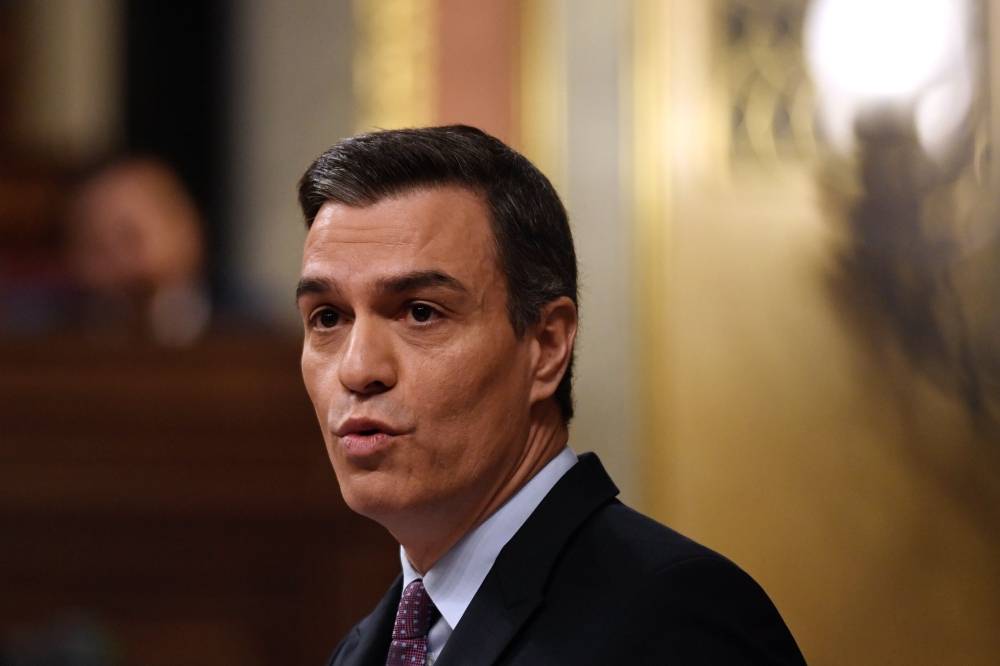
Spanish caretaker prime minister, socialist Pedro Sanchez, delivers a speech during the first day of a parliamentary investiture debate to vote for a premier at the Spanish Congress (Las Cortes) in Madrid on January 4, 2020. / AFP / PIERRE-PHILIPPE MARCOU
Spain’s political deadlock looks set to end as acting Prime Minister Pedro Sanchez prepares for an investiture debate Saturday with the negotiated blessing of a Catalan separatist party.
Sanchez, 47, will set out his pitch to Spaniards from 9 a.m. at the parliament in Madrid. While he doesn’t have the absolute majority he needs to take office at the first ballot of lawmakers on Sunday, he’s set to confirm a new term on Tuesday when a simple majority will be enough.
The separatists of Esquerra Republicana agreed this week to abstain in the second round to allow Sanchez to get through with the backing of the anti-austerity party Podemos.
Even so, the path to power has proved rocky right up to the last minute. Late on Friday, Spain’s electoral board jurists voted to strip Joaquim Torra, Catalonia’s separatist president, of his status as regional deputy. Esquerra pledged support for him and the Spanish flag was briefly taken down from the regional government building in Barcelona as separatist supporters voiced their outrage.
Spain has been in political limbo since Sanchez dissolved parliament to spark the first of two inconclusive general elections in April. With the parliament divided among five major parties and a host of smaller regional forces after a second vote in November, Sanchez turned to Esquerra to make the numbers work in his favor after striking a coalition deal with Podemos.
The pact represents the latest effort to fix the political machinery that jammed in Spain in 2015 when the former People’s Party Premier Mariano Rajoy lost his parliamentary majority in the wake of Spain’s financial crisis. Sanchez claimed his first term in 2018 by ousting Rajoy with a no-confidence vote but wasn’t able to forge a stable majority.
A failed bid by Catalan pro-independence parties to split the region from Spain in 2017 opened up additional rifts in the political landscape as forces including the PP pressed for a clampdown while others including Podemos sought dialogue with the separatists. With many Socialist voters hostile to the Catalans’ demands, Sanchez faces a difficult balancing act as he seeks to govern with support from Esquerra and Podemos.
The decision by Spain’s electoral board to potentially oust Torra for defying court orders added to the atmosphere of tension. Torra’s lawyers have said they will challenge the board’s authority, but the move nevertheless increases the possibility of snap elections in the region and a fight for separatist voters between Esquerra and Torra’s rival group.
Assuming no more last-minute hiccups, Sanchez will form the first coalition government since the 1936-1939 Civil War. His pact with Podemos commits him to tax increases for the highest earners and large companies, a higher minimum wage and tighter protection for workers, rolling back some of the labor reforms enacted in 2012 at the height of a financial crisis.
It also opens the door for dialogue with Catalan separatists bent on seeking to break up Spain. The deal struck with Esquerra recognizes that the Catalan dispute is a political rather than a legal question, though Sanchez has repeatedly ruled out the possibility of an official referendum on Catalan independence.
All the same, that has provoked the fury of the PP and the Spanish nationalists of Vox, who accuse Sanchez of betraying his country. Socialist officials have taken pains to point out that the pact is aimed at unblocking political channels with the separatists and that they will do nothing against Spain’s constitution.
A priority for Sanchez will be to protect an economy that’s starting to lose momentum, even though it continues to outperform most European peers. According to the Bank of Spain, economic growth will continue to slow over the next three years as global tensions remains a threat to the outlook.
Even though Sanchez seems poised to be able to stay on as prime minister, his ability to influence events may in fact be limited by his lack of a majority.
His deal with Esquerra, for instance, includes no commitment to back a new budget. Sanchez says he’ll have to negotiate "law by law” and one day at a time to enact the progressive policies he says Spaniards endorsed in November’s election result.