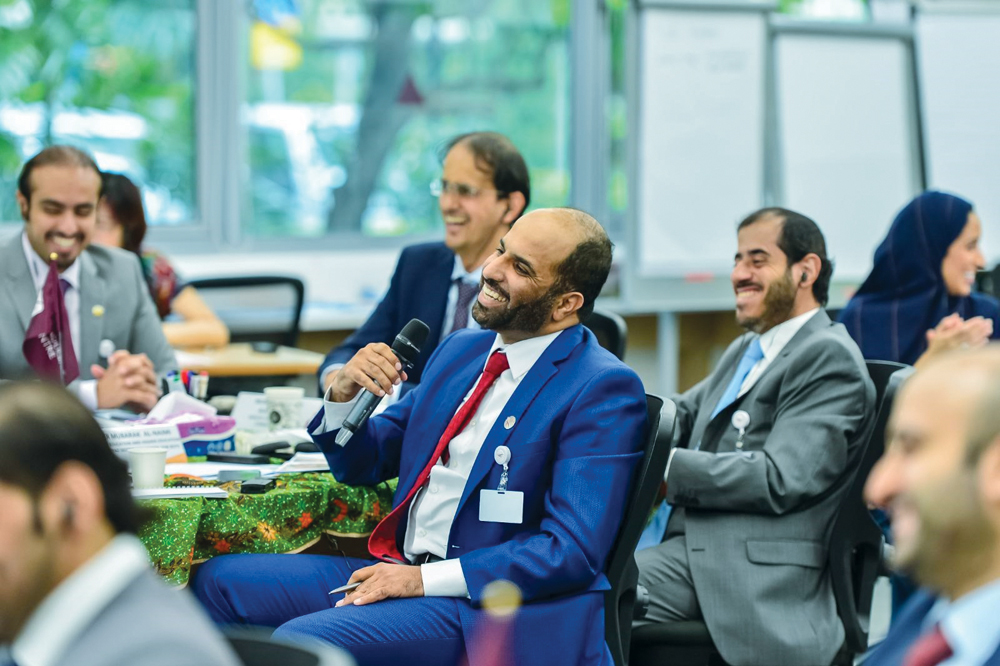
QLC’s Government Leaders Program participants during the Learning Journey, in Singapore.
Qatar Leadership Centre’s (QLC) Government Leaders Program participants recently completed the 2019 Learning Journey in Singapore. Leading experts in Singapore from a range of institutions shared insights on the policy and practice behind the successful national model, with a focus on industrial innovation, economic development, and education and health policy.
Sheikh Dr Abdulla bin Ali Al Thani, Managing Director and Member of the Board of Directors of QLC, said that Singapore’s model of self-sufficiency is directly relevant for QLC participants, who can apply its lessons in their work with Qatari companies and government institutions.
Dr Abdulla highlighted the significance of Learning Journeys as “an integral part of the National Leadership Program, with a critical role in strengthening participants’ capabilities by providing valuable, first-hand learning experiences.”
QLC’s partner for the Learning Journey, the Civil Service College Singapore, is the center of learning for government employees; it is part of the Public Service Division, located within the Prime Minister’s Office. During their study trip to Singapore, the QLC delegation visited leading academic and research institutions and government entities to explore the pivotal role of government leadership in driving a strong economy.
The Government Leaders Program is one of three National Leadership Programs at QLC. Its focus is on supporting the continued development of Qatar’s public sector, reflecting global best practice and the goals of Qatar National Vision 2030.
Participants from QLC’s National Leadership Programs travel each year to key countries to learn about social and economic policy through a range of activities, including field visits, workshops, meetings and lectures.
In Singapore, QLC participants met with Tina Tan, Director of Civil Service College International, who discussed the Fourth Industrial Revolution and challenges posed by emerging technologies, such as artificial intelligence and virtual reality, in public service delivery.
Dr Toh Boon Kwan, Senior Research Fellow at the Institute for Governance and Policy, analysed the role of leaders in shaping governance and policy-making and shared advice on building collaborative partnerships. He also outlined Singapore’s strategy on economic development and its approach to strengthening its manufacturing sector, critical factors in national development.
During their visit to the Institute of Technical Education in Singapore, participants learned how national educational policies can build social cohesion and national identity while also supporting economic development. The Institute briefed participants on their holistic strategy to combat potential external threats, based on six pillars – military, social, civil, economic, psychological, and digital. Speakers emphasised the importance of self-sufficiency gained through long-term planning, highlighting food security and how Singapore both diversified sources of food imports and bolstered local food production.
At the end of the Learning Journey, the Public Utilities Board hosted the participants at Marina Dam to illustrate strategies designed to achieve self-sufficiency and sustainability in water management policies.