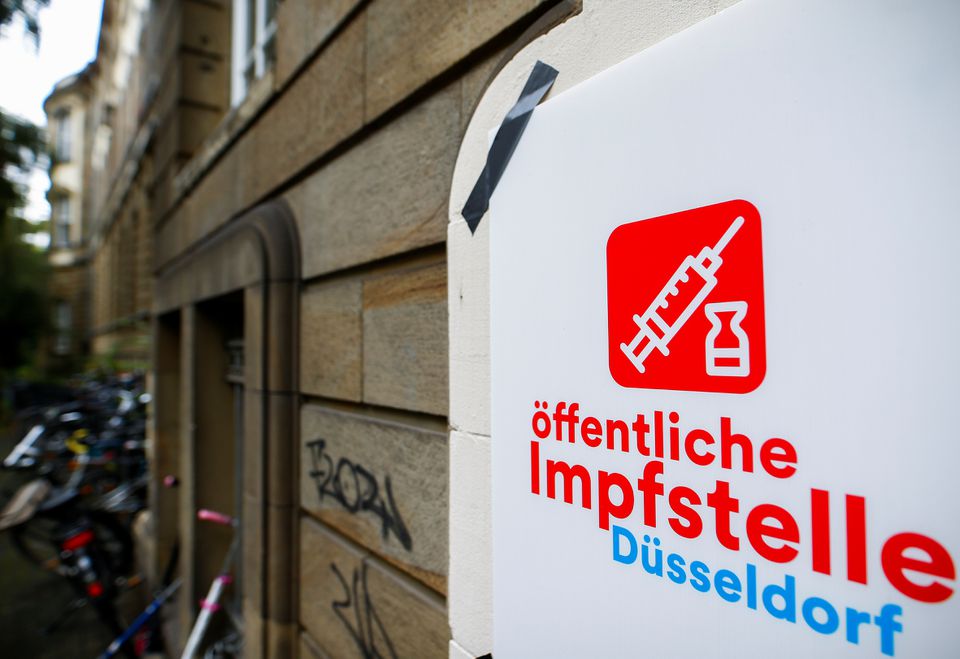
File photo: A sign reading "Pubic vaccination point" is seen at the Leibniz-Montessori secondary school, amid the COVID-19 pandemic, in Dusseldorf, Germany, August 27, 2021. (REUTERS/Thilo Schmuelgen)
Germany’s governing coalition has ruled out lockdowns, curfews and closing schools this fall and winter in its latest update of pandemic strategy designed to deal with an expected resurgence of Covid-19 infections.
Chancellor Olaf Scholz’s three-party alliance published a seven-point plan on Wednesday -- to take effect on Oct. 1 -- which includes ramping up inoculation with new vaccines, rolling out a so-called "pandemic radar” with data updated on a daily basis, a testing regime and special protection measures for hospitals and care homes.
"Restrictions on freedom may only be imposed if they are necessary,” Justice Minister Marco Buschmann, a member of the business-friendly Free Democrats, said in an emailed statement. "Our concept therefore rejects lockdowns and curfews. Instead, we’re relying on measures that are both effective and reasonable.”
Although the number of new Covid infections is currently falling, Health Minister Karl Lauterbach has repeatedly warned that intensive-care units could come under pressure again as cases rise heading into winter, particularly among the elderly.
The disease has killed more than 144,000 people in Germany, with another 210 deaths reported on Wednesday, according to the RKI public-health institute.
Buschmann’s FDP, in particular, was keen to avoid a repeat of the lockdowns that hammered Europe’s biggest economy earlier in the pandemic, pushing many businesses into bankruptcy despite generous government aid to limit the damage.
Under the new rules, masks will be mandatory in hospitals and care facilities, as well as for people using long-distance transport and taking flights. The 16 German regions will have the power to enforce mask-wearing in indoor public spaces and impose other restrictions in virus hotspots.
"Germany should be better prepared for the next coronavirus winter than in previous years,” Lauterbach, a Harvard-trained epidemiologist, said by email.