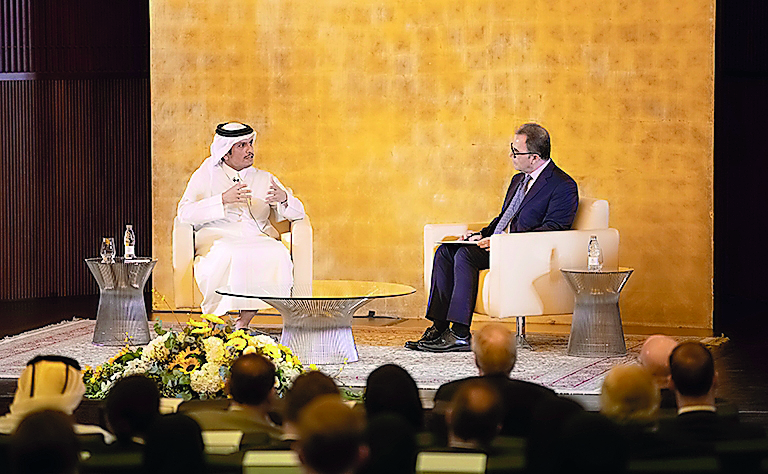
Deputy Prime Minister and Minister of Foreign Affairs H E Sheikh Mohamed bin Abdulrahman Al Thani at the open conversation hosted by Georgetown University yesterday.
Doha: Deputy Prime Minister and Minister of Foreign Affairs H E Sheikh Mohamed bin Abdulrahman Al Thani has said that the unjust blockade imposed on the State of Qatar is a turning point for geopolitics in the region as a whole, stressing that the only way to move forward is the negotiating table.
“This (negotiation) will happen only when these states realise that the blockade will not be the way to achieve their goals or to remove their fears regardless of their definition, “ he said.
In an open dialogue hosted by Georgetown University yesterday, H E the Minister spoke about the priorities of foreign policy and national economic policies of Qatar and the future of Qatari relations with other countries.
Also on the successful strategies adopted by the State to ensure national security and ease the human sufferings resulted from the blockade.
The Deputy Prime Minister said: “We would not have not been able to meet the challenges and overcome them without the support we received at the domestic level; from citizens and residents and we appreciate the valuable contributions made by our diverse society and the role it continues to play in the future development of the country. “
The Deputy Prime Minister added: “We are proud of Georgetown University in Qatar, which has graduated more than 440 graduates so far, including twelve graduates working for us at the foreign ministry and they are part of the team that worked during the blockade. We are also proud of the diversity of Georgetown University campus in Qatar, which currently houses more than 50 different nationalities.”
In response to questions from the audience about the future of the Gulf Cooperation Council (GCC), he stressed the importance of the GCC as a framework for regional cooperation and coexistence.
He also answered a number of questions regarding the future of the energy sector, seeking new security arrangements based on cooperation, and the impact of Georgetown’s international curriculum on building human capital in Qatar.
The Minister of Foreign Affairs also spoke about the Qatar Fund For Development (QFFD), an institution dedicated to improve the lives of peoples and communities around the world saying, “Last year, the Qatar Fund For Development provided assistance to 71 countries and provided grants amounting to about $585m, 30% of it was allocated to education.”
“If we want to achieve stability in the future, we should invest in tools that enable people to achieve that stability,” he said.
The event was attended by Dean of Georgetown University in Washington, Dr. Robert Groves, and a large number of Georgetown University students, faculty and staff members and members of the diplomatic mission.