DOHA: One of the world’s most pioneering diabetes researchers discussed latest developments in treatments for the disease in the latest instalment of Weill Cornell Medicine – Qatar’s (WCM-Q) Grand Rounds.
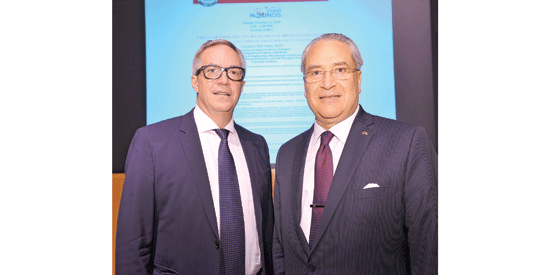
Dr Camillo Ricordi, Director, Diabetes Research Institute and Cell Transplant Programme, University of Miami, visited WCM-Q to explain how patients with type-1 diabetes had been able to stop taking insulin following ‘islet cells’ transplant surgery.
Islet cells are found in the pancreas and are responsible for releasing insulin to control blood sugar levels. People with type-1 diabetes are unable to produce insulin because their immune system has malfunctioned and destroyed their islet cells.
The Grand Rounds, developed by WCM-Q’s Division of Continuing Professional Development, provides a platform for experts to engage with healthcare professionals in the community to disseminate knowledge of latest developments in medical technology, research and best practice.
The activity is accredited through the joint providership of Weill Cornell Medicine and WCM-Q.
Speaking at WCM-Q to an audience of physicians, researchers, students and healthcare professionals, Dr Ricordi said, “The successful transplant of islet cells has been encouraging but had limitations, including the site of transplant.
“In fact, islet are generally transplanted in the liver, enabling them to produce insulin and freeing the patient from the need to constantly administer insulin. However, the liver has disadvantages as a transplant site and many transplanted cells do not survive after intra-hepatic infusion.”
He reported successful islet transplant using a bio-engineered mini-endocrine pancreas transplanted in the abdominal cavity, which represents a much more physiologic technique as it more closely mimics normal human physiology.
Dr Ricordi said, “This represents a great success, but there are difficulties to be overcome because patients must be treated with immunosuppressant drugs after the procedure to prevent rejection of the transplanted cells, and this carries a risk of undesirable side-effects.” To try to eliminate the problem, Dr Ricordi and others are working on technologies that are at the forefront of scientific discovery. One method utilises nanotechnology and conformal coating technology to create incredibly small ‘shells’ that protect each transplanted islet from being destroyed by the immune system, while allowing them to release insulin.
Another research strand is investigating the possibility of converting a patient’s precursor cells found in several tissues, including the pancreas, into insulin-producing cells, removing the need for immunosuppressant drugs.
The Peninsula