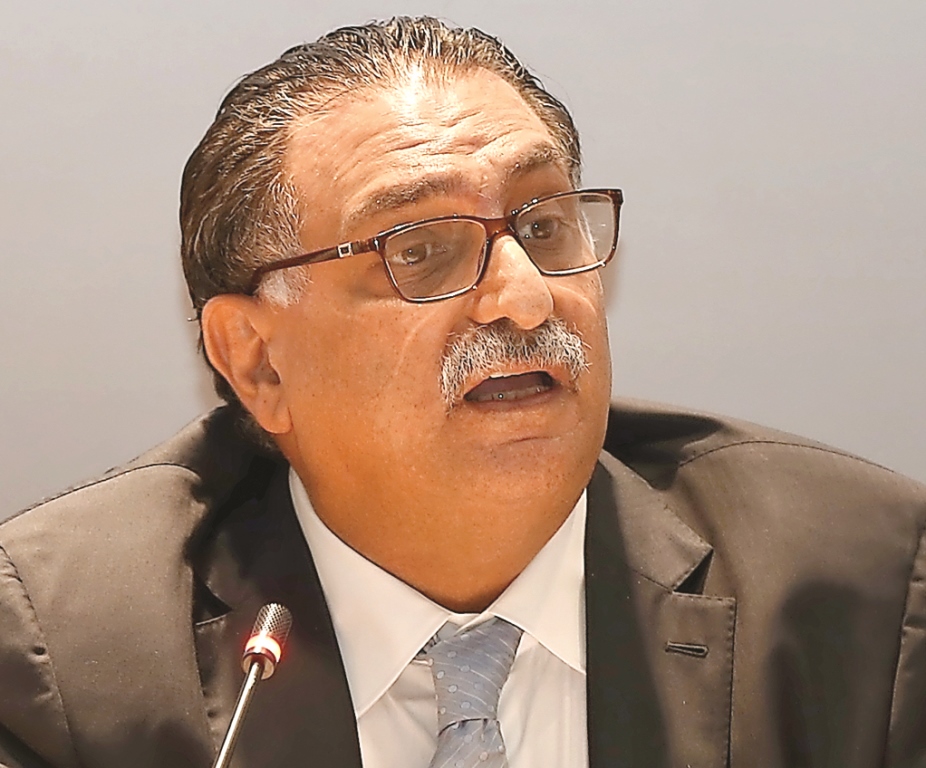
Azmi Bishara speaking at the Fifth Annual Conference on Democratic Transition held yesterday at the Doha Institute for Graduate Studies.
DOHA: No army is away from politics as long as they deal with war, defence and security as these issues are related to political, social and economic stability.
Army has relations with politics in both democratic and non-democratic states but there is concern about its involvement in power and in the decision-making process, said Azmi Bishara, the General Director of the Arab Center for Research and Policy Studies in his opening speech at the Fifth Annual Conference on Democratic Transition held yesterday at the Doha Institute for Graduate Studies.
The theme of the three-day conference is “The army and politics during the transition to democracy” and it brought together over sixty researchers from across the region, universities and research institutions and disciplines.
In his keynote speech, Bishara stressed that «no military commanders overthrow regimes to let others rule” and many people wrongly think that military coup is in their benefit. The army’s relations with politics is not unique to Arab countries and it has to do with the Arab state structure and development, he added.
The experience of military coups in Arab countries showed that the coups were mostly internally designed to “overthrow the former regime to safeguard the interests of its coterie” Bishara said.
From the military experience in Turkey and Egypt, "we can learn that the military establishes coalition with civil and political powers to impose themselves on the societies."
Furthermore, armies in this region have played a role in the establishment of the modern states, and accelerated the transition process, and in some cases led the transition when there was instability, weakness of institutions and politicians.
There is a connection between revolutions and military coups in this region and that is why coups have been seen as a means of bringing social and economical changes. Bishara highlighted that many Arab leaders admired to some extent the Kemal Ataturk model to modernize societies.
It is difficult to set up a formula for the relations between army and politics due to differences of historical context, societies, faiths and the social structure of the armies, Bishara stressed. However, there are several common features such as the military service was the way for peasants to achieve social mobility along to establishment of loyalty to the profession and friendship of individuals which often used to form commanders of a coup.
Another factor is the political and ideological friction among members of the army after they take power or when they seek to take power. The Cold War encouraged Arab armies to play political roles and each of the superpowers then supported regimes with military backgrounds.
The Academic Committee of the Arab Center for Research and Policy Studies said that over 100 authors submitted papers for consideration in the panel discussions, while a total of 35 papers were eventually accepted.
The first session discussed a theoretical examination of the relationship between the military and the political authorities in the Arab world, the historical development of that relationship, and an understanding of the role which military plays in the transition to democracy, including a study of military coups as a political process.
The second session highlighted some experiences of military direct interventions to take power through coups. The third session discussed the establishment of the Arab modern military institutions and development of its political roles.
Alongside these, the conference will have a special panel dedicated to the study of the failed coup in Turkey and its repercussions for Turkey and the wider world.