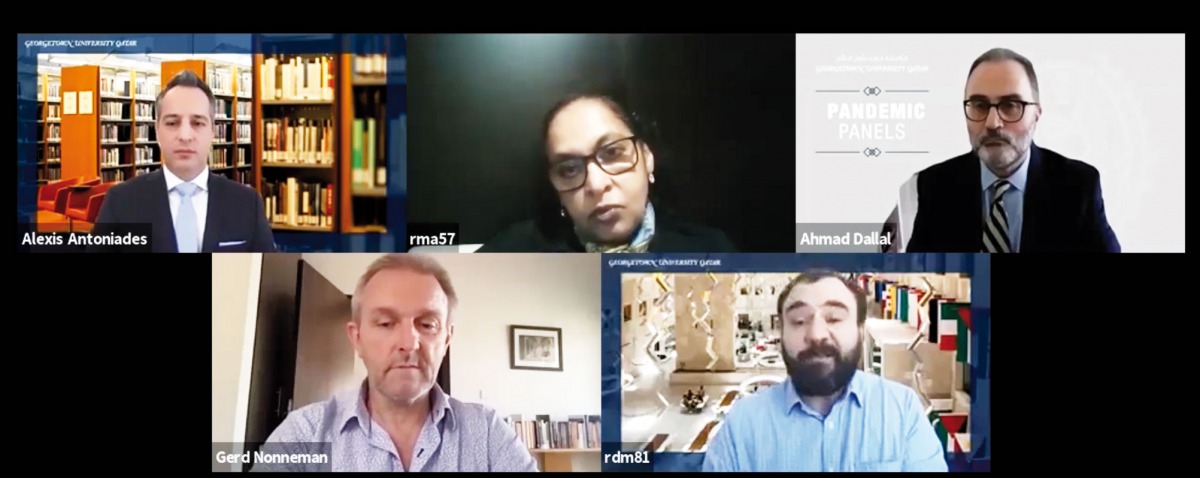
Academics and experts during the online panel discussion on states' responses to the COVID-19 pandemic, organised by QF partner Georgetown University in Qatar.
Qatar’s response to the pandemic has inspired a high level of confidence in the government, and resulted in the social unification of a community working together to fight the effects of the crisis.
This analysis was shared in the third instalment of QF partner Georgetown University in Qatar’s Pandemic Panels, a three part series of virtual discussions featuring GU-Q faculty experts and moderated by the Dean, Dr. Ahmad Dallal.
The third and final panel investigated the types of global pressures that influence regional responses and how these set the nations of the Gulf, Middle East, and North Africa on a path to pandemic recovery.
Panellists included Dr. Rogaia Abusharaf, Professor of Anthropology; Dr. Alexis Antoniades, Professor and Director of International Economics; Dr. Rory Miller, Professor of Government; and Dr. Gerd Nonneman, Professor of International Relations and Gulf Studies.
Dr. Rory Miller, who teaches courses on small state security at GU-Q, provided context for Qatar’s pandemic response, noting that small states like Qatar are better equipped to quickly build social cohesion and institutions, and make rapid decisions.
“You see all of these factors coming into play in Qatar’s response.” So despite the number of cases per million, “there’s still a confidence in all levels of society that they have the structures in place and the decisionmaking capabilities to deal with it.” While some states would be able to emerge from the crisis in better shape than others, he concluded, “there are few opportunities to come out of this in a positive light.”
Dr. Gerd Nonneman focused on the role and future of the GCC, one of his areas of expertise, which continues to be fractured under the blockade, saying: “It would be very important, ideally, to have a coherent GCC framework to have a collective response economically and in terms of health arrangements and logistics and food security, but there isn’t.”
A specialist on the countries that comprise the Indian Ocean rim, Dr. Rogaia Abusharaf discussed the ways the crisis has exposed the fragility of neglected health systems and spurred regional political action, saying: “You will see cooperation and competition highlighted and amplified as a result of the pandemic.”
Touching on the gender inequalities and domestic violence reported by multiple agencies working on women’s issues, Dr. Abusharaf noted that “the pandemic didn’t introduce such domestic violence, but exacerbated it.”
In his analysis of the future outlook of the region’s economies, economics expert Dr. Antoniades described concerns over the recovery timeline as “the trillion dollar question".
In a post-crisis world, he said, markets would see major innovations inspired by changes in consumer behaviour. “How states are dealing with the crisis now will have a long lasting impact on the ground well after the corona crisis ends.”