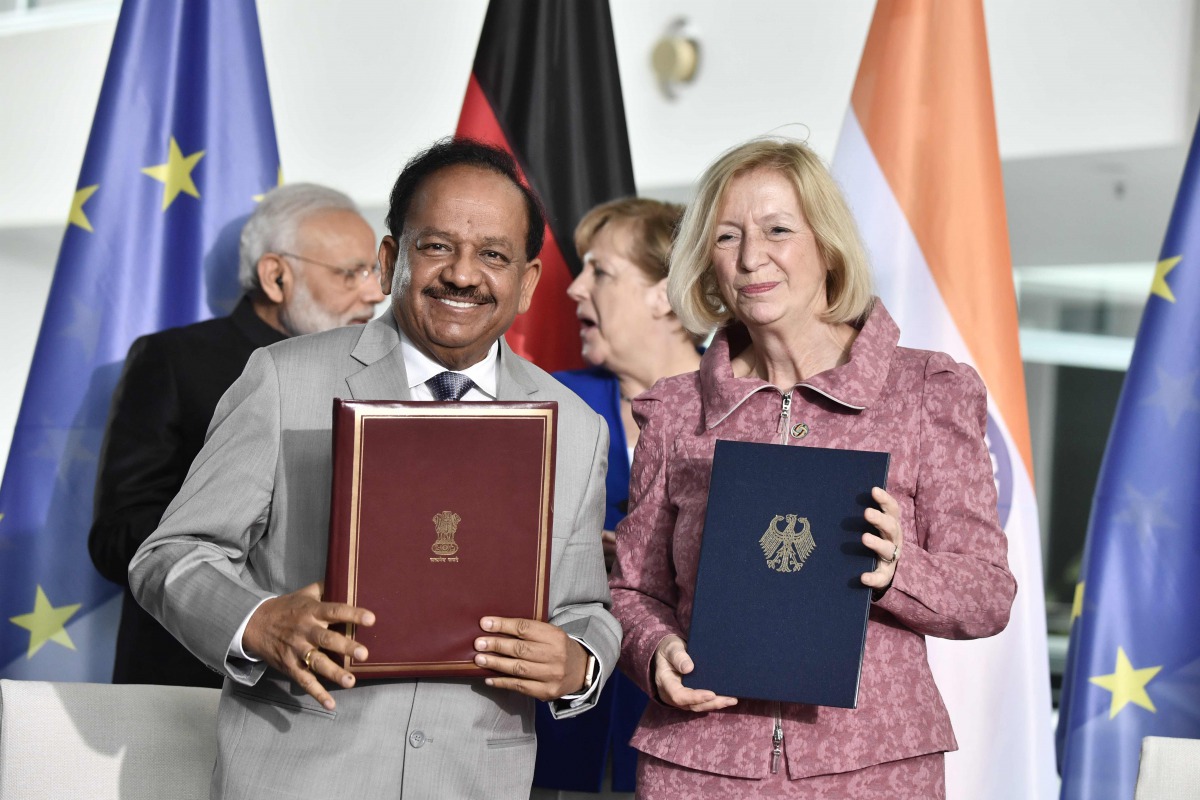
Minister for Science and Technology and Earth Science, Harsh Vardhan (Front L) and German Education and Research Minister, Johanna Wanka hold documents after they signed contracts as Indian Prime Minister Narendra Modi (Back L) and German Chancellor Angel
New Delhi: India's environment minister Friday said his country is committed to the Paris climate accord irrespective of the position of other nations, after the US announced plans to pull out of the global pact.
"As far as the Paris accord is concerned... our government is committed irrespective of the stand of anyone, anywhere in the world," Harsh Vardhan told reporters.
President Donald Trump announced Thursday that the United States will withdraw from the Paris climate accord and accused China and India of benefitting from the deal at the expense of the US.
His announcement triggered a furious backlash from global leaders, including the Chinese premier who said Beijing "will steadfastly" implement the Paris climate pact.
During a visit to Russia Friday Indian Prime Minister Narendra Modi reiterated his country's commitment to reduce emissions.
"Paris or no Paris, our conviction and our traditions say that we cannot snatch the rights of our future generations," said Modi while on stage with Russian President Vladimir Putin at the St Petersburg economic forum.
The prime minister, however, refused to directly comment on Trump's decision to ditch the Paris agreement.
India, which accounts for 4.1 percent of global emissions but is the world's third largest carbon-emitting country, has not agreed to cap or cut its emissions outright like other countries.
Instead Delhi says it will increase its use of green energy and reduce its emissions relative to its gross domestic product by up to 35 percent by 2030 from 2005 levels -- meaning emissions will continue to grow but at a slower rate.
India has long insisted that it needs to keep burning cheap and plentiful coal to cut crippling blackouts and bring electricity to millions of poor residents living off the grid.
In his speech Trump repeatedly painted the pact as a deal that failed to "put America first" and was too lenient on economic rivals China, India and Europe.
China and the US, the world's first and second biggest polluters, respectively, are together responsible for some 40 percent of the world's emissions.
India is investing billions in clean energy infrastructure to cut down on emissions as it battles choking pollution.