By Mohammed Osman
Extremism and terrorism cannot be combated through Isamo-phobia or misrepresenting a certain faith and promoting hatred discourses, but rather by building bridges of cooperation, enter-faith and cultural dialogues and looking for common human heritages and values senior official said.
What happened in Paris and Brussels were criminal acts by the terrorists that all faiths strongly denounce and no conscience or moral accept them because they were odd acts against humanity, said the Chairman of the National Human Rights Committee (NHRC) Dr. Ali bin Samikh Al Marri, addressing audience at the opening ceremony of Arab calligraphy exhibition in Paris.

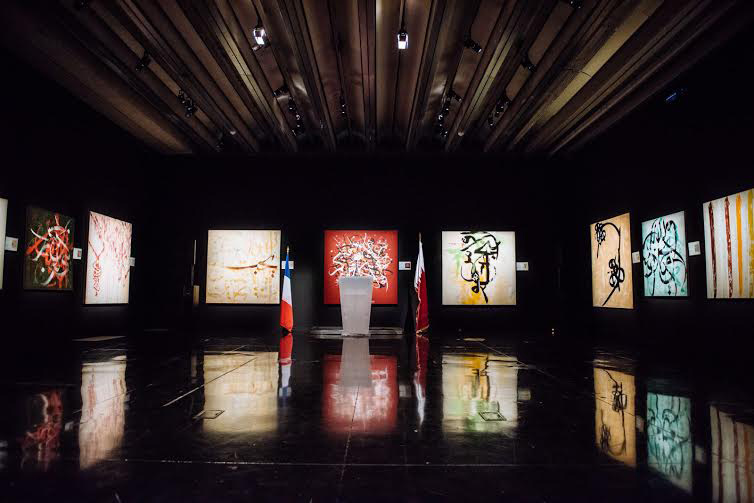
Arab World Institute in Paris hosted Arabic Calligraphy between April 25 and 28 exhibition addressing human rights in Islamic culture.
The exhibition was organised by the Qatar National Human Right Committee (NHRC) in collaboration with Qatar embassy in Paris. The exhibition was opened by the Chairman of the NHRC Dr. Ali bin Samikh Al Marri along with Jack Lang, France’s former Minister of Culture and Qatari ambassador to France Sheikh Mishaal bin Hamad Al Thani, and director of the Arab Institute and a number of prominent politicians, artists, sports, and accredited diplomats in Paris.
The calligraphy exhibition considered quantum leap in efforts countering the anti-Islam campaigns and misrepresentation of Islamic teachings under the influence of terrorist’s attacks in Paris and Brussels. Art representing the spirit of Islam and its respects to human right and dignity using the art of calligraphy obtained momentum in the exhibition.
The exhibition attracted considerable number of different segments of French society, Europeans and diplomats who lauded the content of the exhibition which underlined human right issue in artistic works in which verses from the Quran and the Prophet’s (PBUH) Hadith are used.
The first day of the exhibition witnessed presences of representatives of Arab diplomatic missions, other diplomats and representatives of international organisations and civil societies.
The first edition of this exhibition held in Geneva last February was successful and this also attracted huge number of visitors as the event represent significant response to the fierce campaigns being carried out by some groups working anti-Islam and Muslims. The exhibition explains that our religion is based on values of tolerance, justice and principle of morals and respect to human rights, said Qatari Consul in France Sultan Al Dawsari.
Through the upscale arts of Arabic Calligraphy, the perceptions of human rights in Islamic culture was clearly reflected in verses and Hadith used in the art work, he added.
It is a great job to see issues of human rights and their positions in Islam have been placed through art works, as Islam emphasized these rights before centuries preceding all international declarations and agreements said, Dr. Yusuf Ubaidan, Vice Chairman of NHRC. It is good to use art works to explain the facts that Islam is religion of tolerance, and reject all forms of terrorism and extremism.
For his part Jack Lang president of Arab Institute said this event indicates that Qatar is keen to the mission of the institute’s which is playing the role of cultural bridge between France and the Arab World. The exhibition made it clear that Islam is free of cultural allegations being made by segments of Western societies to defame the substance of Islam’s global mission.
Jang pointed out that, “as a French citizen, he thinks that the exhibition offered noble mission at the right time”. Qatar is known for taking such strong innovative initiatives, and the portraits included upscale arts along with high valued contents reflecting Islam’s value and principles that respects human rights with great comparison between the international conventions on human rights and these priniciples.
On the other hand, representatives of the diplomatic missions in Paris who visited the exhibition talked about the targets and possible achievements addressing the negative impacts of campaigns misrepresenting Islam in the Western communities. In this regard the permanent representative of Kuwait in the United Nations Educational, Scientific and Cultural Organisation UNESCO, Dr. Mishaal Jawhar said the content of this Qatari exhibition reflects the principle of human rights in Islam citing verses from the Quran and Hadith through beautiful Arabic calligraphy and this made it clear for the whole world how far are the terrorists and extremists from the principles and values of Islam.
The good thing in this exhibition is that it focused on Islamic culture and its relation to human rights using art of calligraphy providing with evidence from the Quran and Sunna, in addition to the suitable timing of the exhibition under the current fierce attacks on Islam and Muslims by some in the Western societies, said the Omani ambassador in Paris Sheikh Hameed bin Ali Al Maane.

Saudis ambassador to France, Dr. Khalid bin Mohammed Al Anzzi said, Qatar represented in NHRC managed through these fantastic calligraphic portraits to explain that Islam is the faith of peace, brotherliness and refuse violence, extremism and forbidden terrorism. The exhibition carries many cultural and moral dimensions, in addition to the arts. Some of the citizens visited the exhibition were also expressed their admiration of the art works and its contents and mission. The idea of the exhibition is very good because it mixes fine arts with calligraphy and the Islamic vision on human rights which we all know but some want to misrepresent it, said Pascal Droho, Director of the Department of America and Africa at Alstom Foundation.
President of Paris University for Arts, Christine Zafeh, said: From time to time, I visit this institute to know about the different types of Arab finearts, but the idea of this exhibition is unique because it is addressing issue related to tolerance, human rights from religious point of view following the Paris and Brussels attacks, which led to defamation campaigns against Islam and Muslims. Unfortunately the duration of the exhibition is only three days which is not enough to give chance for more visitors to see the contents and people are interested to know about Arabic arts in particular this event is addressing important issues through art works, she stressed.
An Italian businessman Vincent Pratt said: “I like Arabic calligraphy and arts which carry the magic of the eastern culture. I admire the idea of this exhibition “human rights in Islamic culture”, in addition it is an opportunity to know more about the state of Qatar as country promoting peace and tolerance in line with the Islamic mission.”
The Peninsula