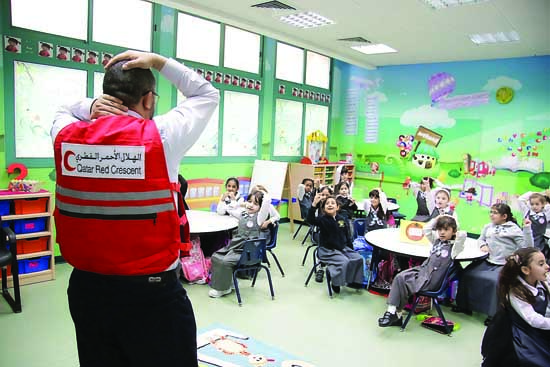
DOHA: Qatar Red Crescent Society (QRCS) has launched the second version of its ‘Safe School’ programme for the current academic year to educate students and staff on how to deal with earthquakes.
During the first semester of the academic year, the programme served 10,304 trainees from 18 schools, including 8,565 students of different education levels and 1,739 teachers, administrative staff and supervisors.
The total number of beneficiaries since 2013 to 2015 reached 29,022 from 49 schools. QRCS plans to expand the programme to more schools.
Funded and implemented by QRCS in coordination with host schools, the programme is conducted every Sunday at an Independent school, with all-day theoretical and practical training scheme with two breaks. Scientific materials are distributed to students, such as the ‘Prepared Child’ booklet, sponsored by Oryx GTL.
At the end of training, a simulated evacuation scenario is implemented by students, teachers and administrative staff, who assemble at predefined assembly points, under the supervision of QRCS risk reduction team.
The programme aims to promote a culture of safe behaviour and societal risk management to prevent, reduce or properly deal with risks, by developing experience and skills among youngsters.
It covers topics related to the safety and security of society members, such as first aid and social psychological support for the victims of earthquakes.
It also raises awareness about the importance of environment protection among children, teachers, administrative staff, bus supervisors and parents (through students themselves), urging them to adopt safe behaviour as a lifestyle and feel a sense of responsibility for themselves and others. It employs a progressive strategy that targets educational institutions to utilise schooling as a way of community education and creation of dynamic and broad-minded personalities, rather than a rigid, backward instructional system limited to theoretical textbooks that spread passiveness and inaction among students.
More than 90 percent of schools have shown interest in the programme, which reflects the positive impression created it.
During 2015-2016, the programme plans to visit 37 schools compared to 25 planned originally.The Peninsula