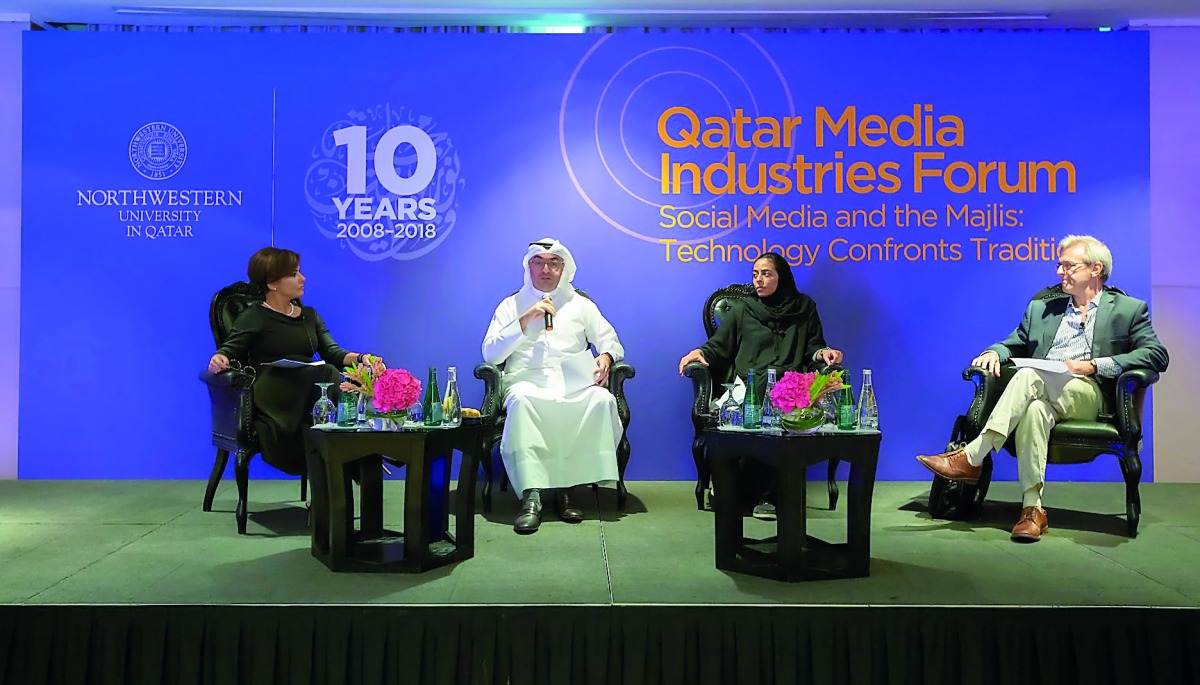
NU-Q Professor Banu Akdenzili listens to Mohamed Jaidah, owner of 60 Degrees and group executive director at Jaidah Group, at a recent Qatar Media Industries Forum.
DOHA: Northwestern University in Qatar (NU-Q) recently held a panel discussion on ‘Social Media and the Majlis: Technology Confronts Tradition’ during a session of the Qatar Media Industries Forum (QMIF).
How the traditional Majlis in Qatar and the Gulf region is influenced by social media was explored and analyzed by a panel of communication experts.
The forum, convened twice annually by Northwestern University in Qatar, reported that the Majlis is the most important source of communication in Qatari society. The use of social media is shaping discourse in family and society.
The forum also provided clues as to how this key feature of public life, and its influence, will evolve in the future.
The panel, moderated by Banu Akdenzili of NU-Q, agreed that the Majlis is changing and in different ways. Weighing in with striking examples and data were panelist business leader Mohamed Jaidah, owner of 60 Degrees and group executive director at Jaidah Group; Manar Al-Muraikhi, director of community and public relations at Ooredoo; and Gulf expert Gerd Nonneman, professor and former dean at Georgetown University in Qatar. Jaidah is also a founding member of QMIF.
QMIF provides media leaders in the Arab Region with a platform to explore topics of critical importance to Qatar’s emerging media and communication industries.
Each year, Northwestern University in Qatar hosts forums bringing industry leaders together to exchange ideas, advice, and experiences across a broad range of topics.
“The Forum offered a cutting-edge perspective combining a respect for the tradition of the Majlis with the added influence of social media,” said Everette E. Dennis NU-Q’s dean and CEO who has convened the QMIF since 2012.
While most majlises are for men, there has also been a rise of the female majlis as well. One panelist noted that some family majlises include both men and women.
During the broad-ranging discussion, the panelists described the positive and detrimental impact of technological advances and widespread use of social media on majlis interaction.
There was broad agreement that media sources have always influenced the content of discussion in majlises, but that social media had broadened discourse and led to a widening of perspectives.
Nonneman argued that there are many types of majlises across the region ranging from some organized by families and community groups to others that are quasi-governmental entities, cautioning against too much generalization.
The disruptive, detrimental concept of technology confronting tradition in the Majlis was rebuffed by Nonneman who noted that: “Because Qatar is so connected, everyone is constantly on Twitter and social media. This has brought in plenty of discussion. I’ve been in plenty of majlises when the discussion has focused on questions like ‘Have you seen the latest on that?’ There is a level of real-time interaction.”
The panelists also acknowledged the willingness of people to speak more openly and frankly in private, face-to-face settings.
“A majlis is a positive and private place where I feel comfortable and can share ideas. Digital media is a platform where we can discuss many things, and a person might feel more comfortable confronting someone from behind the scenes,” Al-Muraikhi said.
In addition to digital technologies, the panelists also considered the influence of other factors on the nature of a majlis, including the changing size and structure of the surroundings, and the impact of rapid development around the country.
Jaidah commented: “Fifty or sixty years ago when I hear my parents talk about it, everyone knew each other. Nowadays, the city has become bigger. The groups are much smaller and this creates sub-communities. That’s not social or digital media doing this. It’s a reflection of the times.”