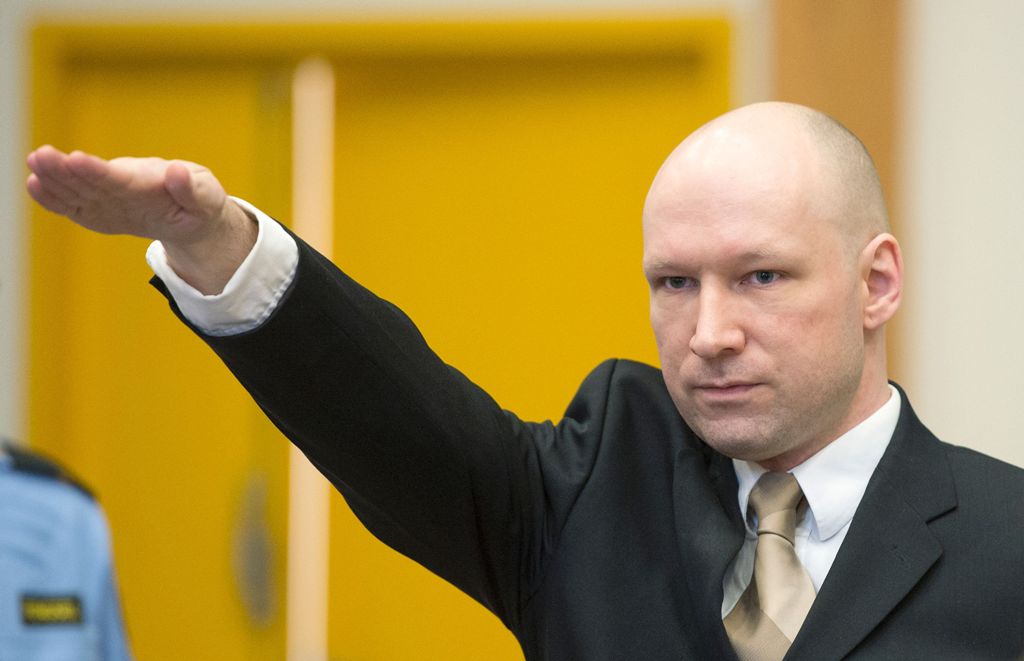
(FILES) This file photo taken on March 15, 2016 shows Norwegian mass killer Anders Behring Breivik making a Nazi salute as he arrives to a makeshift court in Skien prison's gym in Skien, some 130 km south west of Oslo, for his lawsuit against the Norwegia
Oslo: A Norwegian appeals court will decide Wednesday whether mass murderer Anders Behring Breivik is being treated inhumanely in prison by being kept in isolation after a lower court ruled in his favour.
In April 2016, an Oslo district court stunned the survivors and families of the 77 victims of Breivik's 2011 attacks when it found the state guilty of treating him "inhumanely" and in "degrading" fashion, in breach of Article 3 of the European Convention on Human Rights.
The lower court judge noted in particular Breivik's lengthy isolation regime. He has been held apart from other inmates since his arrest on the day of the attacks, and his lawyers have argued that has been detrimental to his mental health.
The Norwegian state appealed.
In January, during the appeals hearing held inside Skien prison where the now 38-year-old neo-Nazi is incarcerated, the state's lawyers argued that the strict regime was justified because he was dangerous.
The state also said it was compensating for the strict regime by providing him with three well-equipped cells, as well as extra interaction with guards and a prison visitor, among others.
In July 2011 Breivik, disguised as a police officer, tracked and gunned down 69 people, most of them teenagers, at a Labour Party youth camp on the island of Utoya, shortly after killing eight people in a bombing outside a government building in Oslo.
No sign of remorse
Breivik said he killed his victims because they valued multiculturalism. Convicted of the bloodiest crimes in postwar Norway, he was sentenced in August 2012 to 21 years in prison, which can be extended indefinitely.
The rightwing extremist has never expressed remorse for his actions, and at the opening of his appeals hearing in January he provoked the court's ire by making a Hitler-like salute.
However nowadays, his actions and statements elicit little reaction in Norway, a tranquil and prosperous country that is trying to close this painful chapter of its history.
Survivors and families of the victims most often try to ignore the man they simply refer to as "the terrorist".
'VIP inmate'
During the appeals hearing the lawyer representing the state, Attorney General Fredrik Sejersted, described Breivik as a "VIP inmate", in good physical and psychological health, and who was holding up well under his prison conditions.
In prison, he has three cells measuring more than 10 square metres (107 square feet) each, some of which have views of nature outdoors, and where he can play video games, watch television and exercise.
"His prison conditions are better than those of other prisoners," argued Sejersted, calling them downright "cosy".
"No other prisoner can discuss and play games with prison staff for two hours a day," he stressed, rejecting the notion of isolation.
Breivik however testified that the isolation has radicalised him, and his lawyer argued it was affecting his client's psychological state.
"Is this man healthy in a general sense?" Oystein Storrvik asked in his final remarks to the court. "His mental health doesn't seem good, in my opinion."
He cited as proof the inappropriate content of his letters and his persistent insensitivity to his crimes.
On Wednesday, an Oslo appeals court is scheduled to publish its verdict, ruling whether his prison conditions violate Article 3 of the Convention.
The three judges will also decide on another issue. Breivik has argued that Norway is also violating Article 8 of the Convention on his right to privacy, by strictly controlling his correspondence with the outside world.
The lower court had found in favour of the state on that point, noting that Breivik remained a dangerous man who was still trying to spread his extreme rightwing ideology and build up a network of followers.
The appeals court's ruling is expected to be published in writing at 12:00 pm (1100 GMT). The court will not be in session.